
What Is the Section Modulus?
The elastic section modulus (S) is a geometric property of a beam's cross-section that measures its resistance to bending. It relates the bending moment a member can carry to the resulting bending stress. A larger section modulus means a stiffer, stronger cross-section for a given material. It is widely used in structural and mechanical engineering for sizing beams, joists, shafts, and other load-bearing members.
How to Use This Calculator
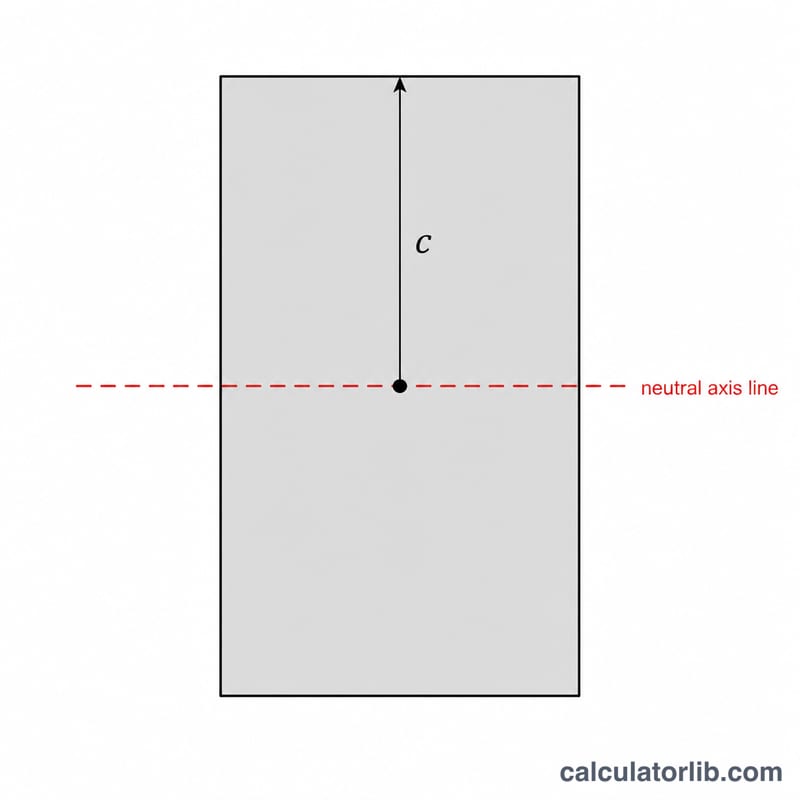
Enter the cross-section's moment of inertia (I) about the bending axis and the distance (c) from the neutral axis to the outermost fiber. The calculator divides I by c to return the section modulus S. Keep your units consistent: if I is in mm⁴ and c is in mm, then S comes out in mm³.
The Formula Explained
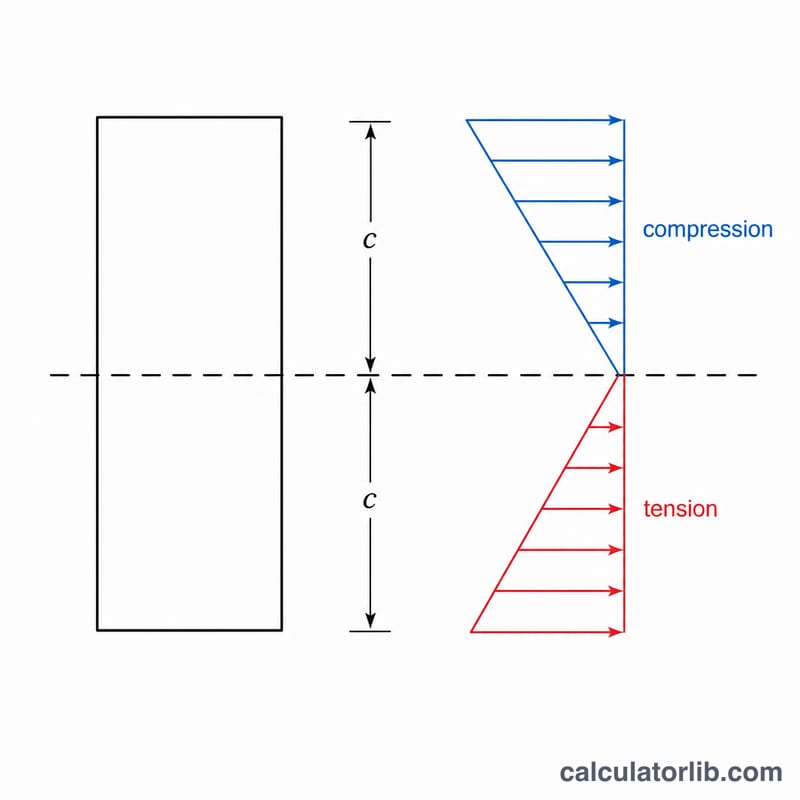
The governing equation is $$S = \frac{I}{c}$$ Here \(I\) is the second moment of area (moment of inertia) of the cross-section, and \(c\) is the perpendicular distance from the neutral (centroidal) axis to the extreme fiber where stress is greatest. Because bending stress is \(\sigma = \frac{M \cdot c}{I} = \frac{M}{S}\), the section modulus directly converts an applied bending moment \(M\) into a maximum stress: \(\sigma = \frac{M}{S}\).
Worked Example
Consider a rectangular section with \(I = 1{,}000{,}000 \text{ mm}^4\) and an extreme-fiber distance \(c = 50 \text{ mm}\). The section modulus is $$S = \frac{1{,}000{,}000}{50} = 20{,}000 \text{ mm}^3$$ If a bending moment of \(2{,}000{,}000 \text{ N}\cdot\text{mm}\) is applied, the maximum bending stress would be $$\frac{2{,}000{,}000}{20{,}000} = 100 \text{ MPa}$$
FAQ
What is the difference between elastic and plastic section modulus? This calculator gives the elastic section modulus (S), used for stresses within the elastic range. The plastic section modulus (Z) is larger and used for fully yielded sections in plastic design.
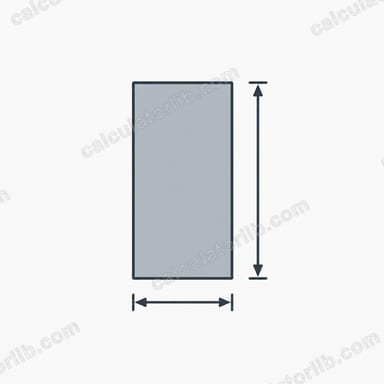
For a rectangle, what is the section modulus? For a rectangle of width \(b\) and height \(h\) bending about its horizontal centroidal axis, \(I = \frac{b \cdot h^3}{12}\) and \(c = \frac{h}{2}\), so \(S = \frac{b \cdot h^2}{6}\).
Does the axis matter? Yes. I and c must both be measured about the same bending axis, otherwise the result is meaningless.