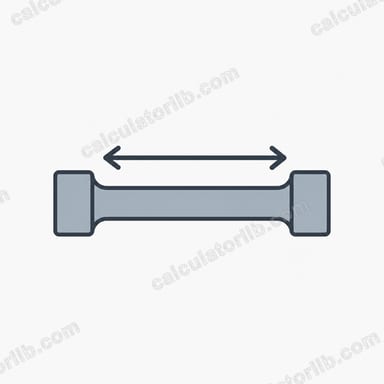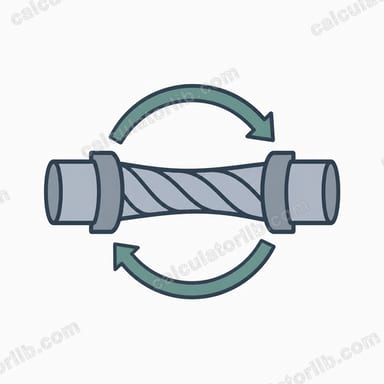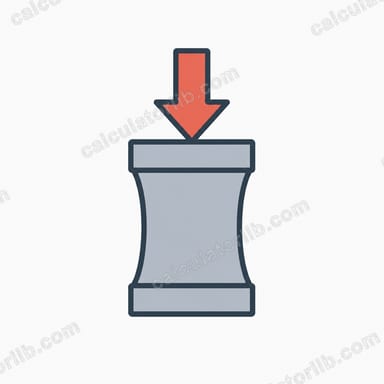

What Is Mechanical Stress?
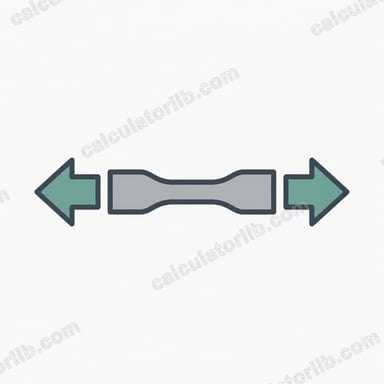
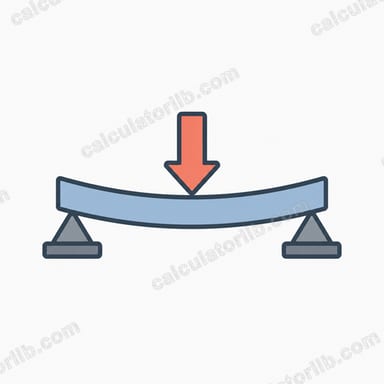
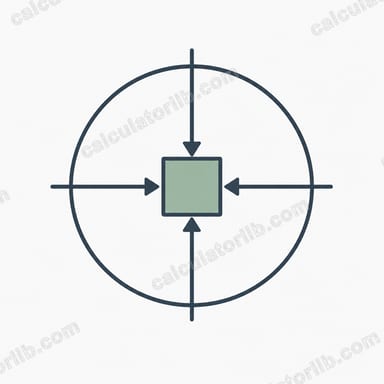
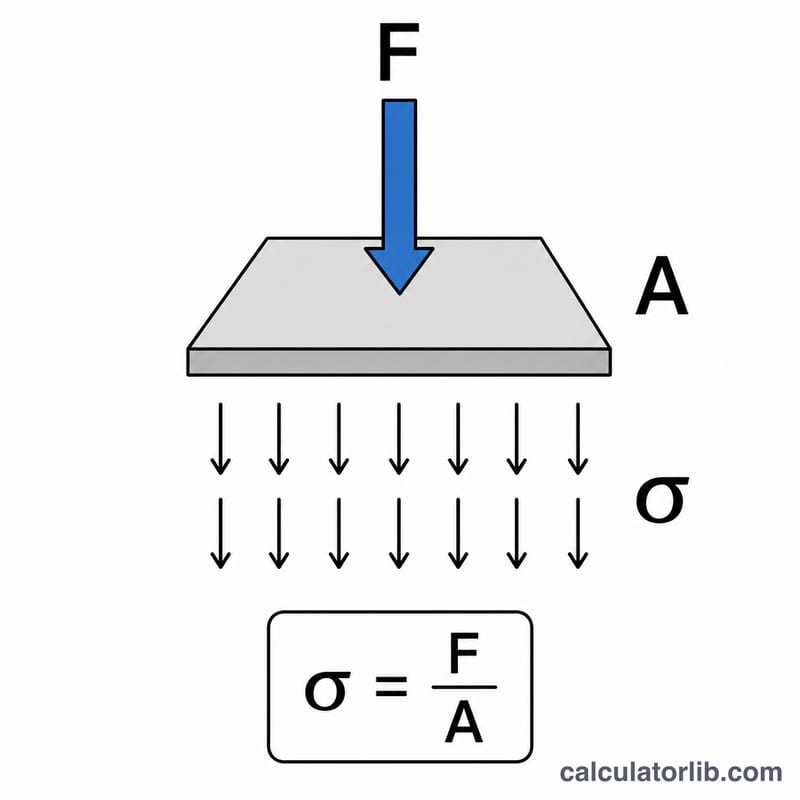
Mechanical stress measures the internal force that particles of a material exert on each other when an external load is applied. It is defined as the force distributed over the cross-sectional area carrying that force. Stress is a fundamental concept in engineering, physics and materials science, used to predict whether a component will deform or fail under load.
How to Use This Calculator
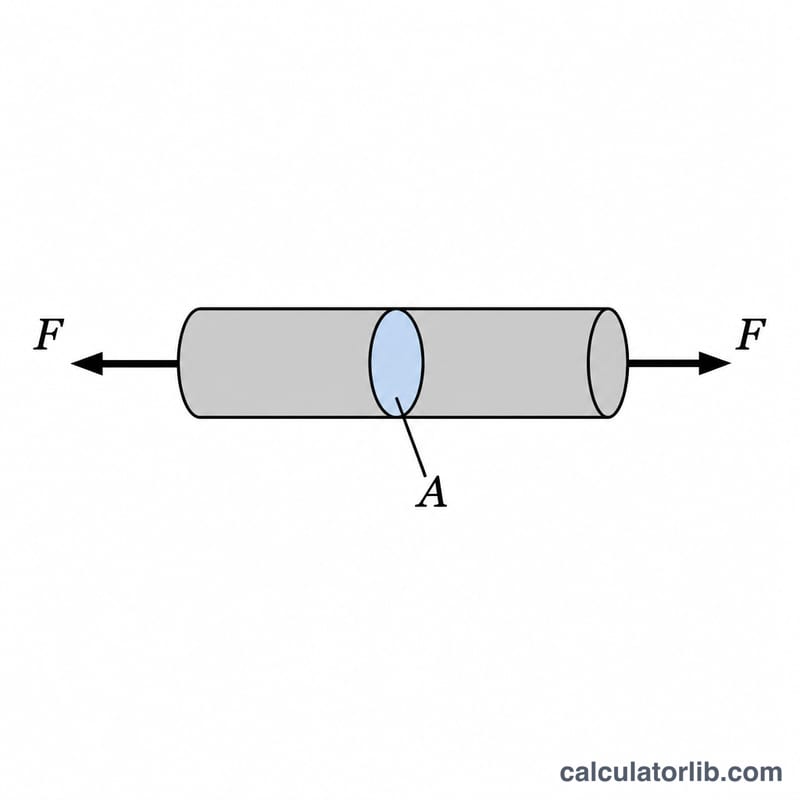
Enter the applied force in newtons (N) and the cross-sectional area in square metres (m²). The calculator divides force by area and returns the stress in pascals (Pa = N/m²), along with convenient conversions to kilopascals (kPa) and megapascals (MPa). One pascal equals one newton per square metre.
The Formula Explained
The governing equation is $$\sigma = \frac{F}{A}$$ where \(\sigma\) (sigma) is the stress, \(F\) is the perpendicular force applied, and \(A\) is the area resisting that force. Because stress is force per unit area, a smaller area concentrates the same force into a higher stress — which is why thin sections fail first.
Worked Example
Suppose a steel rod with a cross-sectional area of 0.01 m² carries a tensile force of 1000 N. The stress is $$\sigma = 1000 \div 0.01 = 100{,}000 \text{ Pa}$$ equal to 100 kPa or 0.1 MPa. Comparing this value to the material's yield strength tells the engineer whether the rod is safe.
FAQ
What units does stress use? The SI unit is the pascal (Pa), equal to N/m². Engineers commonly use MPa (1 MPa = 1,000,000 Pa).
Is this tensile or compressive stress? The formula is identical for both; the sign convention (positive tension, negative compression) depends on the direction of the force.
What if my area is in mm²? Convert to m² first (1 mm² = 1e-6 m²), or note that N/mm² equals MPa directly.