
What Is True Strain?
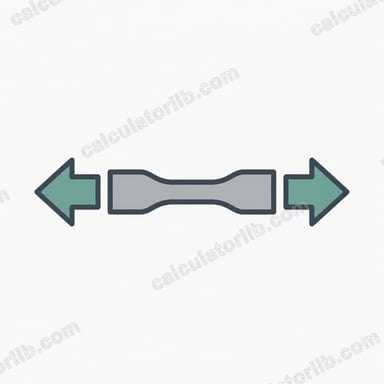
True strain (also called logarithmic or natural strain) measures deformation based on the instantaneous length of a material rather than its original length. Unlike engineering strain, which uses a fixed reference length, true strain integrates each small change in length over the deformation process, making it the preferred measure for large plastic deformations in metal forming, tensile testing, and material science.
How to Use This Calculator
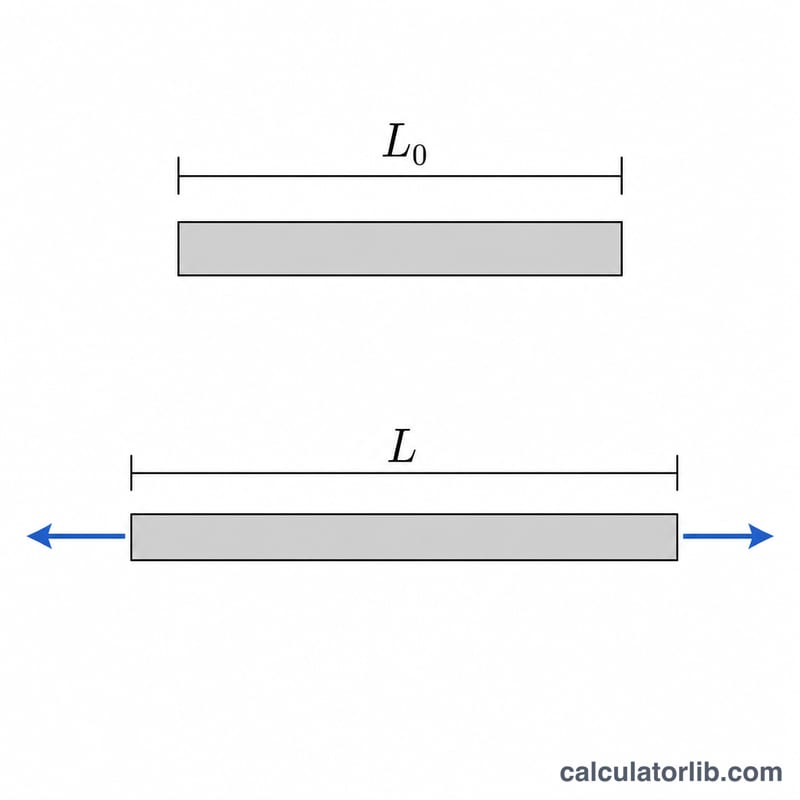
Enter the original (undeformed) length L₀ and the final (deformed) length L of your specimen, using any consistent unit such as mm, cm, or inches. The calculator returns the true strain, the corresponding engineering strain, and the length ratio. A positive value indicates tension (elongation); a negative value indicates compression.
The Formula Explained
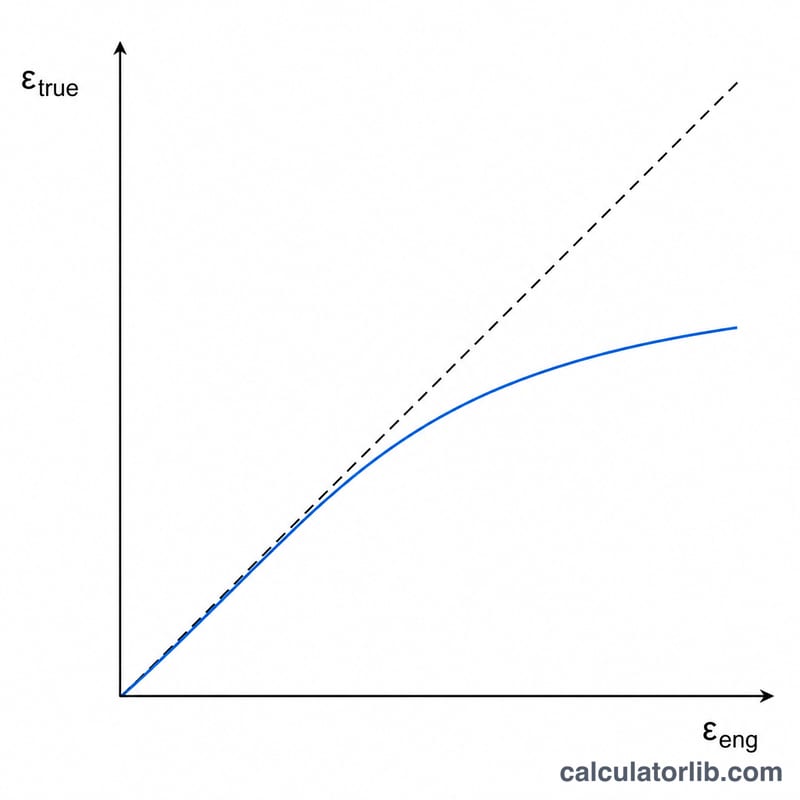
True strain is defined as $$\varepsilon_{true} = \ln\left(\frac{L}{L_0}\right),$$ the natural logarithm of the length ratio. Because engineering strain is \(\varepsilon_{eng} = (L - L_0)/L_0 = L/L_0 - 1\), we can also write \(\varepsilon_{true} = \ln(1 + \varepsilon_{eng})\). For small strains the two measures are nearly identical, but they diverge significantly as deformation grows.
Worked Example
Suppose a rod stretches from \(L_0 = 50\) mm to \(L = 60\) mm. The length ratio is \(60/50 = 1.2\), so the true strain is \(\ln(1.2) \approx 0.182322\). The engineering strain is \((60 - 50)/50 = 0.20\). Notice the true strain (0.1823) is slightly less than the engineering strain (0.20), as expected for tensile deformation.
FAQ
Why use true strain instead of engineering strain? True strain is additive and gives a more accurate picture during large plastic deformation, which is essential in forming, rolling, and necking analysis.
Can true strain be negative? Yes. When the final length is less than the original (compression), \(L/L_0 < 1\) and the natural log is negative.
What units should I use? Any unit works as long as L and L₀ share the same one — strain is dimensionless.