
What Is the Slenderness Ratio?
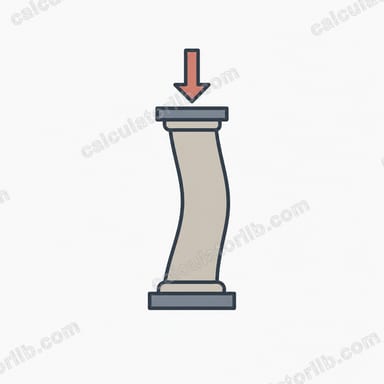
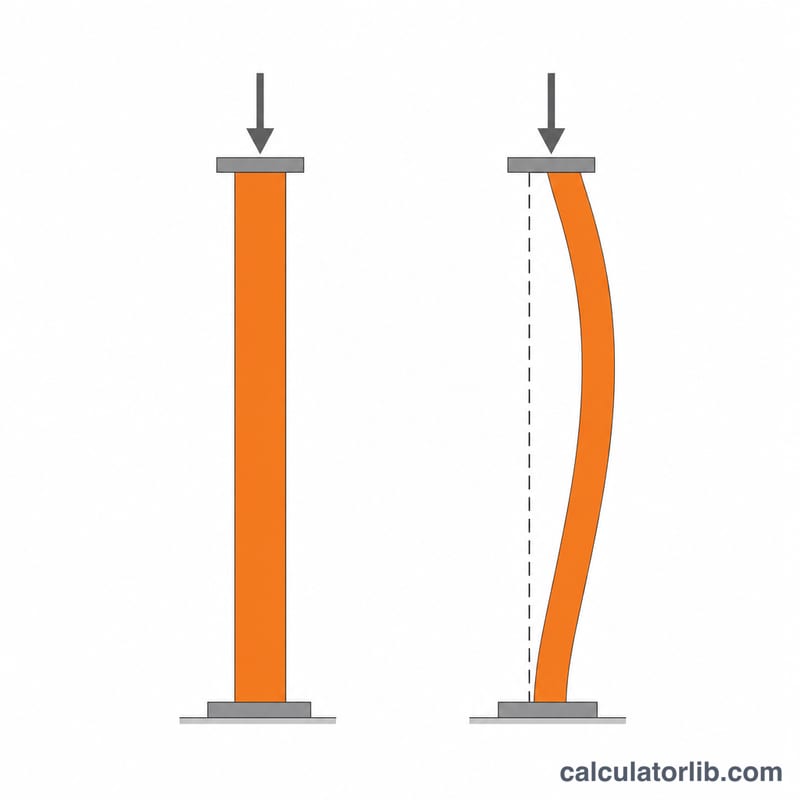
The slenderness ratio (\(\lambda\)) is a key structural-engineering parameter that describes how prone a compression member — such as a column or strut — is to buckling. It compares the member's effective length to its radius of gyration. A high slenderness ratio means a long, thin column that buckles easily under axial load; a low ratio means a short, stocky member that fails by crushing instead.
How to Use This Calculator
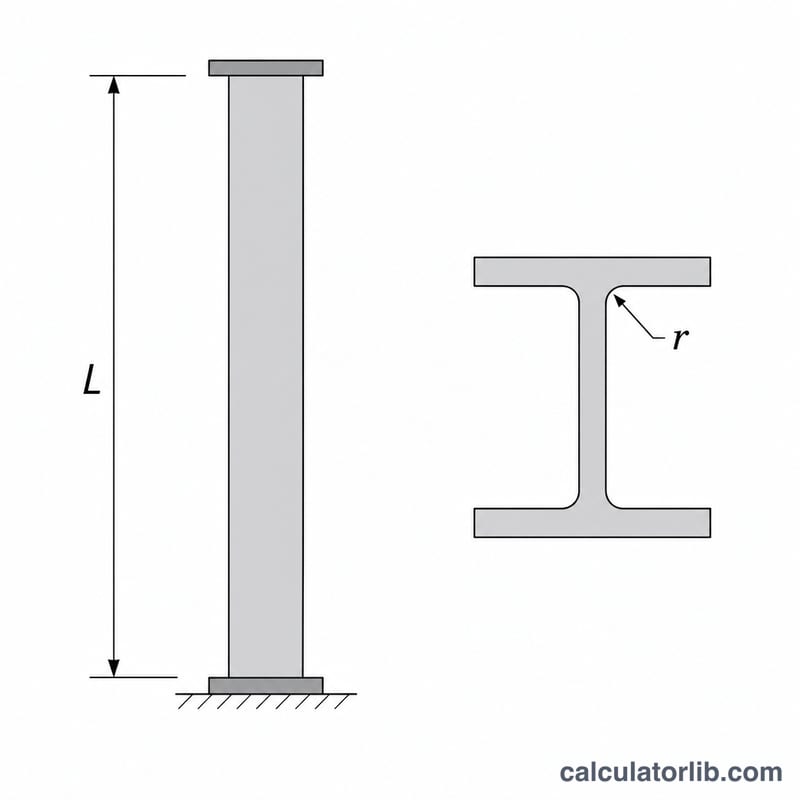
Enter three values: the effective length factor (K), the unbraced length (L), and the radius of gyration (r). Keep L and r in the same units (e.g. both mm) so the result is dimensionless. The calculator returns the slenderness ratio along with the effective length (\(K \times L\)) for reference.
The Formula Explained
The governing equation is $$\lambda = \frac{K \cdot L}{r}$$ The factor K accounts for end restraints: \(K = 1.0\) for pinned-pinned ends, \(0.5\) for fixed-fixed, \(0.7\) for fixed-pinned, and \(2.0\) for fixed-free (cantilever) columns. The radius of gyration \(r = \sqrt{I/A}\), where I is the second moment of area and A is the cross-sectional area, and is taken about the weakest axis.
Worked Example
Consider a pinned-pinned steel column (\(K = 1.0\)) with an unbraced length \(L = 3000\) mm and a radius of gyration \(r = 50\) mm. The slenderness ratio is $$\lambda = \frac{1.0 \times 3000}{50} = 60$$ Many codes cap \(\lambda\) at around 200 for compression members, so this column is well within typical limits.
FAQ
What is a good slenderness ratio? Lower is stiffer. Steel design codes often limit compression members to \(\lambda \leq 200\) and tension members to higher values.
Which radius of gyration should I use? Use the smallest \(r\) (weakest axis) unless that axis is braced, since buckling occurs about the weakest unbraced axis.
Is the slenderness ratio unit dependent? No — as long as L and r share the same units, \(\lambda\) is dimensionless.