
What is the Belt Length Calculator?
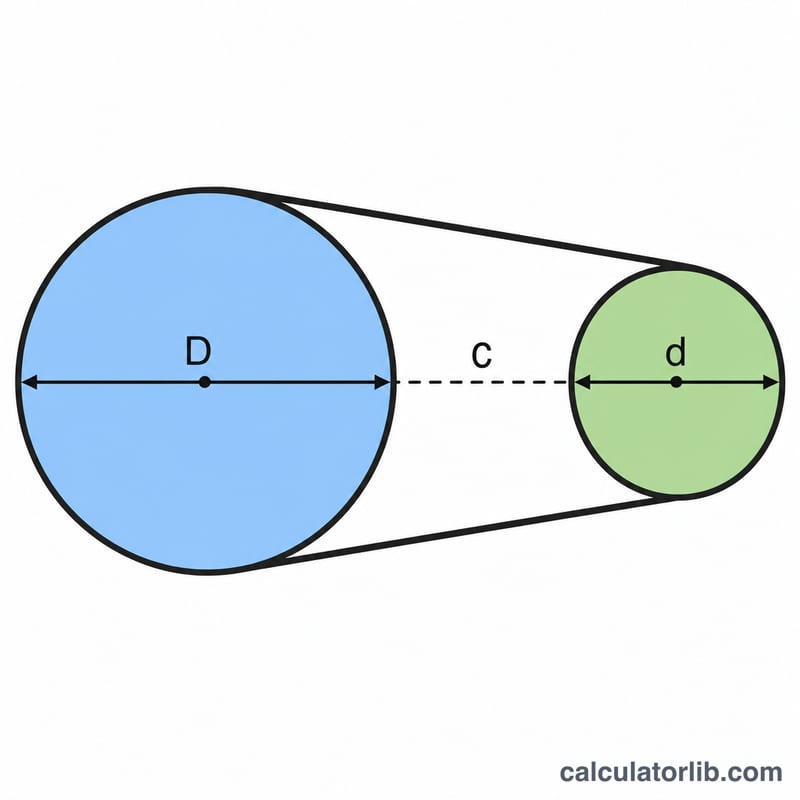
This tool estimates the length of a belt that wraps around two pulleys (or sheaves) in an open belt drive. Given the diameters of the two pulleys and the distance between their centers, it returns the approximate belt circumference. It works with any consistent unit of length — inches, millimeters, or centimeters — as long as all three inputs use the same unit, the answer comes out in that unit.
How to use it
Enter the center distance (C) between the two pulley shafts, the diameter of the large pulley (D), and the diameter of the small pulley (d). Press calculate to get the required belt length. For a simple two-equal-pulley setup, D and d will be the same value and the last term drops to zero.
The formula explained
The belt length is approximated by:
$$L = 2\,\text{C} + \frac{\pi}{2}\left(\text{D} + \text{d}\right) + \frac{\left(\text{D} - \text{d}\right)^{2}}{4\,\text{C}}$$
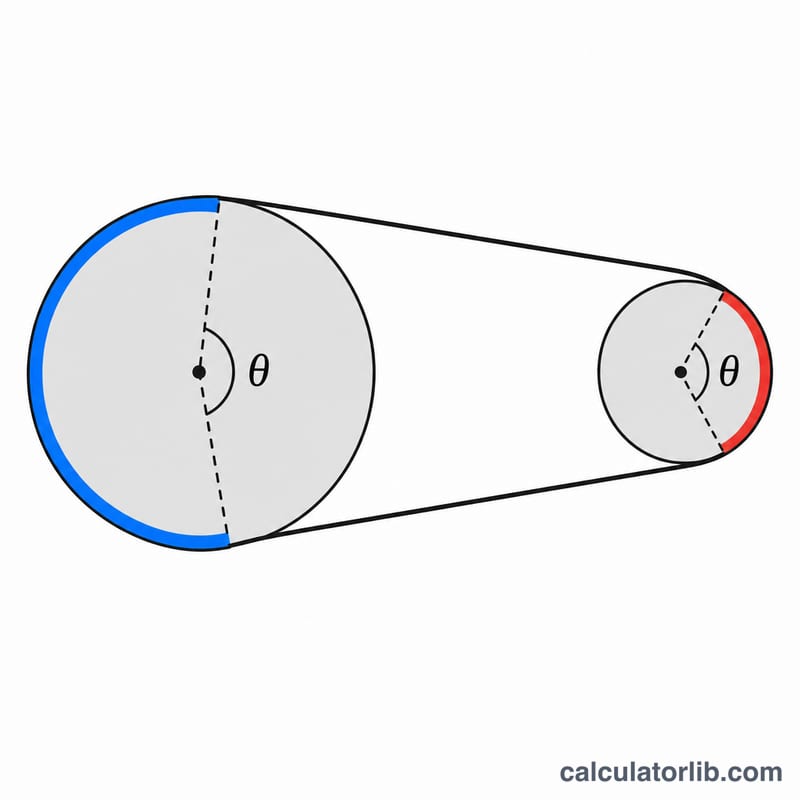
The first term, \(2\text{C}\), accounts for the two straight spans of belt running between the pulleys. The second term, \(\frac{\pi}{2}(\text{D} + \text{d})\), captures the average wrap around the two curved pulley faces. The final term is a correction for the angle change caused by unequal pulley diameters; the bigger the size difference relative to the center distance, the larger this correction.
Worked example
Suppose \(\text{C} = 20\), \(\text{D} = 6\) and \(\text{d} = 4\). Then \(2\text{C} = 40\). The middle term is \(\frac{\pi}{2}(10) = 15.70796\). The last term is \(\frac{(6 - 4)^{2}}{4 \times 20} = \frac{4}{80} = 0.05\). Adding them: $$L = 40 + 15.70796 + 0.05 = 55.758$$ So the belt length is about 55.76 units.
Practical Recommendations
- Always round up to the nearest standard size. The formula yields an exact theoretical length, but stock belts come only in discrete designations. Choosing a belt shorter than the computed length will overstretch it or make it impossible to install; choose the nearest standard effective length that is equal to or greater than your result, then take up the small difference with center-distance adjustment.
- Build in tensioning and adjustment range on the center distance. A fixed center distance rarely matches a stock belt exactly. Provide adjustable motor mounts or an idler so the center distance \(C\) can move both ways: typically allow at least enough take-up to install the belt slack (centers shortened) and enough take-out to re-tension as the belt seats and wears. As a rule of thumb, allow movement of roughly a few percent of the belt length toward the drive for installation and a similar amount away for tensioning.
- Select the correct cross-section for the load, not just the length. The letter (A, B, C) sets the belt's power capacity and the required minimum pulley diameter. Undersized sections slip and overheat under high torque; oversized sections waste cost and may not bend around small sheaves. Match the section to the transmitted horsepower and RPM, and confirm the small pulley meets the minimum recommended diameter for that section.
- Re-check the geometry after choosing a belt. Once you pick a standard length, back-solve the formula for the actual center distance so you know exactly where to set the motor, and confirm the wrap angle on the small pulley is adequate (generally keep it above about 120°) for reliable grip.
This is general engineering information, not a substitute for the belt and drive manufacturer's selection tables, service-factor ratings, and installation specifications for your specific application.
FAQ
Is this exact? It is a widely used engineering approximation that is accurate for normal drives. For extreme size differences or very short center distances, use the full geometric (open-belt) equation.
Do I use radius or diameter? Use diameters for D and d. The formula already accounts for the conversion.
What units should I use? Any consistent length unit. If C, D and d are in millimeters, the result is in millimeters.