
What is vector scalar multiplication?
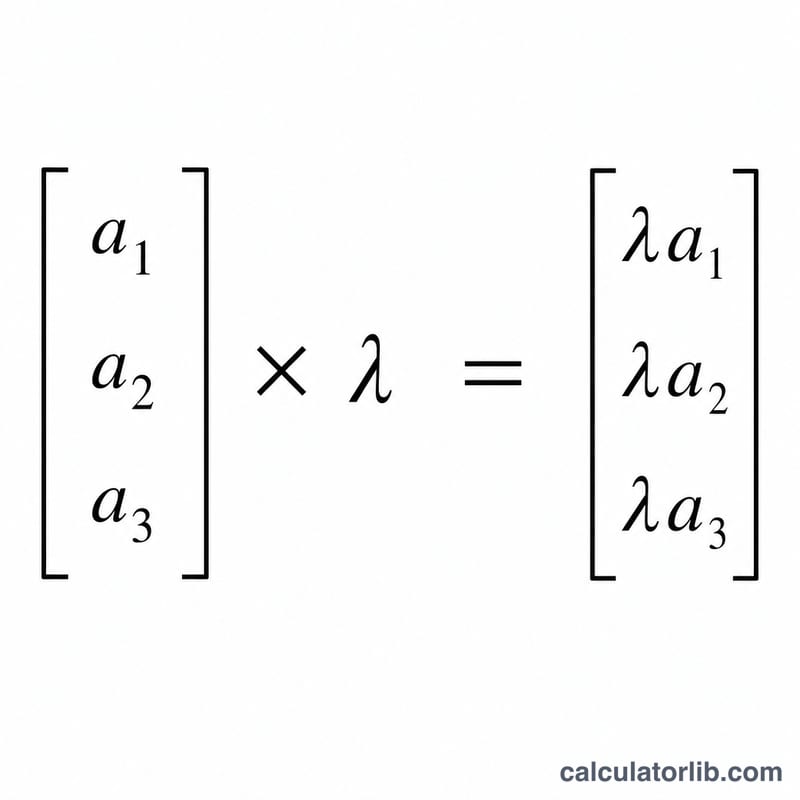
Vector scalar multiplication takes a single number (a scalar, written \(\lambda\)) and a vector a = \((a_1, a_2, \dots, a_n)\), and produces a new vector c in which every component has been multiplied by that scalar. This is one of the two fundamental operations of linear algebra (alongside vector addition) and applies identically everywhere - it is pure mathematics with no units or country-specific rules.
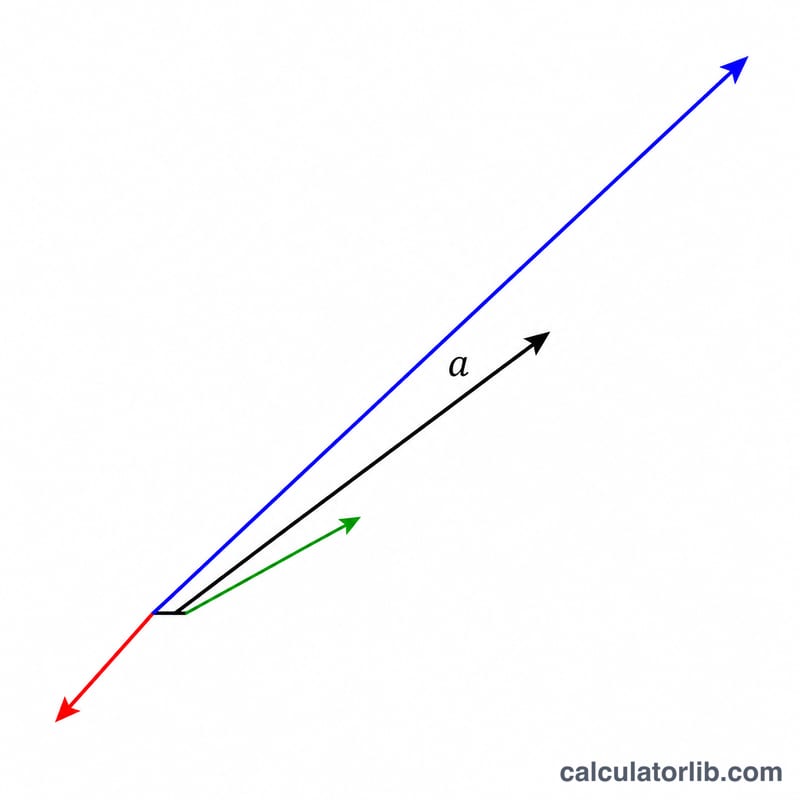
Geometrically, multiplying by a positive scalar stretches or shrinks the vector along its own direction; a negative scalar also flips it to the opposite direction; and a scalar of zero collapses it to the zero vector.
How to use this calculator
Enter the components of your vector as comma-separated numbers (for example 1, 2, 3), then enter the scalar \(\lambda\). The calculator multiplies each component by \(\lambda\) and returns a result vector of the same dimension. Negative, fractional and zero values are all accepted.
The formula
Given \(\mathbf{a} = (a_1, a_2, \dots, a_n)\) and scalar \(\lambda\), the result is $$\lambda\,\mathbf{a} = \lambda\left(a_1,\, a_2,\, \dots,\, a_n\right) = \left(\lambda\,a_1,\ \lambda\,a_2,\ \dots,\ \lambda\,a_n\right)$$ Equivalently, for each index \(i\): \(c_i = \lambda\,a_i\). The output dimension always equals the input dimension.
Worked example
Let \(\mathbf{a} = (1, 2, 3)\) and \(\lambda = 3\). Then $$c_1 = 3 \times 1 = 3,\quad c_2 = 3 \times 2 = 6,\quad c_3 = 3 \times 3 = 9,$$ so \(\mathbf{c} = (3, 6, 9)\). A second example: \(\mathbf{a} = (-2, 0.5, 4)\) with \(\lambda = -2\) gives \(\mathbf{c} = (4, -1, -8)\).
FAQ
Is this the dot product? No. The dot (inner) product multiplies two vectors and returns a single number. Here we multiply one vector by one scalar and get a vector back.
What does \(\lambda = 0\) produce? The zero vector \((0, 0, \dots, 0)\) of the same dimension. \(\lambda = 1\) returns the vector unchanged, and \(\lambda = -1\) returns the opposite (negated) vector.
Does the dimension change? Never - the result vector always has exactly the same number of components as the input vector.