
What Is Engine Displacement?
Engine displacement is the total volume swept by all the pistons inside an engine's cylinders as they move from bottom dead center to top dead center. It is one of the most important measures of an engine's size and a strong indicator of its potential power and torque output. Displacement is commonly expressed in cubic centimeters (cc), liters (L), or cubic inches (in³).
How to Use This Calculator
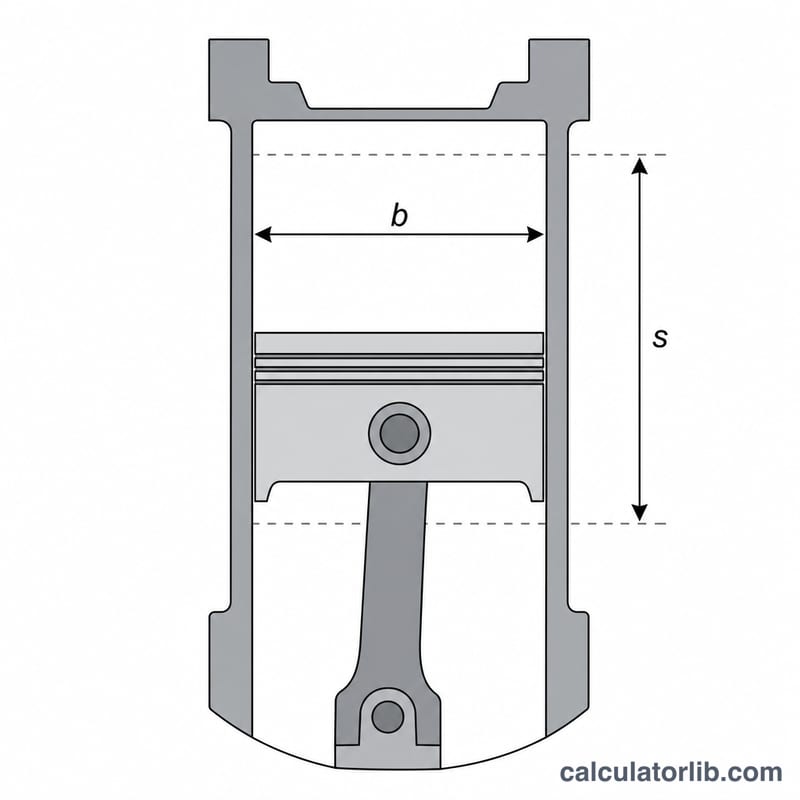
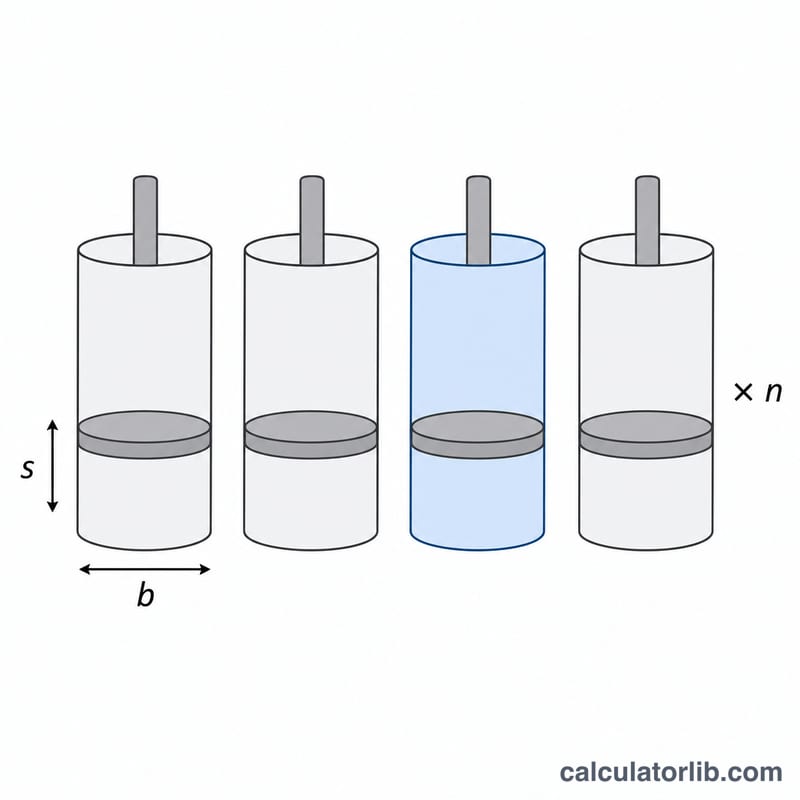
Enter three values: the bore (the diameter of each cylinder, in millimeters), the stroke (the distance the piston travels, in millimeters), and the number of cylinders. The calculator returns total displacement in cc, liters, and cubic inches, plus the volume of a single cylinder. This is universal physics-based geometry and applies to any piston engine regardless of country or manufacturer.
The Formula Explained
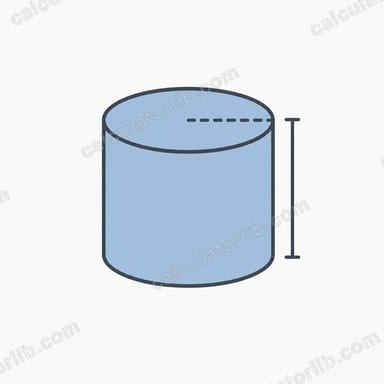
Each cylinder is treated as a perfect cylinder of fluid. Its volume is the area of the bore circle multiplied by the stroke length: \(\frac{\pi}{4} \times \text{bore}^{2} \times \text{stroke}\). Multiplying by the number of cylinders gives total displacement: $$V = \frac{\pi}{4} \times \text{bore}^{2} \times \text{stroke} \times \text{cylinders}$$ Because bore and stroke are entered in millimeters, the raw result is in cubic millimeters; dividing by 1,000 converts to cc and by 16.387064 converts to cubic inches.
Worked Example
Consider a 4-cylinder engine with an 84 mm bore and 90 mm stroke. One cylinder = $$\frac{\pi}{4} \times 84^{2} \times 90 = 0.7854 \times 7{,}056 \times 90 \approx 498{,}759 \text{ mm}^3 \approx 498.76 \text{ cc}$$ Times four cylinders \(\approx 1{,}995\) cc, or about 2.0 liters — a typical four-cylinder car engine.
FAQ
Is displacement the same as power? No. Larger displacement usually allows more power, but turbocharging, RPM, and efficiency mean small engines can outperform larger ones.
What is an "oversquare" engine? An engine whose bore is larger than its stroke. These typically rev higher; "undersquare" (long-stroke) engines favor low-end torque.
How do I convert cc to liters? Divide cc by 1,000. So \(1{,}995\) cc equals 1.995 L, usually rounded to 2.0 L.