What Is the Engine Horsepower Calculator?
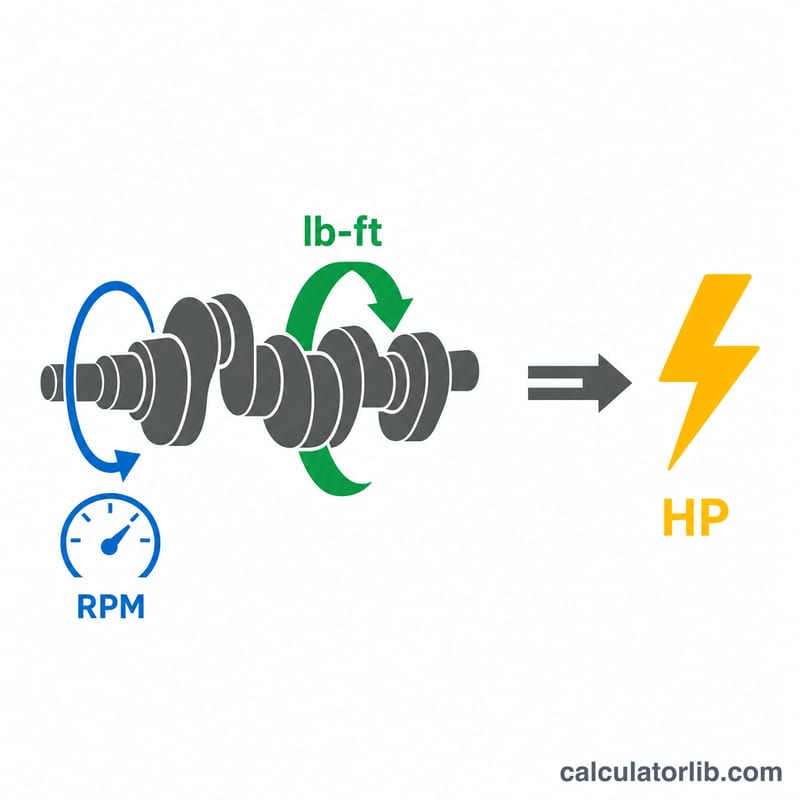
This calculator converts an engine's torque output and rotational speed into horsepower (HP). Horsepower is a measure of an engine's rate of doing work, while torque is the twisting force it produces. The two are linked by engine speed, so knowing torque and RPM lets you determine power output directly.
How to Use It
Enter the engine's torque in pound-feet (lb-ft) and its rotational speed in revolutions per minute (RPM). Click calculate and the tool returns the corresponding horsepower. This is especially useful when reading a dyno chart, where torque is measured at each RPM point and converted to power.
The Formula Explained
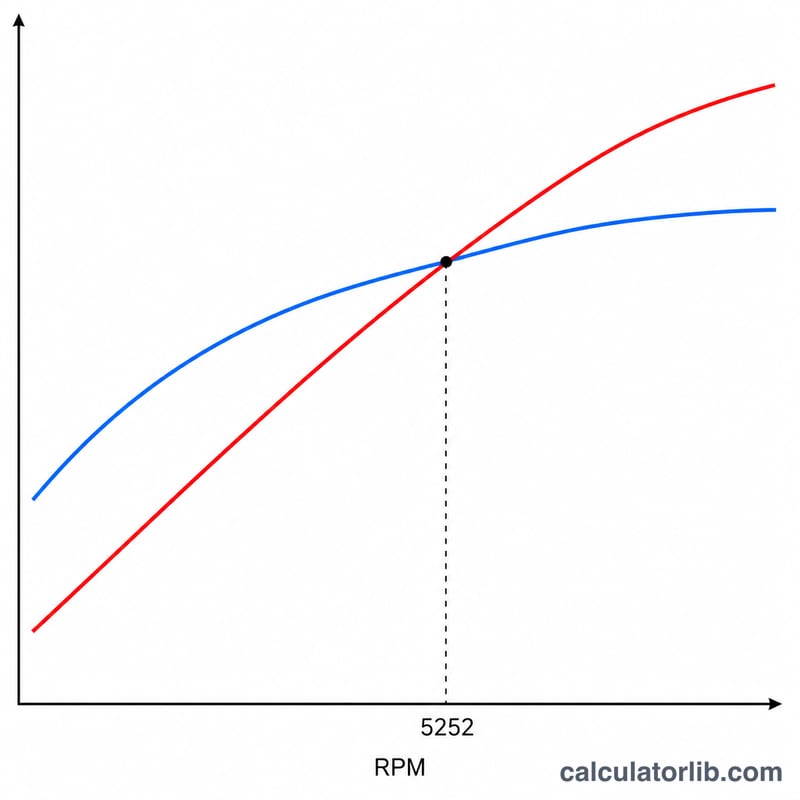
The equation is $$\text{HP} = \frac{\text{Torque (lb-ft)} \times \text{RPM}}{5252}$$ The constant 5252 comes from the definition of horsepower (33,000 ft-lb per minute) divided by \(2\pi\): \(33{,}000 \div (2 \times 3.14159) \approx 5252\). Because of this relationship, torque (lb-ft) and horsepower curves always cross at exactly 5252 RPM on a dyno graph.
Worked Example
Suppose an engine produces 350 lb-ft of torque at 6,000 RPM. $$\text{Horsepower} = \frac{350 \times 6000}{5252} = \frac{2{,}100{,}000}{5252} \approx 399.85 \text{ HP}$$ So this engine makes roughly 400 horsepower at that operating point.
Key Terms: Torque, Horsepower, RPM and Dyno Ratings
- Torque (lb-ft)
- The twisting force an engine applies to its crankshaft. One lb-ft is one pound of force applied at a one-foot lever arm. The SI unit is the newton-metre (N·m).
- Horsepower (mechanical)
- A unit of power, the rate of doing work. One mechanical HP equals 550 foot-pounds per second (33,000 ft·lb per minute), or about 745.7 W.
- RPM
- Revolutions per minute: how many full turns the crankshaft makes each minute. The constant 5252 comes from 33,000 ÷ 2π.
- Brake horsepower (BHP)
- Power measured at the engine output using a brake (dynamometer) load, before losses in the transmission and driveline. It is usually measured with the engine's accessories fitted, so it is a realistic engine figure.
- Crank / flywheel horsepower
- Power at the crankshaft or flywheel. This is the usual way engine power is advertised, although the testing standard and the accessories fitted can vary by manufacturer and region.
- Wheel horsepower (WHP)
- Power measured at the driven wheels, typically on a chassis dynamometer. It is lower than crank horsepower because of drivetrain losses.
- Drivetrain loss
- Power lost to friction and heat in the transmission, driveshaft, differential and tyres. It varies with the layout (front-, rear- or all-wheel drive) and the transmission type, so there is no single universal percentage.
- Metric horsepower (PS)
- The European and Japanese unit of power: 735.5 W, or about 0.9863 mechanical HP. It is also written as CV, PS or hp(M).
- Dynamometer
- A machine that measures torque and RPM under load, and from them calculates power. An engine dyno tests the engine alone; a chassis dyno tests the whole vehicle at the wheels. Results depend on the correction factor, the conditions and the test method used.
FAQ
Why is the constant 5252? It converts the units of torque (lb-ft) and RPM into horsepower based on the original definition of one horsepower as 550 ft-lb per second, or 33,000 ft-lb per minute.
Do torque and horsepower always equal each other at 5252 RPM? Yes — mathematically, when RPM equals 5252 the torque value and horsepower value are identical, which is why the curves intersect there.
Is this wheel horsepower or crank horsepower? It depends on where the torque was measured. Crank (flywheel) torque gives crank HP; torque measured at the wheels on a chassis dyno gives wheel HP.