What is Horsepower?
Horsepower (HP) is a unit of power — the rate at which work is done. James Watt defined it in the 1780s as the work output of a strong draft horse: lifting 33,000 pounds one foot in one minute, or 550 ft·lb per second. The unit stuck and still dominates US automotive and equipment specs.
Three Ways to Calculate Horsepower
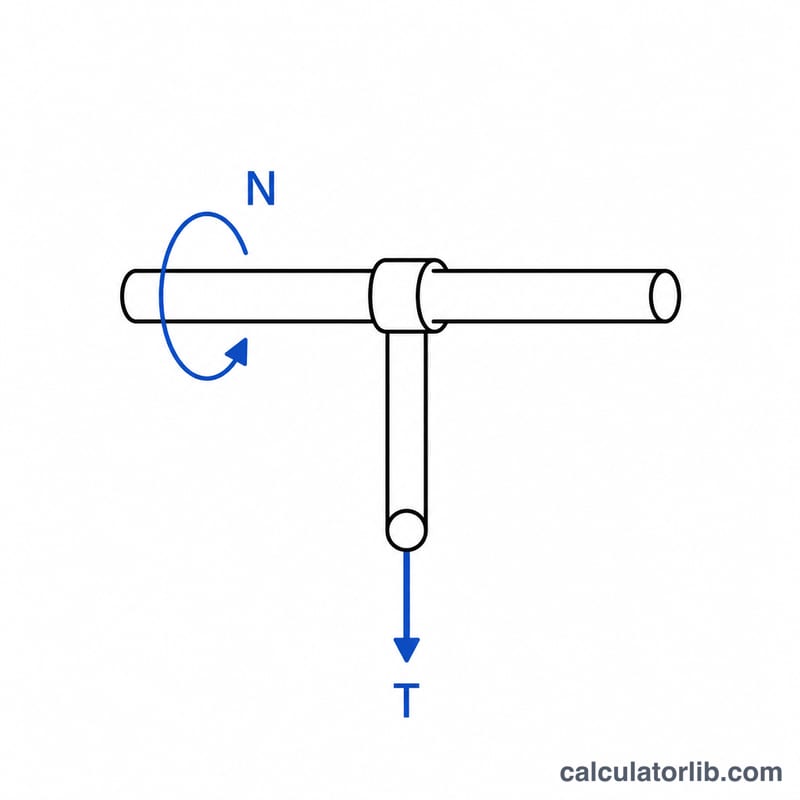
- Mechanical: from torque × rotational speed. The engine bench-test formula.
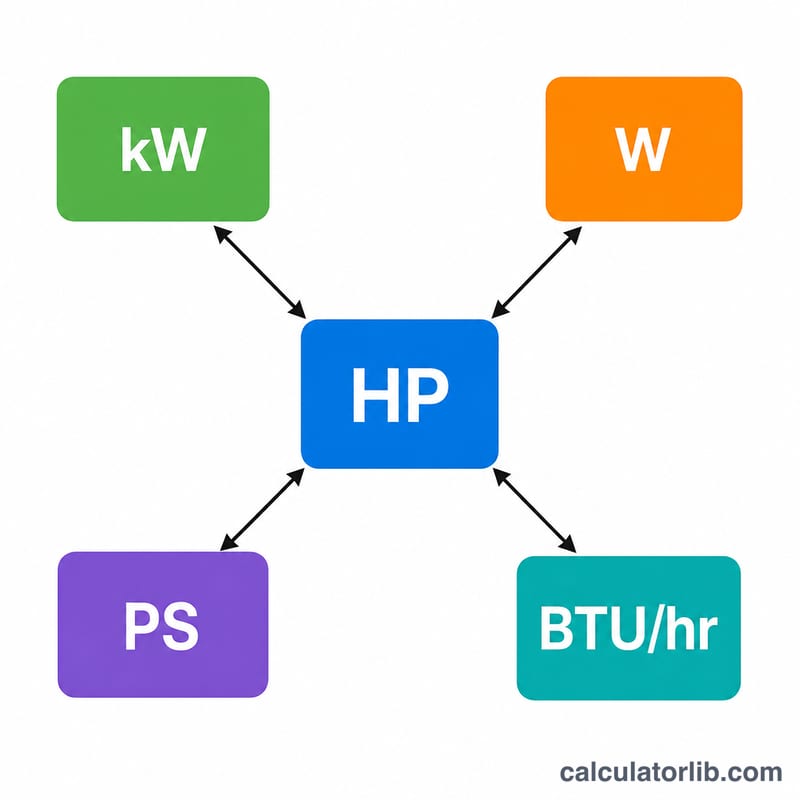
- Power conversion: from any other power unit (W, kW, BTU/hr, PS).
- Electrical: from voltage × current with power factor and motor efficiency. Used to size electric motors.
Mechanical Horsepower (Torque & RPM)
$$\text{HP} = \frac{T \cdot N}{5252}$$
where torque is in lb·ft. The constant 5252 = 33,000 / (2π). For metric:
$$\text{HP}_\text{metric} = \frac{\text{Torque}_{\text{N}\cdot\text{m}} \times \text{RPM}}{7127}$$
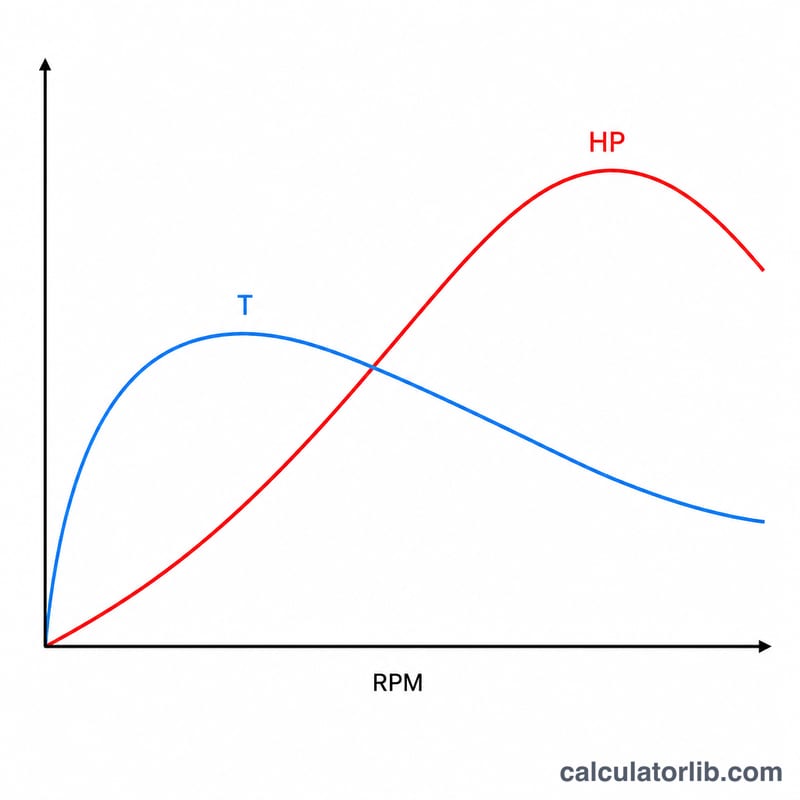
An interesting consequence: at 5252 RPM, torque (in lb·ft) and horsepower are numerically equal. That's the famous "horsepower and torque cross at 5252 RPM" on every dyno chart.
Power Unit Conversions
| From | To HP (mechanical) |
|---|---|
| 1 watt (W) | ÷ 745.7 = 0.001341 HP |
| 1 kilowatt (kW) | × 1.341 HP |
| 1 BTU/hr | × 0.000393 HP |
| 1 PS (metric HP) | × 0.9863 HP |
HP vs PS: European cars often quote PS (Pferdestärke). 1 PS = 75 kgf·m/s = 735.5 W, slightly less than 1 mechanical HP (745.7 W). A "200 PS" Mercedes is about 197 mechanical HP.
Electrical Horsepower
$$\text{HP} = \frac{V \cdot I \cdot \text{PF} \cdot \eta}{746}$$
where V = volts, I = amps, PF = power factor (1.0 for DC and resistive AC loads, 0.7–0.9 for inductive AC motors), and η = motor efficiency (typically 0.85–0.95). The 746 W per HP comes from the mechanical definition.
For three-phase systems multiply by \(\sqrt{3} \approx 1.732\). This calculator handles single-phase only — for three-phase, multiply your final HP result by 1.732.
Worked Example
A V8 making 400 lb·ft of torque at 4,500 RPM:
- $$\text{HP} = \frac{400 \times 4{,}500}{5252} = \textbf{342.7 HP}$$
A 240 V single-phase motor drawing 10 A at PF 0.85 and 90% efficiency:
- $$\text{HP} = \frac{240 \times 10 \times 0.85 \times 0.90}{746} = \textbf{2.46 HP}$$
HP vs Torque — Which Matters?
Common automotive saying: "Torque is what you feel. Horsepower is what you brag about."
- Low-end torque matters for towing, off-roading, hauling — it's the rotational force at low RPM.
- Peak horsepower matters for top speed and high-RPM acceleration. It's torque × RPM, so engines that spin freely make more HP per lb·ft.
- Diesel: high torque, low peak HP. Truck-and-tow.
- Sport bike: lower torque, very high peak HP at 10,000+ RPM.