What This Calculator Does
Predict a child's adult height from the heights of their biological parents using the mid-parental height formula — the simplest and most widely cited heuristic in pediatric clinics. The method requires no information about the child's current height, age, or weight; just both parents' adult heights and the child's biological sex.
The Formula
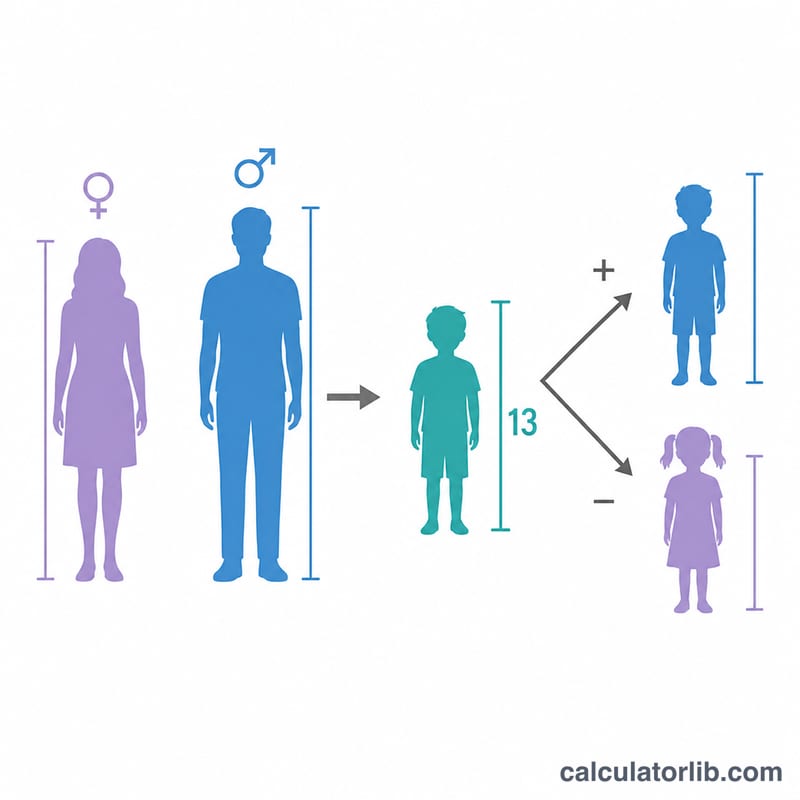
Adjust for the average sex difference (~13 cm or 5 inches), then average:
Boys: $$h_\text{boy} = \frac{H_\text{mother} + H_\text{father} + 13}{2}$$
Girls: $$h_\text{girl} = \frac{H_\text{mother} + H_\text{father} - 13}{2}$$
The 13 cm offset is the average adult-male / adult-female height difference. Add it to bring the parents' average up to the male average (boys), subtract to bring it down (girls).
Prediction Range
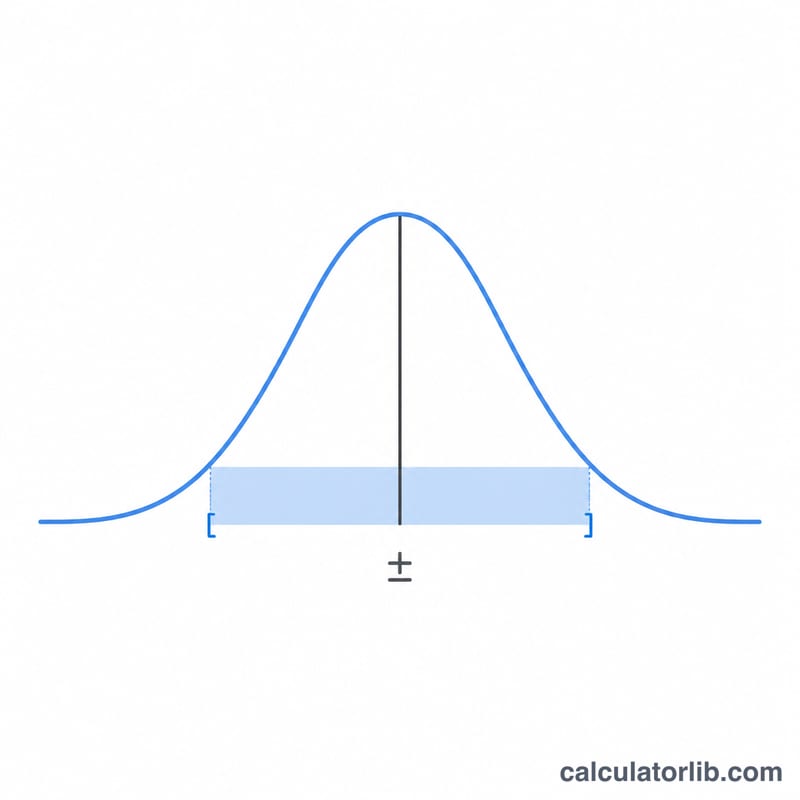
The predicted height is the midpoint — actual adult height typically falls within ± 8.5 cm (~3.3 in) for ~95% of children. Genetics, nutrition, sleep, hormones, and chronic illness all add variance. The interval gets wider for children with major outlier influences (extreme parents, pre-term birth, growth-affecting conditions).
Worked Example
Mother 165 cm (5'5"), Father 178 cm (5'10"):
- Boy: $$\frac{165 + 178 + 13}{2} = 178 \text{ cm}$$ (5'10"). Range: 169.5–186.5 cm.
- Girl: $$\frac{165 + 178 - 13}{2} = 165 \text{ cm}$$ (5'5"). Range: 156.5–173.5 cm.
More Accurate Methods
The mid-parental method is a quick approximation. More accurate options:
- Khamis-Roche method — uses the child's current age, height, weight, plus parents' heights, with proprietary regression coefficients per age. Most accurate at ages 4 and up.
- Bone-age x-ray (Greulich-Pyle / Tanner-Whitehouse) — measures skeletal maturation. Gold standard for clinical prediction; requires X-ray imaging.
- Growth charts (CDC, WHO) — extrapolate the child's current percentile through puberty. Useful when parents' heights are unknown or the child is following an unusual growth curve.
For most healthy children, the mid-parental method is within a few centimeters of the more sophisticated methods, and far easier to use.
Caveats
- Genetics is ~80% of adult height variance, but environment matters. Childhood nutrition, illness, and chronic stress can compress final height by 5–10 cm.
- The formula assumes biological parents. Step-parents and adoptive parents don't predict the child's adult height (different gene pool).
- Doesn't track current growth. A short 8-year-old growing on the 5th percentile is more predictive of short adult height than the parents' formula alone.
- Late bloomers. Some children have constitutional delay (slow puberty) and end up taller than mid-parental predicts. Endocrinologists assess via bone-age x-rays.