
What Is the Baby Height Predictor?
The Baby Height Predictor estimates how tall your child is likely to be as an adult using the widely cited mid-parental height method. It relies on a simple fact: a child's adult stature is strongly influenced by the average height of their two biological parents, adjusted for sex. The result is an estimate, not a guarantee — genetics, nutrition, and overall health all play a role.
How to Use It
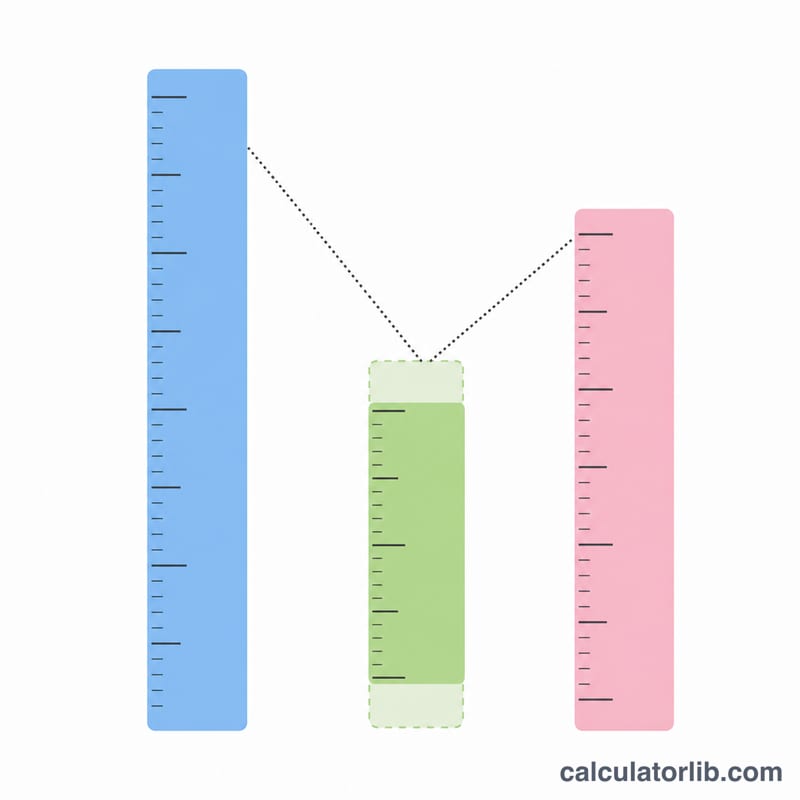
Select whether the child is a boy or a girl, then enter the father's and mother's heights in centimeters. The calculator returns a single predicted adult height plus a typical confidence range of about ±8.5 cm, since most children land within roughly two standard deviations of the mid-parental estimate.
The Formula Explained
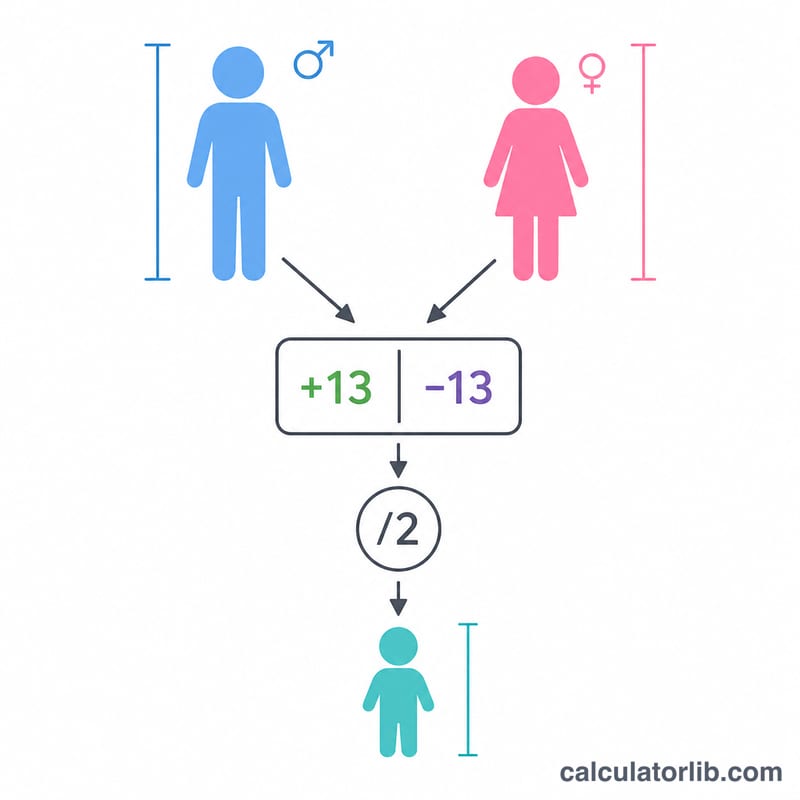
First, the parents' heights are added together. For a boy, 13 cm is added (because adult men are on average about 13 cm taller than women); for a girl, 13 cm is subtracted. The total is then divided by two to find the mid-point:
$$\text{Boy} = \frac{\text{father} + \text{mother} + 13}{2}$$
$$\text{Girl} = \frac{\text{father} + \text{mother} - 13}{2}$$
Worked Example
Suppose the father is 180 cm and the mother is 165 cm, and the child is a boy. The calculation is $$\frac{180 + 165 + 13}{2} = \frac{358}{2} = 179 \text{ cm}.$$ The likely range would be about 170.5 cm to 187.5 cm.
Height Conversion: cm to Feet & Inches
Predicted heights are given in centimeters. Use this table to convert to feet and inches (1 inch = 2.54 cm, 1 foot = 30.48 cm). Values are rounded to the nearest inch.
| Centimeters | Feet & inches (approx.) |
|---|---|
| 150 cm | 4 ft 11 in |
| 155 cm | 5 ft 1 in |
| 160 cm | 5 ft 3 in |
| 165 cm | 5 ft 5 in |
| 170 cm | 5 ft 7 in |
| 175 cm | 5 ft 9 in |
| 180 cm | 5 ft 11 in |
| 185 cm | 6 ft 1 in |
| 190 cm | 6 ft 3 in |
| 195 cm | 6 ft 5 in |
| 200 cm | 6 ft 7 in |
To convert exactly, divide the centimeter value by 2.54 to get total inches, then divide by 12 for feet with the remainder as inches. For example, 175 cm \(= 175 / 2.54 \approx 68.9\) in \(= 5\) ft \(8.9\) in, which rounds to 5 ft 9 in.
Interpreting Your Result
The number this calculator returns is a central estimate of your child's likely adult height based purely on the heights of the two biological parents. It represents the midpoint of the range your child is genetically most likely to reach.
The accompanying \(\pm 8.5\text{ cm}\) range (about \(\pm 3.3\) inches) reflects normal biological variation. Roughly 95% of children with parents of these heights are expected to fall somewhere within this band. A result of 179 cm with a range of 170.5–187.5 cm means heights anywhere in that span would all be considered consistent with the prediction — no single point within it is "more correct" than another.
Important things to keep in mind when reading the result:
- It estimates genetic potential only. The formula uses just two inputs — the parents' heights. It does not know your child's current measurements, growth pattern, or health history.
- Other factors shift actual height. Nutrition, sleep, general health, chronic illness, hormonal conditions, and overall living conditions during the growing years can move a child's final height up or down within (or occasionally outside) the predicted range.
- It is not a diagnosis. This tool cannot detect a growth disorder, delayed puberty, or any medical condition. A short prediction is not a problem and a tall one is not a guarantee.
- Track real growth separately. To monitor how a child is actually growing relative to peers, follow their height-for-age and weight-for-age on standard growth charts over time rather than relying on a single predicted endpoint.
This is general educational information, not professional or medical advice. If you have concerns about your child's growth or development, consult a pediatrician or other qualified healthcare provider, who can assess current measurements, growth velocity, and bone age.
FAQ
How accurate is this prediction? It gives a reasonable central estimate, but actual adult height commonly varies by several centimeters in either direction.
Does it work for any age? Yes — it uses only parents' heights, so it can be calculated at any point, even before birth.
Why add or subtract 13 cm? 13 cm reflects the average adult height difference between men and women, correcting the parental average for the child's sex.