What Is the Baby Gender Heart Rate Predictor?
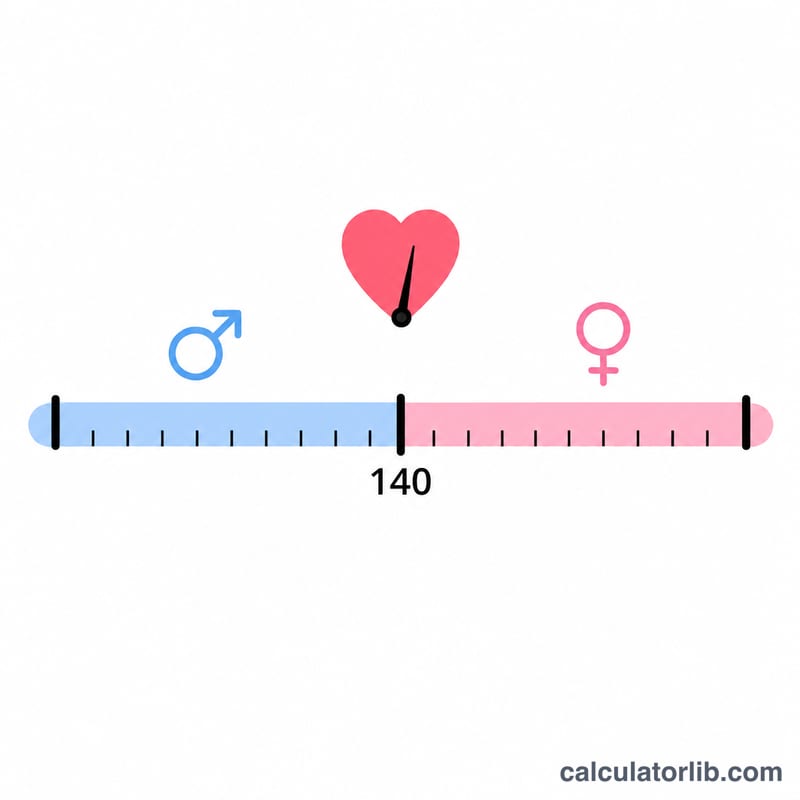
This is a fun calculator based on a popular old wives' tale that claims you can guess a baby's sex from its fetal heart rate (FHR). The folklore says a faster heartbeat means a girl and a slower one means a boy, with 140 beats per minute (bpm) as the dividing line. Enter the heart rate measured at a prenatal visit and the tool tells you what the tradition predicts.
How to Use It
Type the fetal heart rate in beats per minute (bpm) — typically a value somewhere between 110 and 180 bpm during pregnancy. Click calculate and the result will show "It's a Girl!" for 140 bpm or higher, or "It's a Boy!" for anything below 140 bpm.
The Rule Explained
The calculator simply compares your number to the 140 bpm threshold: FHR ≥ 140 → Girl and FHR < 140 → Boy. There is no math beyond that single comparison.
$$\text{Prediction} = \begin{cases} \text{Girl}, & \text{Fetal Heart Rate (bpm)} \geq 140 \\[0.6em] \text{Boy}, & \text{Fetal Heart Rate (bpm)} < 140 \end{cases}$$
Worked Example
Suppose the doctor measures a fetal heart rate of 152 bpm. Since \(152 \geq 140\), the folk rule predicts a girl. If instead the reading were 132 bpm, that is below 140 (\(132 < 140\)), so the rule would predict a boy.
Interpreting Your Result
This calculator applies a folk rule: a heart rate of 140 bpm or higher predicts a girl, and below 140 bpm predicts a boy. The output only shows which side of the 140 bpm cutoff your reading falls on. It is not a biological determination of the baby's sex.
Studies comparing fetal heart rates have found no meaningful difference between male and female fetuses, so the rule's accuracy is about chance, roughly 50%, similar to a coin flip.
- Readings near 140 bpm: a value such as 138 or 142 flips the prediction easily, so the result carries almost no information.
- Gestational age: FHR rises to a peak around 9–10 weeks and then declines, so the same cutoff means different things at different stages.
- Fetal activity and measurement: movement, sleep cycles, and the measuring method all shift the reading from moment to moment.
Only ultrasound (typically at the mid-pregnancy anatomy scan) or genetic testing, such as cell-free DNA screening or diagnostic testing, can reliably determine a baby's sex. Treat this tool as entertainment only. Heart rate readings and any health concerns should be discussed with a qualified healthcare provider; this is not medical advice.
FAQ
Does fetal heart rate really predict gender? No. Multiple studies have found no reliable difference in heart rate between male and female fetuses. This tool is purely for entertainment.
What is a normal fetal heart rate? It usually ranges from about 110 to 160 bpm and naturally varies with the baby's activity and gestational age.
How can I know my baby's sex for sure? Only medical methods such as an ultrasound or genetic testing (like NIPT or amniocentesis) can reliably determine sex. Ask your healthcare provider.