What Is the Chinese Gender Predictor?
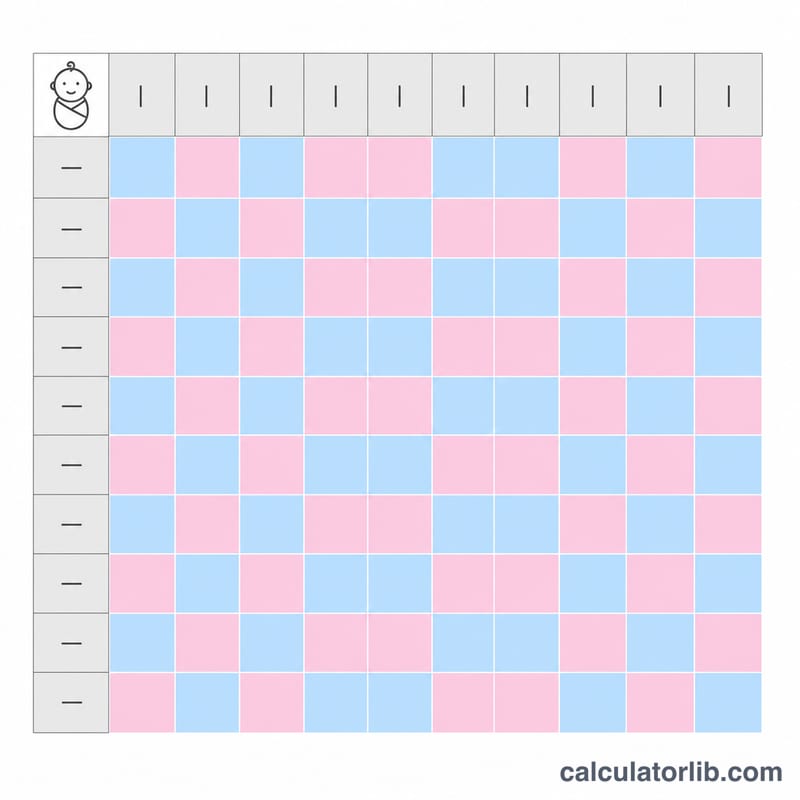
The Chinese gender predictor (also called the Chinese birth chart or Qing dynasty gender chart) is a centuries-old folk tradition that claims to predict whether a baby will be a boy or a girl using two inputs: the mother's age and the month the baby was conceived. This calculator reconstructs that chart using a parity rule based on the mother's lunar age and the lunar conception month. It is a cultural curiosity, not a medical tool.
How to Use It
Enter the mother's age at the time of conception and select the month conception occurred. The calculator converts the Gregorian age to a lunar (East-Asian) age by adding one year, then applies the chart's parity rule to produce a boy or girl prediction. For best alignment with the traditional chart, use the mother's lunar age and the lunar (Chinese) calendar month.
The Formula Explained
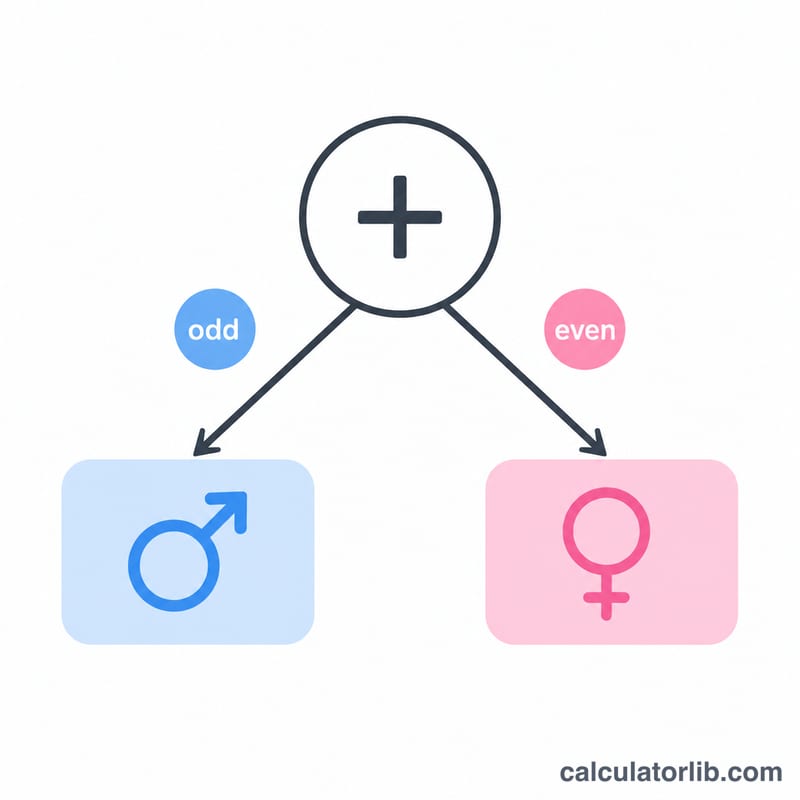
First we compute lunar age = Gregorian age + 1, reflecting the East-Asian custom where a baby is considered one year old at birth. We then add the conception month to the lunar age. If the sum is odd, the chart predicts a boy; if even, a girl. This parity approach captures the alternating pattern found across most cells of the historical chart.
$$\text{Gender} = \begin{cases} \text{Boy} & \text{if } \big[\left(\text{Mother Age}+1\right) + \text{Conception Month}\big] \bmod 2 = 1 \\[0.6em] \text{Girl} & \text{if } \big[\left(\text{Mother Age}+1\right) + \text{Conception Month}\big] \bmod 2 = 0 \end{cases}$$
Worked Example
A mother aged 29 conceives in March (month 3). Lunar age = \(29 + 1 = 30\). Sum = \(30 + 3 = 33\), which is odd, so the chart predicts a boy. Change conception to April (month 4) and the sum becomes \(34\) (even) — predicting a girl.
Interpreting Your Result
The Chinese gender chart result is a parity outcome, not a biological measurement. This calculator adds your lunar age and the lunar conception month and checks whether the total is odd or even:
$$\text{Boy if } (\text{age}+1+\text{month}) \bmod 2 = 1, \qquad \text{Girl if } (\text{age}+1+\text{month}) \bmod 2 = 0$$Nothing about the sum of two calendar numbers carries information about a fetus. Fetal sex is determined at fertilization by whether the sperm carries an X or a Y chromosome, and no feature of the mother's age or the month of conception alters that. Published evaluations of the Chinese birth calendar — including a retrospective analysis of thousands of singleton births — have found its accuracy statistically indistinguishable from chance, i.e. around 50%, which is exactly what a coin-flip rule predicts. Treat the output as entertainment.
What actually determines fetal sex clinically
| Method | Earliest typical use | Documented accuracy for sex | Type |
|---|---|---|---|
| Mid-trimester anatomy ultrasound | ~18–20 weeks | ~95–99% when the view is adequate | Imaging (observational) |
| Cell-free DNA screening (NIPT) | From ~10 weeks | >99% for detection of Y-chromosome material | Screening (maternal blood) |
| Amniocentesis / chorionic villus sampling (CVS) | CVS ~10–13 weeks; amniocentesis ~15–20 weeks | >99% (direct fetal karyotype) | Diagnostic (invasive) |
Earlier first-trimester ultrasound sex assessment is much less reliable than the anatomy scan, and NIPT is a screening test: a result suggesting no Y material can also occur in a vanished twin or in certain sex-chromosome variations. Availability and legality differ by country — disclosure of fetal sex for non-medical reasons is legally restricted in some jurisdictions, for example in India under the PCPNDT Act of 1994.
Why this chart's answer is unstable
Because the rule is pure parity, changing either input by one unit flips the answer. A mother listed as 28 with conception in lunar month 6 gives \(29+6=35\) (odd) → Boy; shift the month to 7 and \(29+7=36\) (even) → Girl; keep month 6 but use age 29 and \(30+6=36\) → Girl. Since lunar age depends on where a birthday falls relative to Chinese New Year, and the lunar conception month depends on a date boundary that moves by several weeks each year, ordinary uncertainty of one unit in either field reverses the prediction. A result that inverts under a one-day calendar ambiguity cannot be carrying real signal.
This section is general information about how the calculation works and about established clinical methods; it is not medical advice. Questions about fetal sex, screening options or test results belong with a qualified clinician.
Prediction Across Common Ages and Conception Months
Every cell below is computed strictly as \((\text{age}+1+\text{month}) \bmod 2\), with lunar age taken as Gregorian age plus 1. Each entry shows the sum, its parity, and the resulting prediction for a representative subset of lunar conception months.
| Mother's age (Gregorian) | Lunar age (age+1) | Month 1 | Month 2 | Month 3 | Month 6 | Month 9 | Month 12 |
|---|---|---|---|---|---|---|---|
| 22 | 23 | 24 · even · Girl | 25 · odd · Boy | 26 · even · Girl | 29 · odd · Boy | 32 · even · Girl | 35 · odd · Boy |
| 25 | 26 | 27 · odd · Boy | 28 · even · Girl | 29 · odd · Boy | 32 · even · Girl | 35 · odd · Boy | 38 · even · Girl |
| 28 | 29 | 30 · even · Girl | 31 · odd · Boy | 32 · even · Girl | 35 · odd · Boy | 38 · even · Girl | 41 · odd · Boy |
| 30 | 31 | 32 · even · Girl | 33 · odd · Boy | 34 · even · Girl | 37 · odd · Boy | 40 · even · Girl | 43 · odd · Boy |
| 33 | 34 | 35 · odd · Boy | 36 · even · Girl | 37 · odd · Boy | 40 · even · Girl | 43 · odd · Boy | 46 · even · Girl |
| 36 | 37 | 38 · even · Girl | 39 · odd · Boy | 40 · even · Girl | 43 · odd · Boy | 46 · even · Girl | 49 · odd · Boy |
Pattern: within any row the prediction alternates Boy/Girl from one month to the next, and any two adjacent ages give exactly inverted rows — a lunar age that is odd predicts Girl in odd months and Boy in even months, and an even lunar age does the reverse. The months omitted above follow the same alternation: 4, 5, 7, 8, 10 and 11 simply continue the flip.
Caveat: these cells reproduce this tool's parity rule exactly. Printed versions of the historical Qing-dynasty chart are not perfectly alternating grids — individual squares differ between reproductions, and no authoritative original is agreed upon — so some published charts will disagree with specific cells here. Either way the long-run hit rate is about 50%.
Converting Gregorian Age and Dates to the Lunar Calendar
The chart needs two East Asian calendar quantities: the mother's lunar age and the lunar month of conception. Neither is the same as the Gregorian value.
Gregorian age → East Asian lunar age
| Gregorian age | Lunar age used here (age + 1) | Parity of lunar age |
|---|---|---|
| 20 | 21 | Odd |
| 25 | 26 | Even |
| 28 | 29 | Odd |
| 30 | 31 | Odd |
| 33 | 34 | Even |
| 36 | 37 | Odd |
| 40 | 41 | Odd |
In the traditional East Asian reckoning a person is counted as 1 year old at birth, so lunar age is normally Gregorian age plus 1. Some traditions instead advance everyone's count at Chinese New Year, which effectively adds 2 for someone whose Gregorian birthday has not yet come round in that lunar year. This calculator applies the simple +1 rule; if you use the +2 convention, the parity changes and so does the prediction.
Chinese New Year (start of lunar month 1), Gregorian dates
| Lunar year | Chinese New Year falls on |
|---|---|
| 2022 | 1 February 2022 |
| 2023 | 22 January 2023 |
| 2024 | 10 February 2024 |
| 2025 | 29 January 2025 |
| 2026 | 17 February 2026 |
| 2027 | 6 February 2027 |
These dates matter because a conception in January or early February often falls in the previous lunar year, in lunar month 11 or 12 — not in month 1 or 2.
Worked example
- Conception date: 5 February 2026. Chinese New Year 2026 is 17 February 2026, so 5 February is still before the lunar new year.
- The lunar year that began on 29 January 2025 is therefore still running, and 5 February 2026 sits in its final lunar month: lunar month 12 — not month 2, as the Gregorian date would suggest.
- Mother's Gregorian age at conception: 30 → lunar age \(30+1=31\).
- Sum: \(31+12=43\), and \(43 \bmod 2 = 1\) (odd) → prediction Boy.
- Had the date been read naively as month 2, the sum would be \(31+2=33\) — also odd, also Boy in this case; but for a 29-year-old mother (lunar age 30) the same mistake flips the answer from \(30+12=42\) (Girl) to \(30+2=32\) (Girl)… while month 11 would give \(30+11=41\) (Boy). One month of mis-assignment is enough to reverse the output.
Why the month number is only an approximation: a lunar month runs from new moon to new moon, about 29 or 30 days, and twelve of them total roughly 354 days. The lunar calendar inserts a leap (intercalary) month about every three years to stay aligned with the solar year, so the Gregorian month number and the lunar month number drift apart by up to several weeks and occasionally by a whole extra month. If your conception date is within two or three weeks of a lunar-month boundary, convert the exact date with a proper lunisolar calendar rather than entering the Gregorian month number. Dates above are for the Chinese lunisolar calendar; Korean and Vietnamese lunar new year dates usually coincide but can differ by a day because of time-zone-dependent new moon timing.
FAQ
Is the Chinese gender chart accurate? No. Studies show it performs no better than a coin flip. Use it for fun only.
Should I use lunar or Gregorian age? The traditional chart uses lunar age, which this tool estimates by adding one year to the Gregorian age.
What about the conception month? The chart was designed around the Chinese lunar calendar, so converting your conception date to the lunar month gives the most authentic result.