
What Is the Race Time Predictor?
This calculator estimates how fast you could run a race at a new distance based on a result you already have. It uses Pete Riegel's widely cited endurance formula, which models how running speed declines as distance increases. It's a universal tool for any runner — 5K, 10K, half marathon, or full marathon — and works in kilometers, miles, or meters.
How to Use It
Enter the time you ran for a known distance (hours, minutes, and seconds), then the distance you raced and the distance you want to predict. Choose your unit. The calculator returns your projected finish time and an average pace per unit of distance. For best accuracy, base your prediction on a recent, all-out race effort over a distance reasonably close to your target.
The Formula Explained
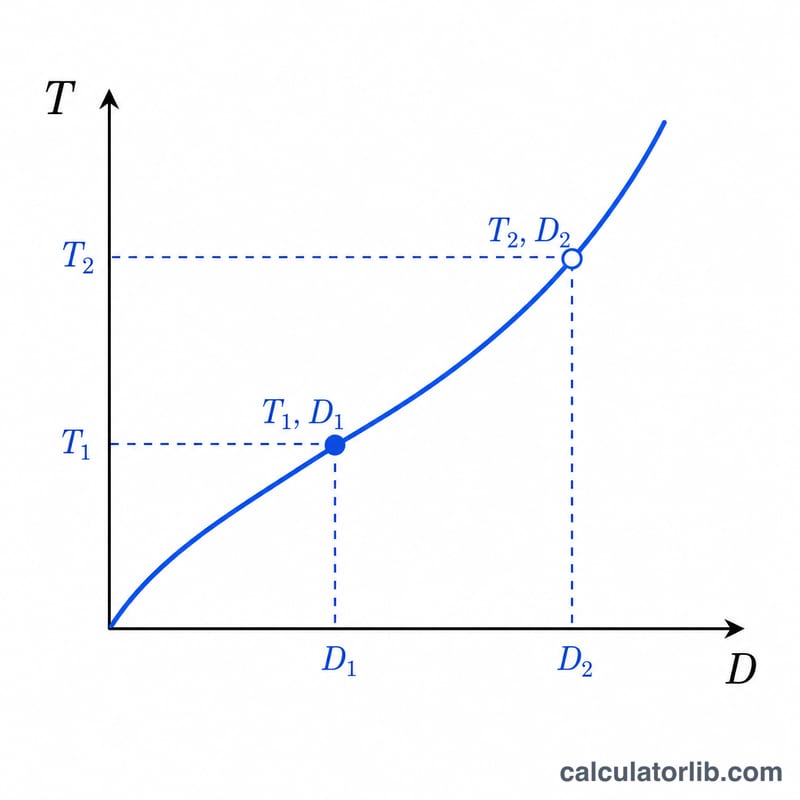
Riegel's equation is $$T_2 = T_1 \times \left( \frac{D_2}{D_1} \right)^{1.06}$$ \(T_1\) is your known time and \(D_1\) the distance you ran it over; \(D_2\) is the target distance and \(T_2\) the predicted time. The exponent \(1.06\) is the "fatigue factor" — it captures the fact that you cannot hold your shorter-race pace over a longer race. If the exponent were \(1.0\), pace would stay constant; because it is slightly above \(1.0\), predicted time grows a little faster than distance.
Worked Example
Suppose you run a 5 km race in 25:00 (1500 seconds) and want to predict your 10 km time. The ratio \(D_2/D_1 = 10/5 = 2\). Then \(2^{1.06} \approx 2.0851\), so $$T_2 \approx 1500 \times 2.0851 \approx 3127.6 \text{ seconds}$$ or about 52:08. That's slightly slower than simply doubling your 5K time (50:00), reflecting real-world fatigue.
FAQ
How accurate is it? It's a solid estimate for distances within roughly a 2× range of your known race. Predictions for very long jumps (e.g., 5K to marathon) tend to be optimistic.
Does the distance unit matter? No — only the ratio \(D_2/D_1\) is used, so any consistent unit gives the same prediction.
Why the exponent 1.06? Riegel derived it from large datasets of race performances across distances; it reflects average endurance decay for well-trained runners.