
What is the Running Pace Predictor?
This calculator estimates how fast you can run a target race distance based on a time you have already achieved at another distance. It uses Pete Riegel's well-known endurance formula, which models how running speed naturally slows as distance increases. Enter one known result and a target distance to get a predicted finish time and average pace.
How to use it
Enter your known distance and choose kilometers or miles. Type the time you ran for that distance (hours, minutes, seconds). Then enter the target distance you want a prediction for, in the same unit. The calculator returns your predicted finish time in hh:mm:ss and your average pace per unit.
The formula explained
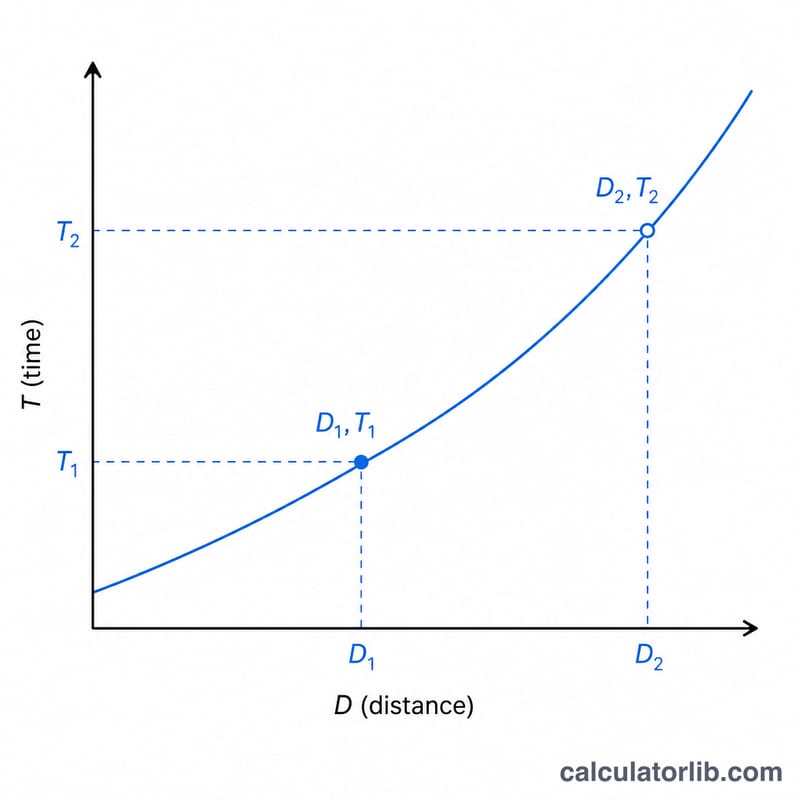
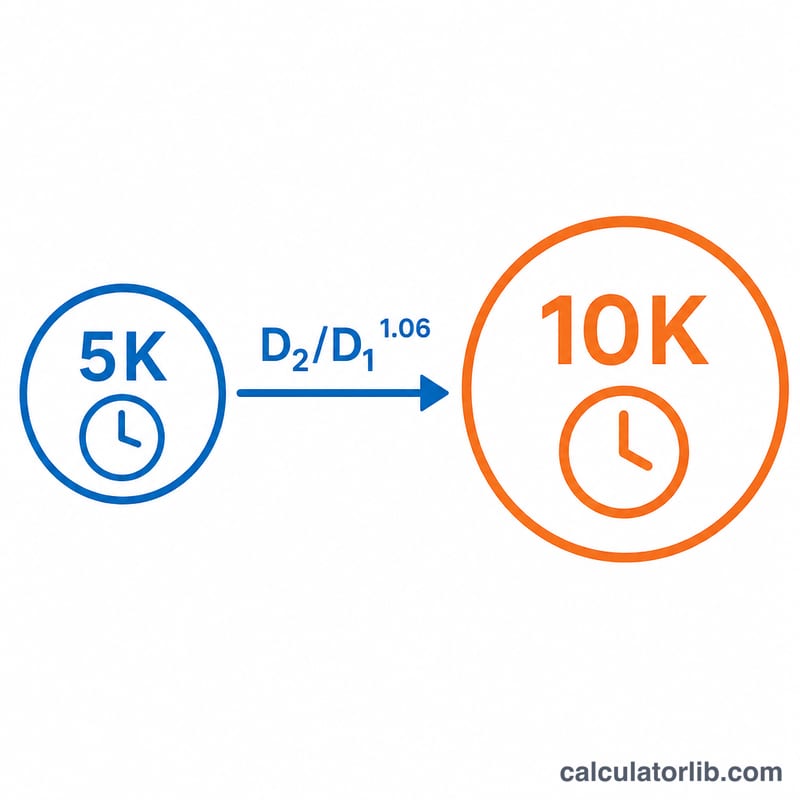
Riegel's equation is $$T_2 = T_1 \times \left(\frac{D_2}{D_1}\right)^{1.06}$$ ... actually the widely used exponent is 1.06 in some sources, but the classic Riegel constant is 1.06 for fatigue. This tool uses the exponent that best fits typical road-race performance. The exponent greater than 1 means that doubling the distance more than doubles the time, reflecting fatigue over longer efforts.
Worked example
Suppose you run 5 km in 25:00 (1500 seconds) and want your 10 km prediction. $$T_2 = 1500 \times \left(\frac{10}{5}\right)^{1.10} = 1500 \times 2^{1.10} = 1500 \times 2.1435 \approx 3128 \text{ seconds}$$ or about 52:08. Your average pace would be roughly 5:13 per km.
FAQ
Is the prediction guaranteed? No. It assumes similar conditions, terrain, and adequate training for the target distance. Real results vary with fitness and pacing.
What distances work best? The model is most accurate between about 1500 m and the marathon, and for predictions within a reasonable range of your known distance.
Can I use miles? Yes — just keep both distances in the same unit. The ratio \(D_2/D_1\) is unit-independent.