What This Calculator Does
The Pregnancy Calorie Needs Calculator estimates how many calories you may need per day during pregnancy. It first calculates your maintenance energy needs (TDEE) from your pre-pregnancy body stats and activity level, then adds the extra energy your body needs to support a healthy pregnancy based on your current trimester. This is general educational guidance and not medical advice — always follow the recommendations of your doctor, midwife, or registered dietitian, especially if you have a high-risk pregnancy, are carrying multiples, or have a condition such as gestational diabetes.
How to Use It
Choose your activity level, select your trimester, and enter your pre-pregnancy weight (kg), height (cm), and age. The calculator returns your estimated daily calorie target along with your BMR, maintenance TDEE, and the pregnancy add-on so you can see exactly how the number is built up.
The Formula Explained
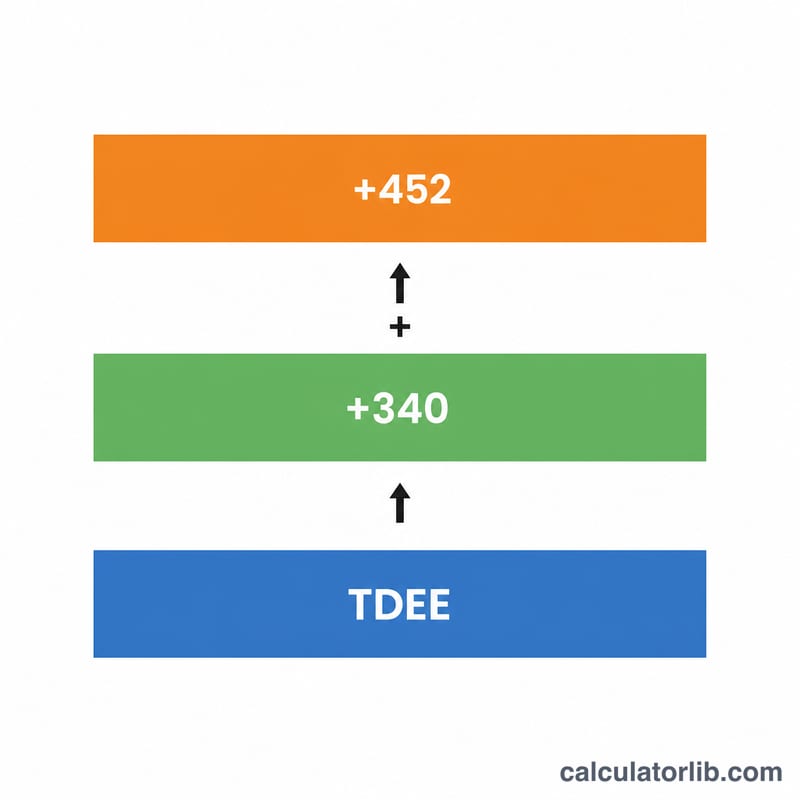
We use the Mifflin-St Jeor equation for women: $$\text{BMR} = 10 \times \text{weight} + 6.25 \times \text{height} - 5 \times \text{age} - 161$$. BMR is multiplied by an activity factor (1.2 to 1.9) to get TDEE, your maintenance calories. Finally a trimester add-on is applied: +0 kcal in the first trimester, +340 kcal in the second, and +452 kcal in the third. These add-ons reflect widely cited estimates of the extra energy required to support fetal growth and maternal tissue changes.
Worked Example
A 30-year-old woman who is 165 cm tall and weighed 65 kg before pregnancy, lightly active (factor 1.375), in her second trimester: $$\text{BMR} = 10 \times 65 + 6.25 \times 165 - 5 \times 30 - 161 = 650 + 1031.25 - 150 - 161 = 1370.25 \text{ kcal}$$ $$\text{TDEE} = 1370.25 \times 1.375 \approx 1884.1 \text{ kcal}$$ Adding the second-trimester +340 gives about 2,224 calories/day.
Activity Factors and Trimester Add-Ons
The calculator multiplies your basal metabolic rate (BMR) by an activity factor to estimate total daily energy expenditure (TDEE), then adds a fixed trimester-specific amount. The add-on values of +340 and +452 kcal are commonly cited in US-based dietary guidance and are population averages.
| Activity factor | Level | Typical description |
|---|---|---|
| 1.2 | Sedentary | Little or no exercise, mostly seated daily routine |
| 1.375 | Lightly active | Light exercise or walking, about 1-3 days per week |
| 1.55 | Moderately active | Moderate exercise, about 3-5 days per week |
| 1.725 | Very active | Hard exercise, about 6-7 days per week |
| 1.9 | Extra active | Very hard daily exercise or a physically demanding job |
| Trimester | Approximate weeks | Added calories |
|---|---|---|
| First | Up to 13 weeks 6 days | +0 kcal |
| Second | 14 weeks 0 days to 27 weeks 6 days | +340 kcal |
| Third | 28 weeks onward | +452 kcal |
The BMR uses the Mifflin-St Jeor equation for women: \(\text{BMR} = 10 \cdot \text{weight (kg)} + 6.25 \cdot \text{height (cm)} - 5 \cdot \text{age (yr)} - 161\).
Calorie Estimates Across Example Scenarios
Example woman: 30 years old, 165 cm, 65 kg. Her BMR is:
$$\text{BMR} = 10 \cdot 65 + 6.25 \cdot 165 - 5 \cdot 30 - 161 = 650 + 1031.25 - 150 - 161 = 1370.25 \text{ kcal}$$
TDEE is BMR × activity factor, and the total is TDEE plus the trimester add-on. Values are rounded to the nearest kcal.
| Activity factor | BMR | TDEE | 1st trimester (+0) | 2nd trimester (+340) | 3rd trimester (+452) |
|---|---|---|---|---|---|
| 1.2 (sedentary) | 1,370 | 1,644 | 1,644 | 1,984 | 2,096 |
| 1.375 (lightly active) | 1,370 | 1,884 | 1,884 | 2,224 | 2,336 |
| 1.55 (moderately active) | 1,370 | 2,124 | 2,124 | 2,464 | 2,576 |
Worked check for the second trimester, lightly active: \(1370.25 \times 1.375 = 1884.09\), then \(1884.09 + 340 = 2224.09\), about 2,224 kcal per day. Moving from sedentary to moderately active changes the estimate by roughly 480 kcal, more than the difference between the second and third trimester add-ons, so the activity choice matters.
Interpreting Your Result
The result is a population-based estimate of average energy needs, not a measurement of your own metabolism. The calculator keeps three pieces separate: BMR (energy at rest), TDEE (BMR scaled by your activity factor), and the trimester add-on (+0, +340 or +452 kcal). Looking at them separately shows how much of the total comes from your body size and activity versus pregnancy.
- Individual variation: actual needs differ with pre-pregnancy BMI, body composition, multiple pregnancy (twins or more), medical conditions such as gestational diabetes or thyroid disorders, nausea or other symptoms, and changes in activity as pregnancy progresses.
- Equation limits: the Mifflin-St Jeor equation was developed in non-pregnant adults and was not validated specifically in pregnancy. The fixed add-ons are averages, and the activity multipliers are rough categories.
- Weight gain targets: recommended gestational weight gain ranges, such as those from the US Institute of Medicine (now the National Academy of Medicine, NAM) guidelines, depend on pre-pregnancy BMI and are set and monitored by your clinician. Calorie estimates are not a substitute for tracking progress with your care team.
This is general information, not medical or professional advice. Your doctor, midwife or a registered dietitian can tailor energy and nutrient needs to your situation.
FAQ
Do I really "eat for two"? No. Calorie needs increase only modestly — typically a few hundred extra calories per day in the second and third trimesters, not double.
Why is the first-trimester add-on zero? Energy needs change very little in early pregnancy, so most guidelines recommend no extra calories during the first trimester for most women.
Is this accurate for twins or underweight/overweight women? No — those situations need individualized advice. Use this only as a rough starting estimate and consult your healthcare provider.