
What this Calorie Calculator does
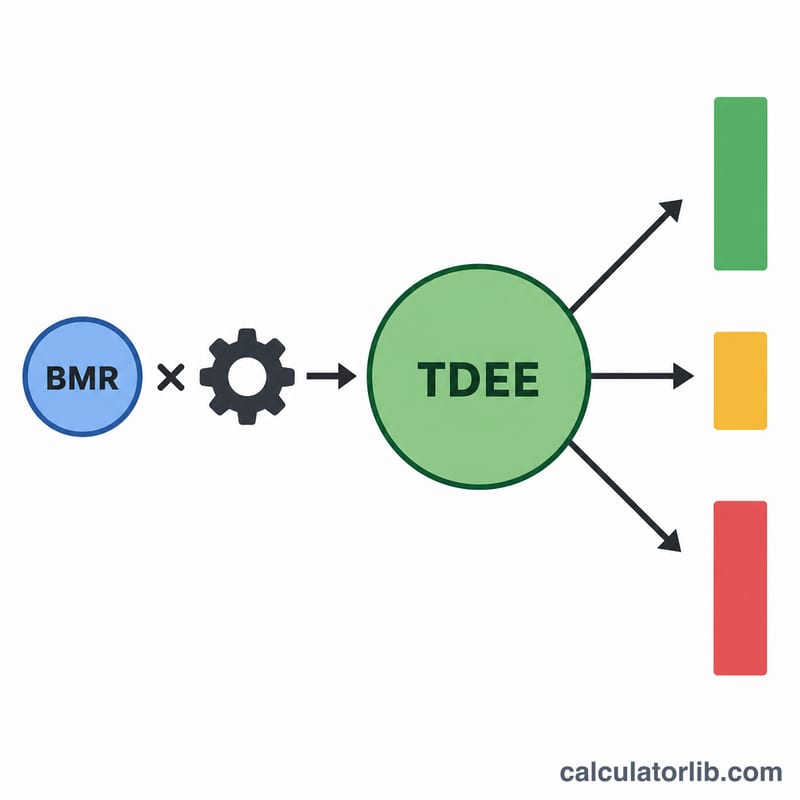
This tool estimates how many calories your body needs each day. It first calculates your Basal Metabolic Rate (BMR) — the energy you burn at complete rest — using the Mifflin-style Harris-Benedict (revised) equations. It then multiplies your BMR by an activity factor to give your Total Daily Energy Expenditure (TDEE), the calories needed to maintain your current weight. Calories are universal, so this calculator works for any country.
The inputs you enter
- Age – in years (defaults to 30 if left blank).
- Gender – Male or Female, as the BMR formulas differ.
- Unit System – Metric (kg, cm) or Imperial (lbs, ft/in). Imperial entries are converted internally: lbs × 0.453592 = kg, and (ft × 12 + in) × 2.54 = cm.
- Height – in cm, or feet and inches.
- Weight – in kg, or pounds.
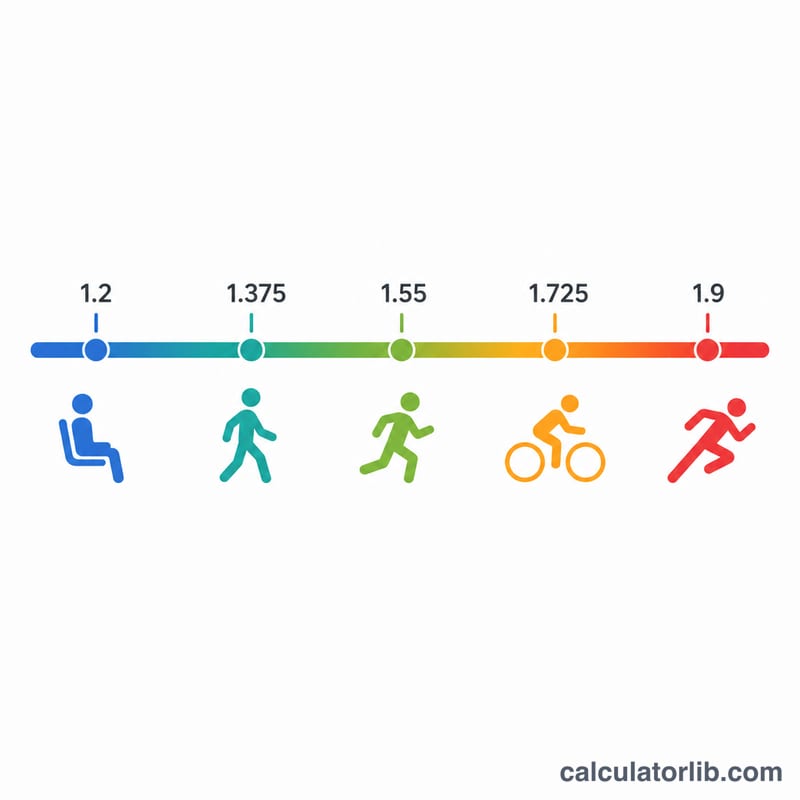
- Activity Level – Sedentary, Light, Moderate, Active, or Very Active.
The formula explained
BMR is calculated with the revised Harris-Benedict equations:
- Male: 88.362 + (13.397 × weight kg) + (4.799 × height cm) − (5.677 × age)
- Female: 447.593 + (9.247 × weight kg) + (3.098 × height cm) − (4.330 × age)
TDEE is then BMR × an activity factor: Sedentary 1.2, Light 1.375, Moderate 1.55, Active 1.725, Very Active 1.9.
Worked example
A 30-year-old male, 80 kg and 180 cm tall:
BMR = 88.362 + (13.397 × 80) + (4.799 × 180) − (5.677 × 30) = 88.362 + 1071.76 + 863.82 − 170.31 ≈ 1,853 calories.
With Moderate activity: TDEE = 1,853 × 1.55 ≈ 2,872 calories/day to maintain weight. For weight loss, subtract about 500 (≈2,372); to gain, add about 500 (≈3,372).
Understanding Your Calorie Numbers
Each number this calculator reports answers a different question:
- BMR (basal metabolic rate) is the energy your body burns at complete rest just to keep basic functions running — breathing, circulation, cell repair, and maintaining body temperature. It is the floor of your energy expenditure, not a target to eat at.
- Maintenance TDEE is your BMR multiplied by an activity factor. It estimates the total calories you burn in a typical day including movement and exercise. Eating at this level should keep your weight roughly stable.
- Loss and gain targets shift maintenance down or up. A deficit means eating fewer calories than you burn so the body draws on stored energy; a surplus means eating more to support weight or muscle gain.
Body fat stores roughly 3,500 kcal per pound, so a sustained deficit or surplus of about 500 kcal/day corresponds to roughly 1 lb (≈0.45 kg) of change per week. A 1,000 kcal/day deficit corresponds to about 2 lb/week, which is generally considered the upper end of a safe rate for most people.
To avoid nutrient shortfalls and excessive lean-mass loss, daily intake is commonly cited as not dropping below about 1,200 kcal for women and 1,500 kcal for men without medical supervision. If a computed loss target falls below these figures, choose a smaller deficit instead.
These figures are statistical estimates from population equations. Actual needs vary with genetics, body composition, medications, hormones, and measurement accuracy, and can differ from the estimate by a few hundred calories. This is general educational information, not medical or nutritional advice — consult a qualified professional before making significant dietary changes, especially if you have a health condition.
Key Terms Defined
- Basal metabolic rate (BMR)
- The number of calories your body uses at complete rest in a neutral environment to sustain vital functions such as breathing, circulation, and cell maintenance. It excludes any physical activity or digestion.
- TDEE (total daily energy expenditure)
- The total calories you burn in a full day, combining BMR with the energy cost of movement, exercise, and digesting food. It is estimated as BMR multiplied by an activity factor.
- Activity factor (multiplier)
- A number (commonly 1.2 to 1.9) applied to BMR to account for your typical activity level, from sedentary desk work to intense daily training.
- Maintenance calories
- The intake that matches your TDEE, keeping body weight approximately stable over time.
- Calorie deficit
- Eating fewer calories than you burn, prompting the body to use stored energy and generally leading to weight loss.
- Calorie surplus
- Eating more calories than you burn, providing extra energy for weight gain or muscle building.
Frequently asked questions
How do I lose or gain weight from these numbers? A deficit of roughly 500 calories per day below your TDEE typically produces about 1 lb (0.45 kg) of loss per week; a 500-calorie surplus does the reverse.
Which activity level should I choose? Sedentary is little or no exercise, Light is 1–3 days a week, Moderate is 3–5 days, Active is 6–7 days, and Very Active is hard daily training or a physical job.
How accurate is it? The Harris-Benedict equations give a solid estimate, but real needs vary with body composition, genetics, and health. Track your weight over two to three weeks and adjust your intake accordingly.