
What the Burpee Calorie Calculator Does
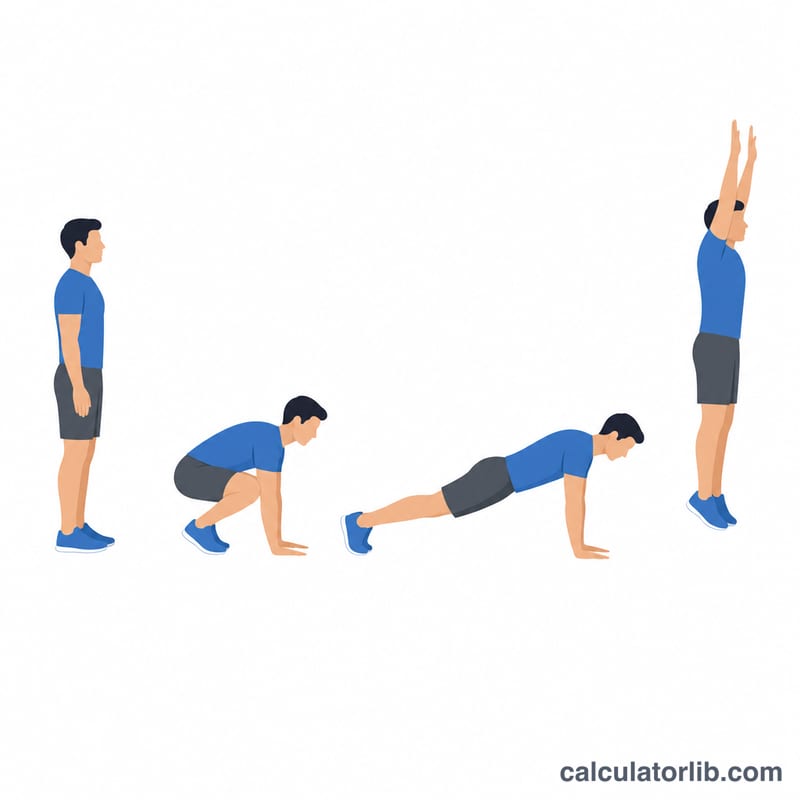
The Burpee Calorie Calculator estimates how many calories you burn during a session of burpees, then breaks that figure down into calories per burpee and your work rate in burpees per minute. It uses the metric system (weight in kilograms), so it suits users worldwide who track body weight in kg. Burpees are a high-intensity, full-body exercise, and this tool helps you quantify the effort so you can plan workouts, set targets, and compare sessions over time.
The Inputs You Provide
- Weight (kg): Your body weight in kilograms. Heavier bodies expend more energy, so this directly scales your result.
- Number of Burpees: The total reps you completed. This does not change total calories, but it is used to work out calories per burpee.
- Time (minutes): How long you spent doing burpees. The longer you exercise, the more calories you burn.
The Formula Explained
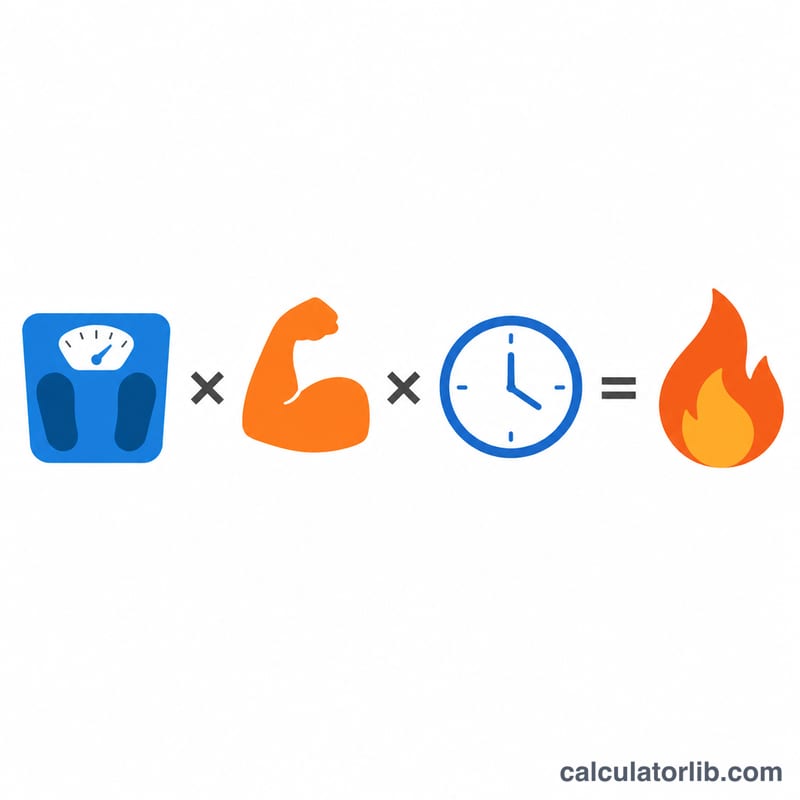
The calculator uses the standard MET-based energy equation:
$$\text{Calories Burned} = \text{Weight} \times 0.0175 \times 8 \times \text{Time}$$
Here, 8 is the MET value (Metabolic Equivalent of Task) assigned to vigorous calisthenics like burpees, and 0.0175 is the per-kilogram, per-minute constant that converts METs and weight into calories. Two extra metrics are then derived:
- Calories per Burpee = Total Calories ÷ Number of Burpees
- Burpees per Minute = Number of Burpees ÷ Time
Note that the total calorie figure depends only on weight and time — the rep count simply tells you efficiency and pace, not extra burn.
Worked Example
Suppose you weigh 70 kg, complete 100 burpees, and finish in 10 minutes:
- Calories Burned = $$70 \times 0.0175 \times 8 \times 10 = 98 \text{ calories}$$ 98 calories
- Calories per Burpee = $$98 \div 100 = 0.98 \text{ calories}$$ 0.98 calories
- Burpees per Minute = $$100 \div 10 = 10 \text{ burpees/min}$$ 10 burpees/min
So a 10-minute, 100-rep set burns roughly 98 calories at a pace of 10 reps per minute.
Interpreting Your Calorie Result
The number this calculator returns is an MET-based estimate, not a direct measurement. It is derived from population-average oxygen-consumption data, so it tells you the typical energy cost of vigorous calisthenics for someone of your body weight exercising for the time entered — not the exact calories your individual body burned today.
Several real-world factors cause your actual burn to differ from the estimate:
- Fitness level: A highly trained athlete is more metabolically efficient and may burn slightly fewer calories doing the same movement than a beginner.
- Intensity and form: Explosive, full-range burpees with a jump and push-up demand far more energy than slow, modified "squat-thrust" versions, yet both register the same MET here.
- Rest periods: The formula assumes continuous effort across the time you enter. If your session included long pauses between sets, the true burn is lower — enter only active minutes for a closer estimate.
- Body composition, age, sex and temperature all nudge real energy expenditure up or down by a margin the formula cannot capture.
Note also that this figure covers only the exercise duration itself. It does not include the elevated calorie burn that can continue for a while after intense interval work (sometimes called the "afterburn" or EPOC), nor your baseline resting metabolism. For total daily expenditure, combine it with a BMR or daily-calorie estimate.
The most useful way to apply the result is to track trends rather than chase an exact number. Because the same assumptions are applied every time, the calculator is consistent: comparing this week's sessions to last week's, or burpees against another workout, gives a reliable relative picture even if any single absolute value is approximate. Treat the output as a planning and motivation tool, and remember this is general fitness information, not personalized medical or nutritional advice.
Frequently Asked Questions
Why doesn't doing more burpees increase my total calories? Total calories are based on weight and duration via the MET formula. More reps in the same time simply means each burpee burns slightly fewer calories — your overall effort is captured by the time you spend exercising.
Is the result exact? No. It is a reliable estimate. Actual burn varies with intensity, fitness level, form, and individual metabolism. Use it for planning and comparison rather than precise dietary calculations.
What if I weigh myself in pounds? Convert to kilograms first by dividing pounds by 2.205, since this calculator expects weight in kg.