
What is the Walking Calorie Calculator?
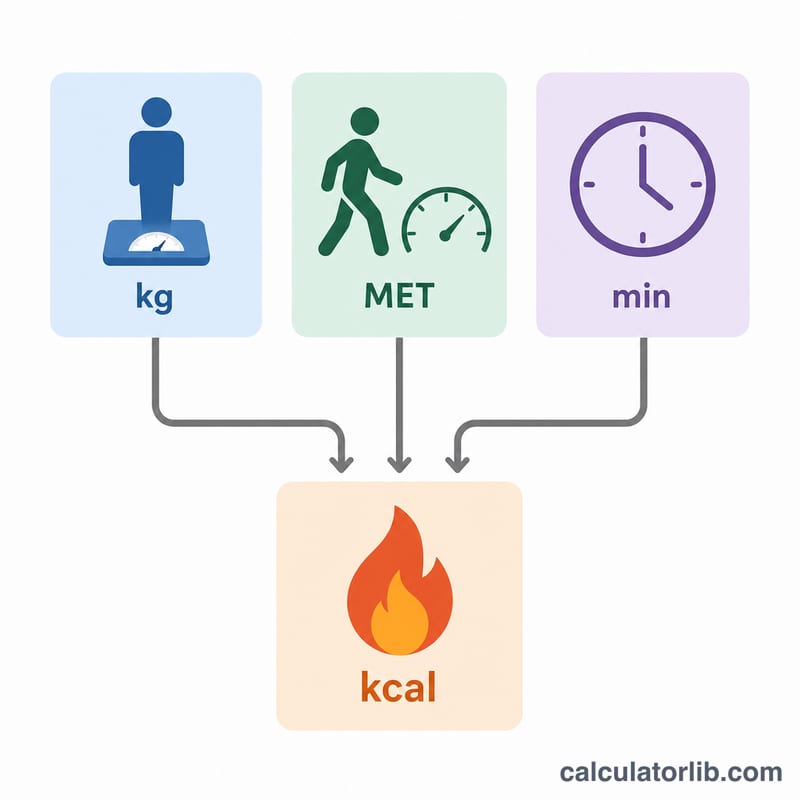
This tool estimates how many calories you burn while walking, based on your body weight, walking speed, and how long you walk. It uses the MET (Metabolic Equivalent of Task) method, the same approach used in exercise physiology to compare the energy cost of different activities. Faster walking carries a higher MET value, so the calculator automatically picks the right MET from your speed.
How to use it
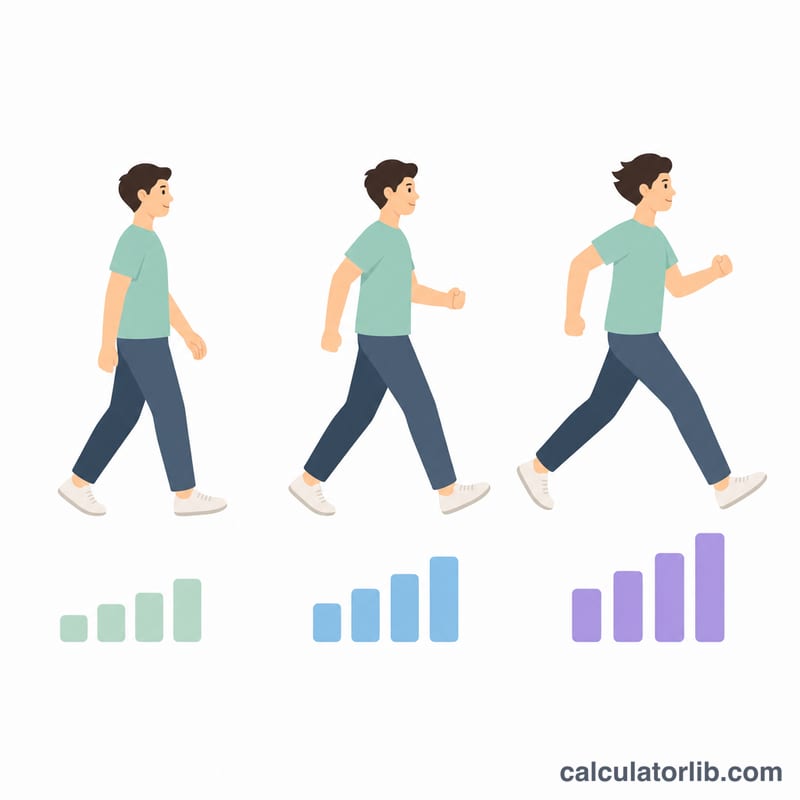
Enter your weight in kilograms, your average walking speed in km/h, and the total minutes you walked. The calculator returns the estimated calories burned, plus your calories per minute, the MET value used, and the distance you covered. It works for casual strolls (around 3 km/h) up to brisk power walking (7+ km/h).
The formula explained
The core equation is $$\text{Calories} = \frac{\text{MET} \times 3.5 \times \text{weight (kg)}}{200} \times \text{minutes}$$. Here 3.5 ml/kg/min is the oxygen consumption at rest (1 MET), and dividing by 200 converts oxygen use into kilocalories. The MET value scales with intensity: roughly 2.8 for a slow walk, 3.5 for a moderate pace, and 5.0 or more for a fast, brisk walk.
Worked example
A 70 kg person walks for 30 minutes at 5 km/h. At that speed the MET is 3.5, so: $$\text{Calories} = \frac{3.5 \times 3.5 \times 70}{200} \times 30 = 128.6\ \text{kcal}$$ They cover \(5 \times (30 \div 60) = 2.5\ \text{km}\), burning about 4.3 kcal per minute.
FAQ
Is this exact? No — MET-based estimates are averages. Terrain, fitness, age and body composition all affect the real number, so treat it as a close guide.
Does walking uphill burn more? Yes, considerably. This calculator assumes flat ground; inclines can double the calorie cost.
What if I walk in mph? Convert to km/h first (\(1\ \text{mph} \approx 1.609\ \text{km/h}\)) before entering your speed.