
What this calculator does
This tool estimates the calories you burn while horseback riding. Energy use depends mainly on how hard the activity is (its intensity in METs), how long you ride, and how much you weigh. The MET values used here come from the international Compendium of Physical Activities (the same source cited by Japan's National Institute of Health and Nutrition revised Physical Activity METs Table), so the formula applies anywhere in the world.
How to use it
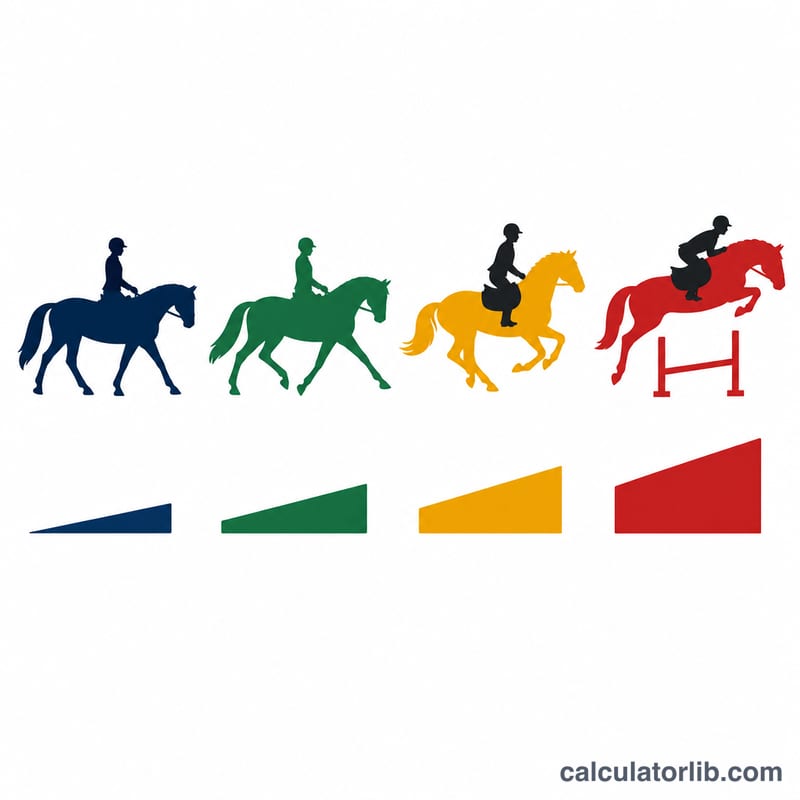
Pick the riding gait that best matches your session: walk, general riding, trot, canter/gallop, or jumping. Each option carries a fixed MET (metabolic equivalent) value. Enter your riding time in minutes and your body weight in kilograms, then read the estimated calories burned and the exercise intensity in METs.
The formula explained
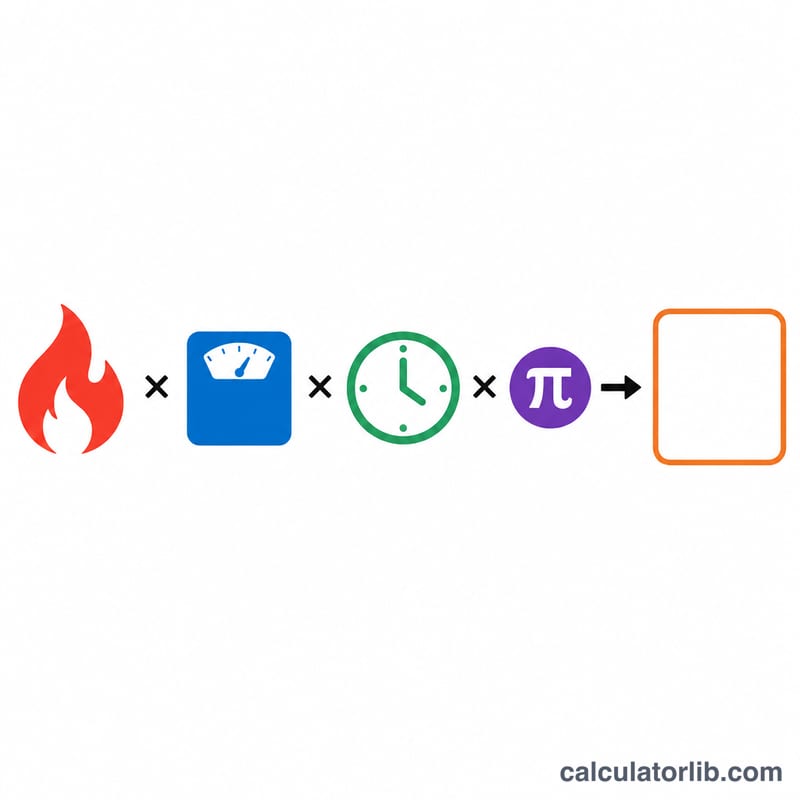
The calculation uses the standard MET energy equation: $$\text{Calories} = \text{MET} \times \text{Weight (kg)} \times \frac{\text{Time (min)}}{60} \times 1.05$$ One MET is the energy you use sitting quietly, about \(1.05\) kcal per kilogram per hour. Because riding time is entered in minutes, it is first converted to hours by dividing by \(60\). The \(1.05\) constant is a fixed physiological conversion and should not be changed. The result is gross expenditure, meaning it includes the resting metabolism you would burn anyway during that time.
Worked example
Suppose you trot (5.8 METs) for 90 minutes and weigh 60 kg. First convert time: \(90 / 60 = 1.5\) hours. Then $$\text{calories} = 5.8 \times 60 \times 1.5 \times 1.05 = 548.1 \text{ kcal}$$ The exercise intensity is reported as 5.8 METs.
FAQ
Why does jumping burn so much more than walking? Higher gaits demand more muscular effort and balance, raising the MET value (walking 3.8 vs jumping 9.0), which scales the calorie estimate proportionally.
Is this net or gross calories? It is gross energy expenditure, including the calories your body uses at rest during the same period. Subtract roughly 1 MET worth if you want net activity calories.
How accurate is it? MET-based estimates are approximations. Actual burn varies with fitness, technique, terrain, and the horse, so treat the number as a useful guide rather than an exact measurement.