
What Is the Bike Pace Calculator?
The Bike Pace Calculator turns your ride distance and elapsed time into two useful numbers: your average speed (km/h or mph) and your pace (minutes and seconds per kilometer or mile). Speed is what most cyclists glance at on a bike computer, while pace is handy for comparing efforts and planning how long a route will take.
How to Use It
Enter the distance you rode and pick kilometers or miles. Then enter the time it took, split into hours, minutes, and seconds. The calculator instantly shows your average speed and your pace per unit. It works for any distance, from a quick spin around the block to a century ride.
The Formula Explained
Two simple relationships drive everything. Average speed is distance divided by time expressed in hours: \(\text{Speed} = \text{Distance} / \text{Time}\). Pace is the inverse idea — total time divided by distance — usually expressed as time per unit: \(\text{Pace} = \text{Time} / \text{Distance}\). To convert raw seconds-per-unit into a friendly format, divide by 60 for minutes and keep the remainder as seconds.
$$\text{Speed} = \frac{\text{Distance}}{T} \qquad \text{Pace} = \frac{T}{\text{Distance}}$$$$\text{where}\quad T = \text{Hours} + \frac{\text{Minutes}}{60} + \frac{\text{Seconds}}{3600}$$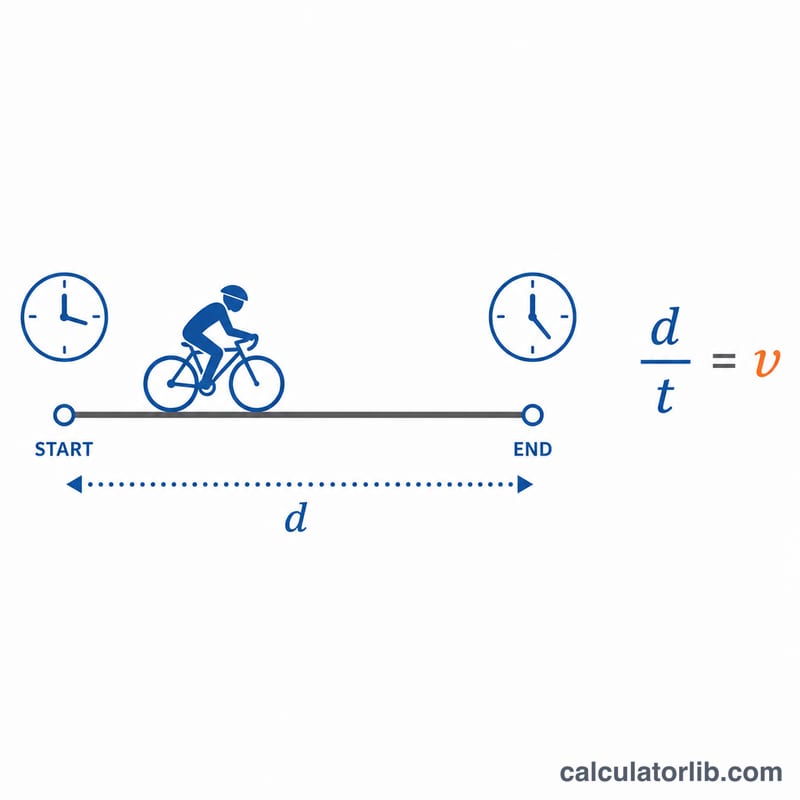
Worked Example
Suppose you ride 40 km in 1 hour and 20 minutes. Total time is 1.333 hours (4800 seconds). Average speed:
$$\text{Speed} = \frac{40}{1.333} = 30 \text{ km/h}$$Pace:
$$\text{Pace} = \frac{4800}{40} = 120 \text{ seconds per km}$$which is 2 minutes 0 seconds per km.
FAQ
What is a good cycling pace? Casual riders average 15–20 km/h; fit road cyclists often hold 25–35 km/h on flat terrain. Your ideal pace depends on fitness, terrain, and wind.
Does this account for elevation or wind? No. It computes pure average speed and pace from distance and time, so hills and headwinds are already baked into your recorded time.
Can I use miles? Yes. Select "Miles" and the speed is reported in mph and pace in minutes per mile.