
What is the Cycling Heart Rate Zone Calculator?
This tool estimates your maximum heart rate (MaxHR) and breaks your effort into five training zones used widely in cycling. By riding within specific heart rate ranges, you can target recovery, build aerobic endurance, develop threshold power, or push your VO₂ max — without guessing. It works for cyclists of any level and uses only your age.
How to use it
Enter your age in years and submit. The calculator returns your estimated maximum heart rate plus the lower bound (in bpm) of each of the five classic zones. To train in a zone, keep your heart rate above that zone's bound and below the next one up. For example, Zone 2 endurance riding sits between the 60% and 70% boundaries.
The formula explained
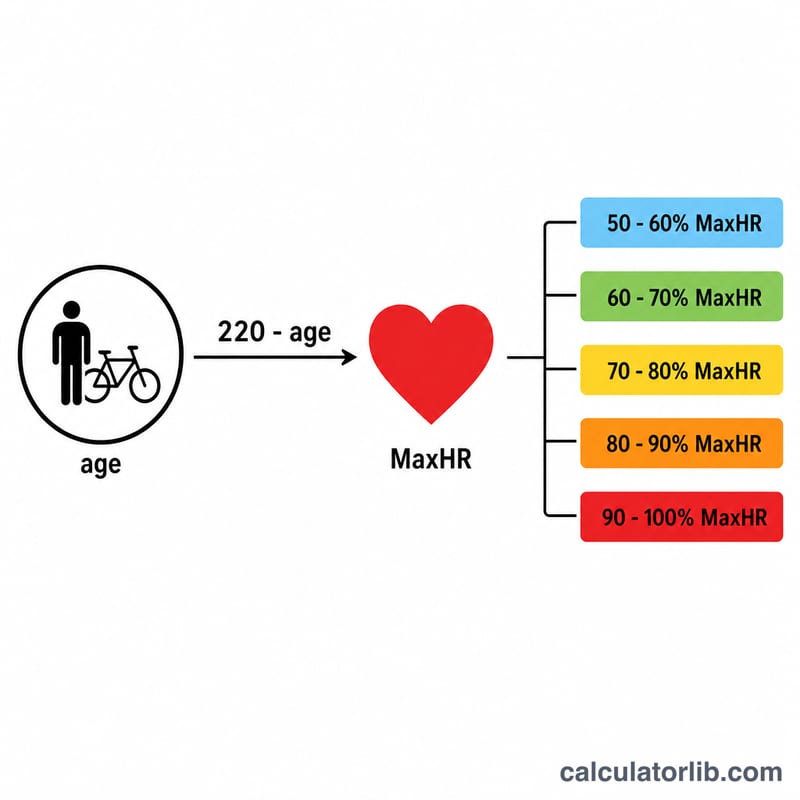
The widely used age-based estimate is \(\text{MaxHR} = 220 - \text{age}\). Each zone boundary is then a fixed percentage of that maximum: Zone 1 = 50%, Zone 2 = 60%, Zone 3 = 70%, Zone 4 = 80%, and Zone 5 = 90%. These percentages reflect the common 5-zone model where lower zones build base fitness and higher zones build speed and power.
$$\text{HR}_{\max} = 220 - \text{Age (years)}$$$$\begin{aligned} \text{Zone 1} &= 0.50 \times \text{HR}_{\max} \\ \text{Zone 2} &= 0.60 \times \text{HR}_{\max} \\ \text{Zone 3} &= 0.70 \times \text{HR}_{\max} \\ \text{Zone 4} &= 0.80 \times \text{HR}_{\max} \\ \text{Zone 5} &= 0.90 \times \text{HR}_{\max} \end{aligned}$$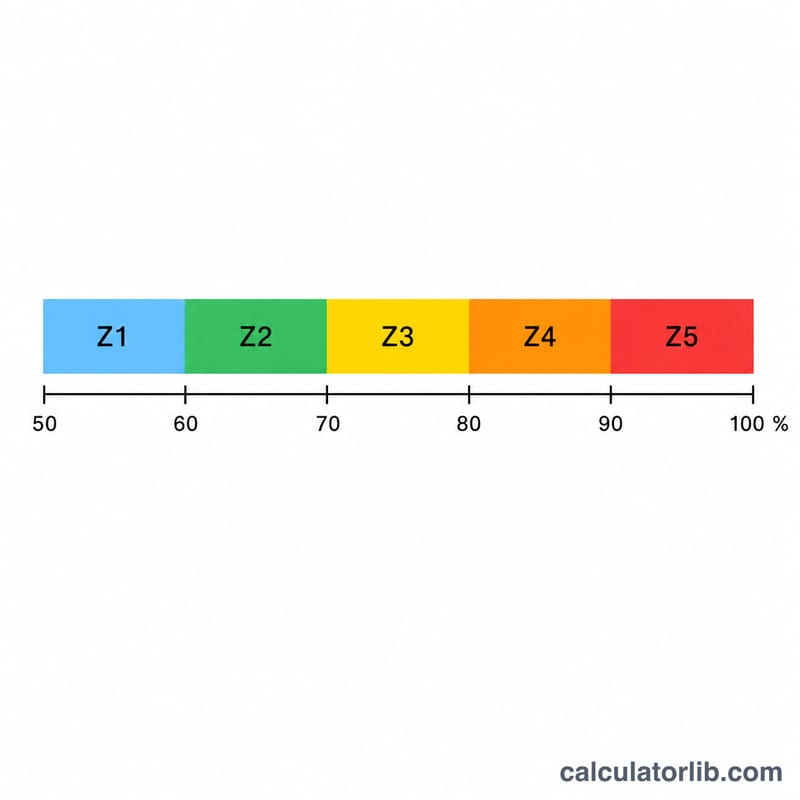
Worked example
For a 30-year-old rider: \(\text{MaxHR} = 220 - 30 = 190\) bpm. Zone 1 starts at \(0.50 \times 190 = 95\) bpm, Zone 2 at \(0.60 \times 190 = 114\) bpm, Zone 3 at \(0.70 \times 190 = 133\) bpm, Zone 4 at \(0.80 \times 190 = 152\) bpm, and Zone 5 at \(0.90 \times 190 = 171\) bpm. So a tempo (Zone 3) ride would target roughly 133–152 bpm.
FAQ
Is "220 − age" accurate for everyone? It's a population average and can be off by ±10–12 bpm for an individual. A lab test or field test gives a more personal figure.
Which zone should I ride in most? Most endurance training time is best spent in Zones 2–3 to build an aerobic base, with shorter, harder efforts in Zones 4–5.
Why are cycling zones sometimes lower than running zones? Heart rate during cycling is often a few beats lower than running at the same perceived effort because more body weight is supported, so many riders calibrate zones specifically for the bike.