
What Is the Relaxation Heart Rate Zone?
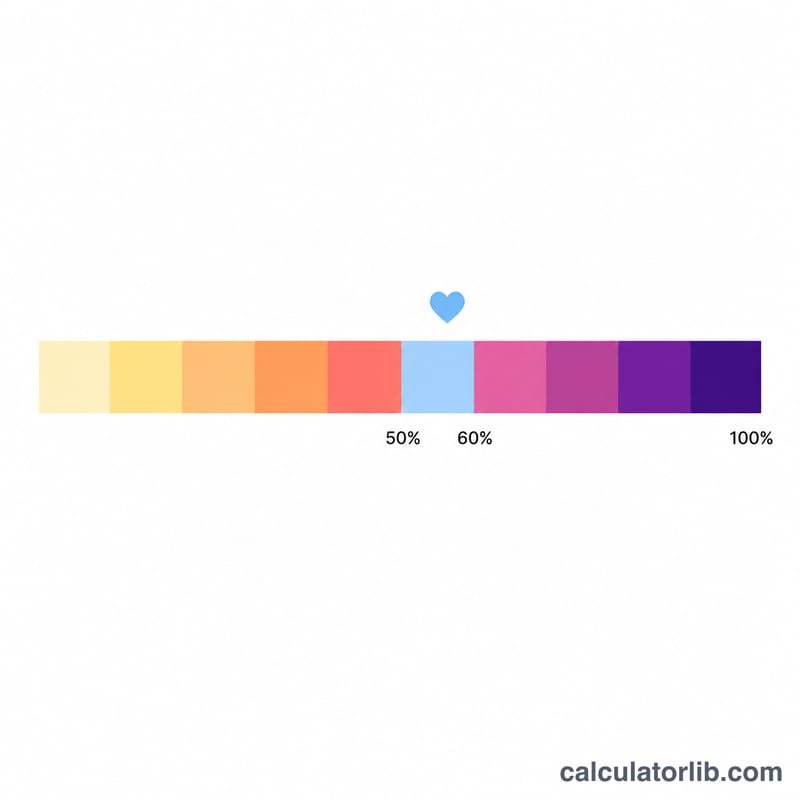
The relaxation heart rate zone is a low-intensity target band — roughly 50% to 60% of your estimated maximum heart rate — that is ideal for deep breathing, meditation, gentle yoga, and active recovery. Training or simply resting in this zone helps activate your parasympathetic "rest and digest" nervous system, lower stress, and improve cardiovascular health. This calculator estimates that zone from a single input: your age.
How to Use It
Enter your age in years and submit. The calculator first estimates your maximum heart rate using the classic formula, then multiplies it by 0.5 and 0.6 to give the lower and upper bounds of your relaxation zone in beats per minute (bpm). Compare these numbers to readings from a fitness watch, chest strap, or by counting your pulse for 15 seconds and multiplying by four.
The Formula Explained
Maximum heart rate is estimated as 220 − age. This is a population average, so individual results vary. The relaxation zone is then Max HR × 0.5 to Max HR × 0.6. Keeping your heart rate in this gentle range during deep breathing exercises encourages slow, controlled breaths and a calmer state.
$$\text{Relaxation Zone} = \left(220 - \text{Age}\right) \times \left[0.5,\ 0.6\right]$$$$\begin{gathered} \text{HR}_{\max} = 220 - \text{Age (years)} \\[1.5em] \text{where}\quad \left\{ \begin{aligned} \text{Zone}_{\text{low}} &= 0.5 \times \text{HR}_{\max} \\ \text{Zone}_{\text{high}} &= 0.6 \times \text{HR}_{\max} \end{aligned} \right. \end{gathered}$$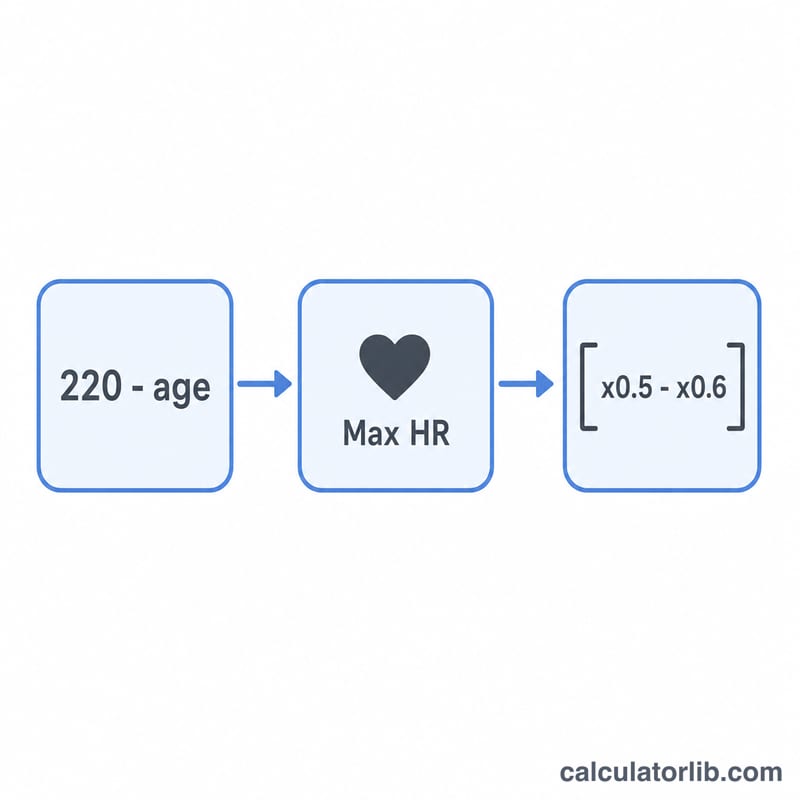
Worked Example
For a 40-year-old: Max HR = 220 − 40 = 180 bpm. The relaxation zone is 180 × 0.5 = 90 bpm to 180 × 0.6 = 108 bpm. So a calming target during deep breathing would be roughly 90–108 bpm.
$$\text{Max HR} = 220 - 40 = 180\ \text{bpm}$$$$180 \times 0.5 = 90\ \text{bpm} \quad\text{to}\quad 180 \times 0.6 = 108\ \text{bpm}$$FAQ
Is the 220 − age formula accurate? It is a widely used estimate but can be off by 10–20 bpm for any individual. For precise zones, a supervised exercise test is best.
Should my heart rate drop below this zone when truly resting? Yes. A typical resting heart rate is 60–100 bpm; the relaxation zone here describes a light-activity calming band, not your seated resting pulse.
Can deep breathing lower my heart rate? Slow diaphragmatic breathing can reduce heart rate and blood pressure by stimulating the vagus nerve, helping you move toward the lower end of this range.