
What is the Target Heart Rate Zone Calculator?
This tool estimates your maximum heart rate (MHR) and breaks your training into five target heart rate (THR) zones, each expressed in beats per minute (bpm). Exercising within a chosen zone helps you train with intention — whether the goal is burning fat, building aerobic endurance, or pushing anaerobic capacity. It is a universal sports-medicine tool intended for adults older than 19, and the zone concept is widely promoted by groups such as the American Heart Association.
How to use it
Pick a method, then enter the required numbers:
- Basic by Age – enter only your age. Zones are a straight percentage of MHR.
- Karvonen by Age & RHR – enter age and resting heart rate. Zones use your heart rate reserve, which is more personalised.
- Karvonen by MHR & RHR – enter a measured maximum heart rate (from a field test) and your resting heart rate; age is ignored.
Measure your resting heart rate first thing in the morning before getting up for the most accurate value.
The formula explained
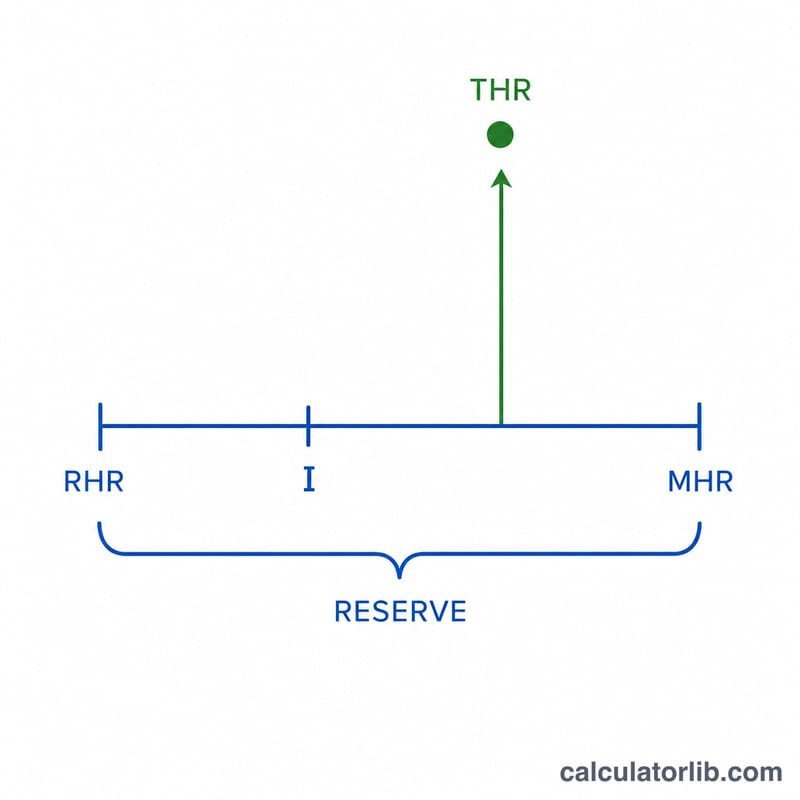
Maximum heart rate is estimated with the Fox formula \(\text{MHR} = 220 - \text{age}\). Some researchers prefer \(207 - 0.7 \times \text{age}\) (Tanaka), but this calculator uses \(220 - \text{age}\). Each zone is then computed at its lower and upper intensity bound I:
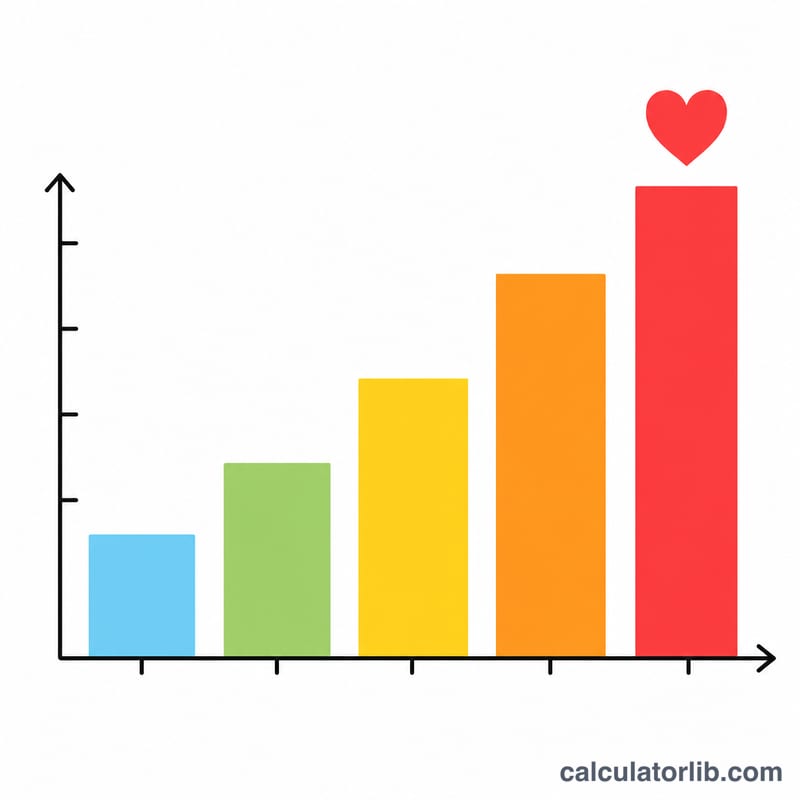
Basic: $$\text{THR} = \text{MHR} \times I$$ Karvonen: $$\text{THR} = (\text{MHR} - \text{RHR}) \times I + \text{RHR}$$ where \(\text{MHR} - \text{RHR}\) is the Heart Rate Reserve (HRR). The five zones span 50–60% (Warm Up), 60–70% (Fat Burn), 70–80% (Aerobic), 80–90% (Anaerobic) and 90–100% (VO2 Max).
Worked example
For a 42-year-old using the Basic method: $$\text{MHR} = 220 - 42 = 178 \text{ bpm}$$ The Aerobic zone runs from \(0.70 \times 178 = 125\) bpm to \(0.80 \times 178 = 142\) bpm. Using Karvonen with a resting heart rate of 60: \(\text{HRR} = 178 - 60 = 118\), so the Aerobic zone runs from \(0.70 \times 118 + 60 = 143\) bpm to \(0.80 \times 118 + 60 = 154\) bpm.
FAQ
Which method is more accurate? Karvonen accounts for your resting heart rate, so it tailors zones to your fitness level and is generally preferred over the Basic percentage method.
Why does my VO2 Max upper bound equal my MHR? At 100% intensity the THR equals MHR in both methods, which is the expected maximum.
Is the \(220 - \text{age}\) formula exact? No — it is a population estimate with wide individual variation. A measured maximum from a supervised test is more precise; use the Karvonen-by-MHR option for that.