
What this calculator does
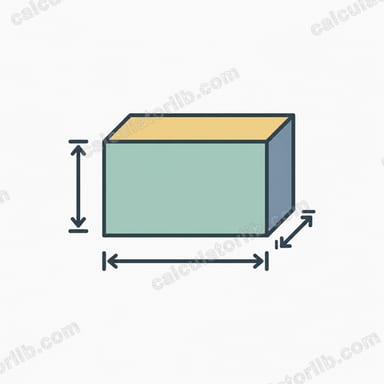
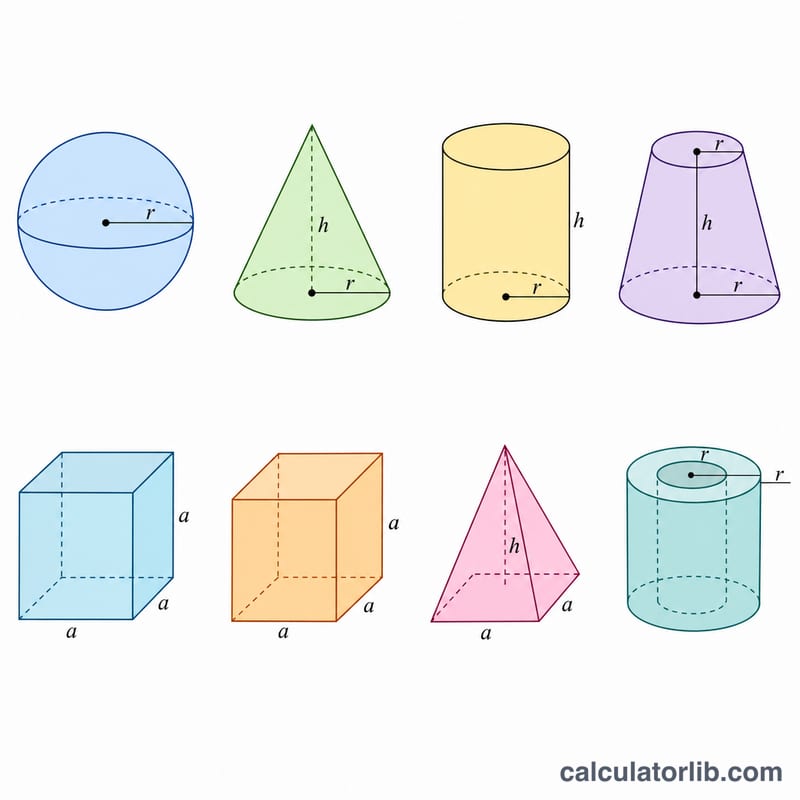
This solid geometry calculator finds the volume and total surface area of the most common three-dimensional shapes, plus useful secondary properties such as lateral area, base and top areas, slant height, great-circle circumference and space diagonal. It also includes a 3D distance tool. Pick a solid from the dropdown, enter its dimensions, choose a length unit, and the relevant results appear instantly. Because this is pure geometry, the results are valid everywhere — no country or jurisdiction applies.
How to use it
1. Choose a Solid type. 2. Select a Length unit (millimeter, centimeter, meter, kilometer, inch, foot or yard) — every linear input uses the same unit, so areas come out in unit² and volumes in unit³. 3. Enter the dimensions shown for that shape. 4. Set how many decimals to display (computation is always done in full double precision). The form reveals only the inputs that matter for the selected solid.
The formulas explained
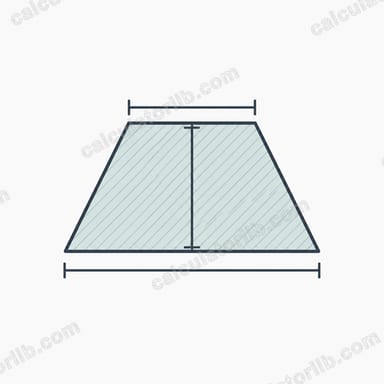
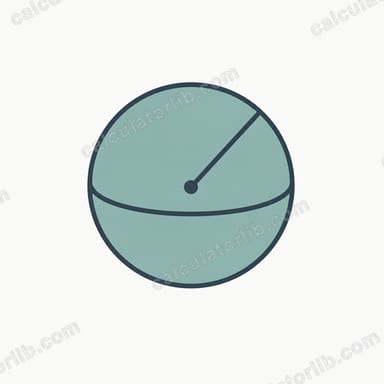
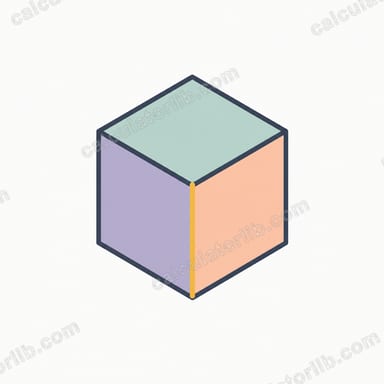
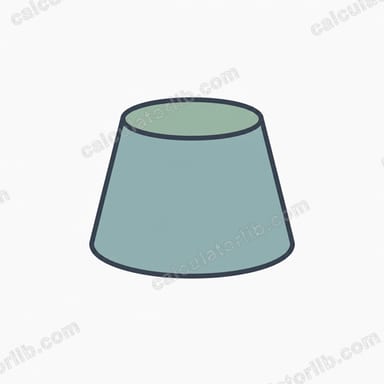
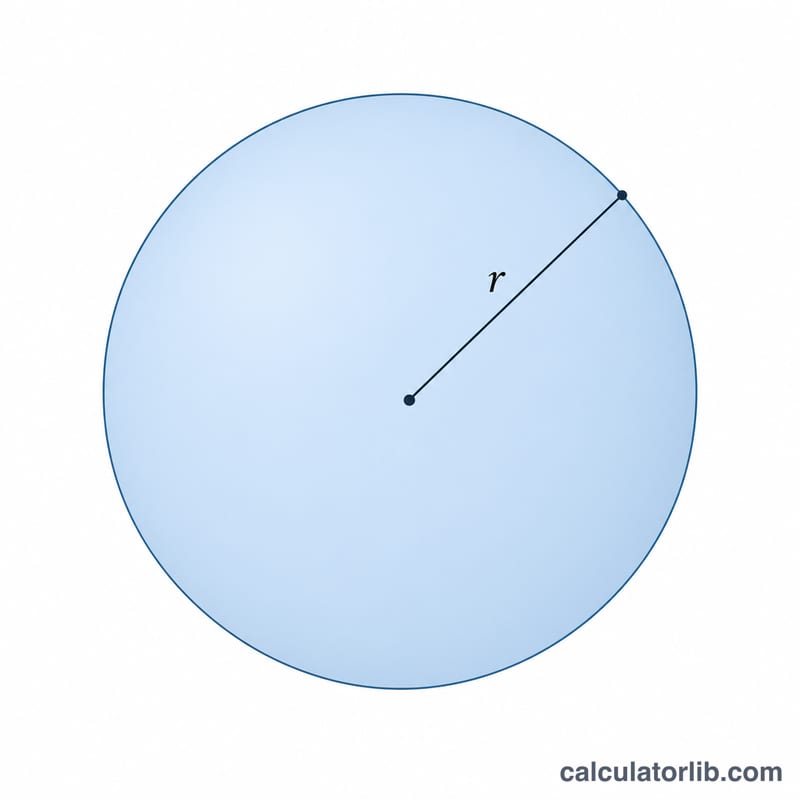
Each shape uses its standard closed form with \(\pi = 3.14159265\ldots\) For a sphere, $$V = \tfrac{4}{3}\pi r^{3} \quad\text{and}\quad S = 4\pi r^{2}.$$ A cylinder is \(V = \pi r^{2}h\) with total surface \(2\pi r(r+h)\). A cone first needs its slant height \(l = \sqrt{r^{2}+h^{2}}\), giving \(V = \tfrac{1}{3}\pi r^{2}h\) and \(S = \pi r(r+l)\). Prisms multiply a cross-sectional area by length; frustums blend top and bottom dimensions. A cube of edge \(a\) has \(V = a^{3}\), \(S = 6a^{2}\) and space diagonal \(a\sqrt{3}\).
Worked example
Take a cone with radius 3 m and height 4 m. The slant height is \(\sqrt{9+16} = 5\) m. $$V = \tfrac{1}{3} \cdot \pi \cdot 9 \cdot 4 = 12\pi \approx 37.699 \text{ m}^{3}.$$ $$S = \pi \cdot 3 \cdot (3+5) = 24\pi \approx 75.398 \text{ m}^{2}.$$ The base area is \(9\pi \approx 28.274\) m² and the lateral area \(15\pi \approx 47.124\) m².
FAQ
Do I need to convert units? No. All inputs share one length unit and the answers stay in that unit (area in unit², volume in unit³). Just pick a single unit for the whole problem.
Why does the tube need outer radius greater than inner radius? A tube is a hollow cylinder; its wall must have positive thickness, so the outer radius \(R\) must exceed the inner radius \(r\), otherwise the volume would be zero or negative.
What is the slant height? For cones, pyramids and frustums it is the straight-line distance up the sloping face, used to compute lateral surface area — not the same as the vertical height.