
What Is the Surface Area to Volume Ratio?
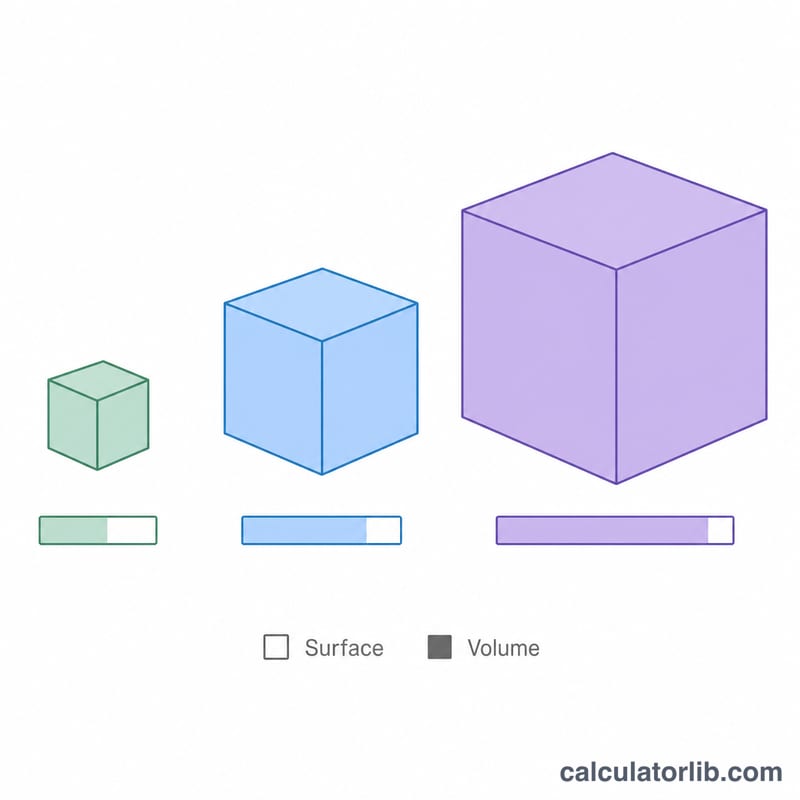
The surface area to volume ratio (often written SA:V or SA/V) measures how much exposed surface an object has relative to the space it occupies. It is found by dividing the total surface area by the volume. Because surface area scales with the square of length and volume with the cube, smaller objects have a much higher SA:V than larger objects of the same shape — a principle that shapes everything from cell biology to heat loss in engineering.
How to Use This Calculator
Enter the object's total surface area and its volume in any consistent units (for example cm² and cm³, or m² and m³). Click calculate and the tool returns the ratio. The result has units of inverse length (1/length), so if you used cm the ratio is per centimetre.
The Formula Explained
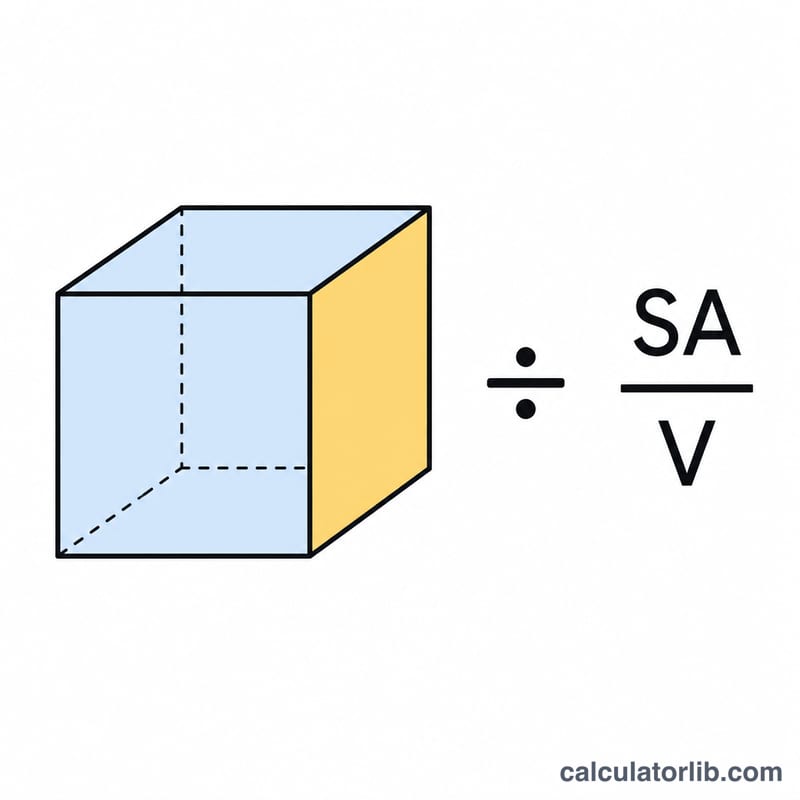
The equation is simply $$\text{SA:V} = \frac{\text{Surface Area}}{\text{Volume}}$$ A larger value means more surface relative to volume, which favors faster exchange of heat, gas, or nutrients across the boundary. A smaller value indicates a bulkier, more compact object that retains heat and resists diffusion.
Worked Example
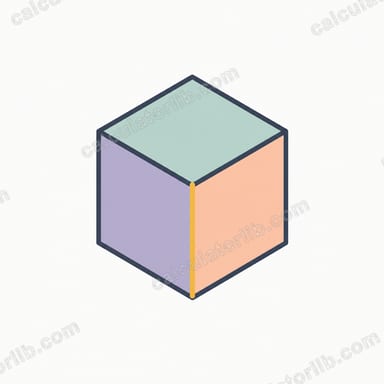
Consider a cube with side length 5. Its surface area is \(6 \times 5^2 = 150\) and its volume is \(5^3 = 125\). The SA:V ratio is $$150 \div 125 = \mathbf{1.2}$$ per unit length. A larger cube with side 10 would give \(600 \div 1000 = 0.6\) — half the ratio, showing how SA:V falls as size grows.
FAQ
What units does the ratio use? The ratio carries units of 1/length (inverse of whatever length unit your area and volume share).
Why is SA:V important in biology? Cells rely on diffusion across their membranes. A high SA:V lets nutrients and waste move efficiently, which is why cells stay small and divide rather than growing indefinitely.
Does shape affect the ratio? Yes. For a given volume, a sphere has the smallest possible surface area and therefore the lowest SA:V, while flat or branched shapes have much higher ratios.