
What is a regular tetrahedron?
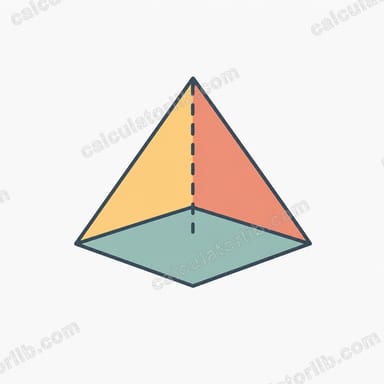
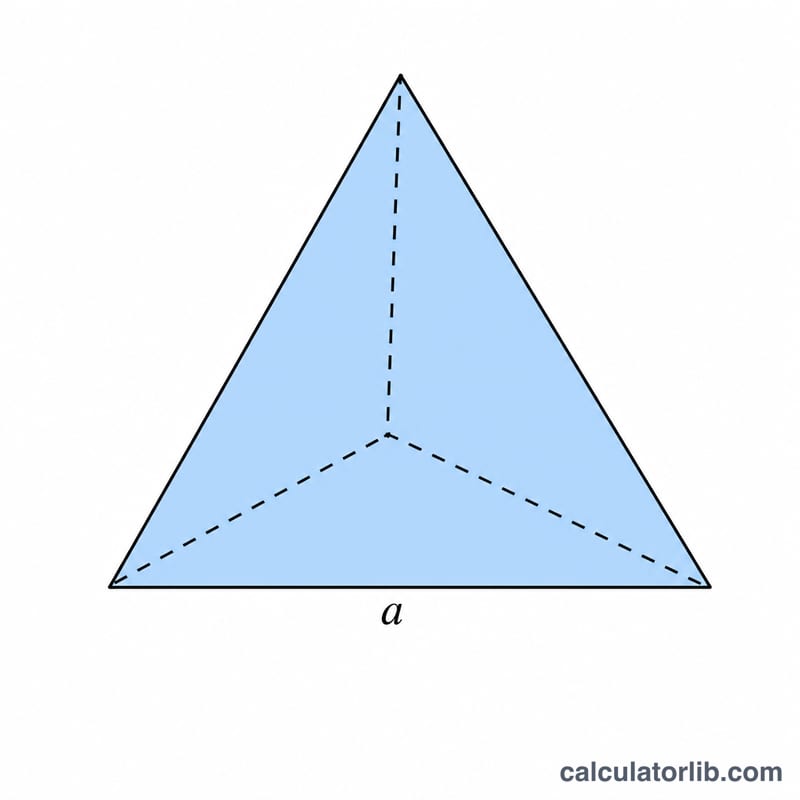
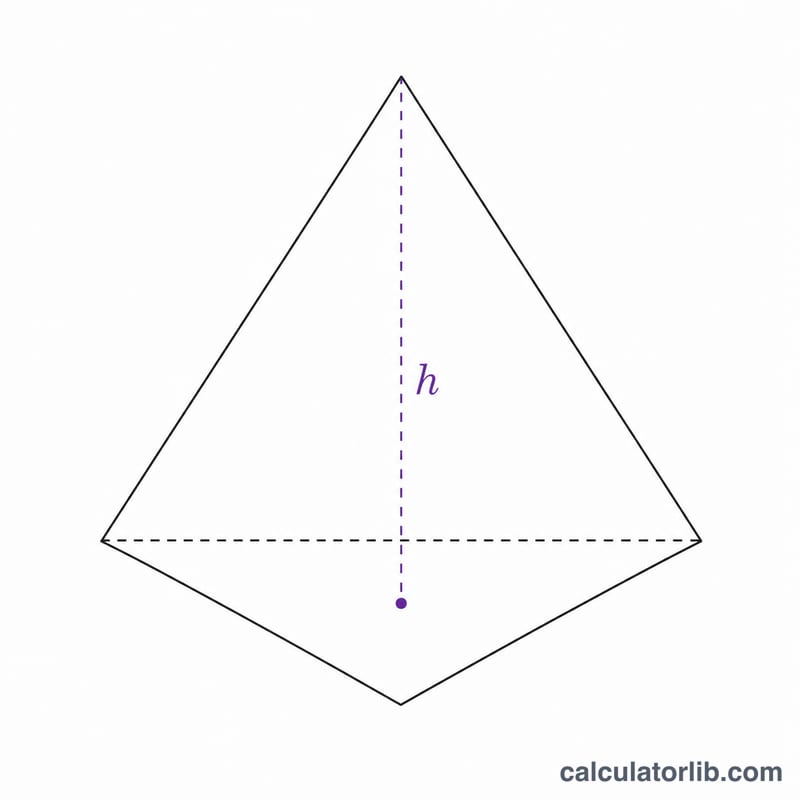
A regular tetrahedron is a three-dimensional shape made of four identical equilateral triangular faces, with all edges equal in length. It is the simplest of the Platonic solids and appears frequently in geometry, chemistry (molecular shapes), and engineering. This calculator finds its volume — along with surface area and height — directly from a single edge length.
How to use the calculator
Enter the edge length a in any consistent unit (cm, m, inches, etc.) and the calculator returns the volume in cubic units of that same unit. For example, if you enter the edge in centimeters, the volume is in cubic centimeters. The tool also reports the surface area and the vertical height of the tetrahedron.
The formula explained
The volume of a regular tetrahedron is given by:
$$V = \frac{a^{3}}{6\sqrt{2}}$$
This can also be written as \(V = \frac{\sqrt{2}}{12} \cdot a^{3} \approx 0.11785 \cdot a^{3}\). The surface area is \(A = \sqrt{3} \cdot a^{2}\), and the height (apex to base) is \(h = a \cdot \sqrt{\tfrac{2}{3}}\).
Worked example
Suppose the edge length is \(a = 6\). Then $$V = \frac{6^{3}}{6\sqrt{2}} = \frac{216}{8.4853} \approx 25.456 \text{ cubic units.}$$ The surface area is \(\sqrt{3} \times 36 \approx 62.354\) square units, and the height is \(6 \times \sqrt{\tfrac{2}{3}} \approx 4.899\) units.
FAQ
Does this work for an irregular tetrahedron? No — this formula assumes all four faces are equilateral triangles with equal edges. Irregular tetrahedra require the coordinates of all four vertices.
What units does it use? Any unit you like, as long as you are consistent. The volume comes out in the cube of whatever unit you used for the edge.
Why divide by 6√2? It results from integrating the cross-sectional area over the tetrahedron's height; the constant \(\frac{1}{6\sqrt{2}} \approx 0.11785\) is exact for the regular case.