
What This Calculator Does
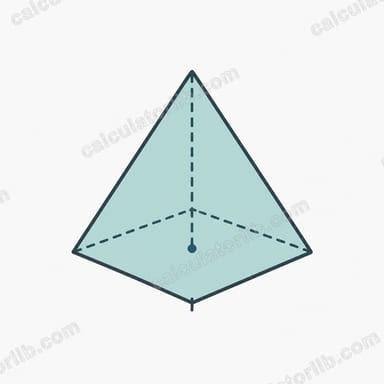
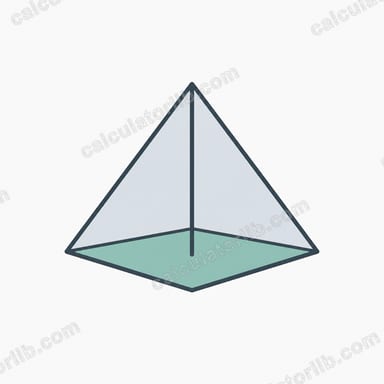
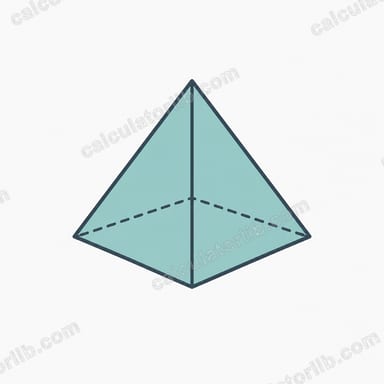
The Rectangular Pyramid Volume Calculator works out three key measurements for a right rectangular pyramid — one with a rectangular base and an apex sitting directly above the centre of that base. From just three inputs it returns the volume, the base area, and the total surface area. All dimensions are entered in metres, so results come back in cubic metres (volume) and square metres (areas).
The Inputs You Enter
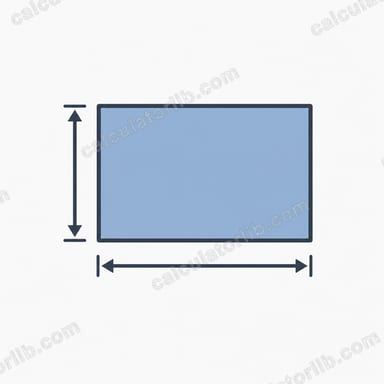
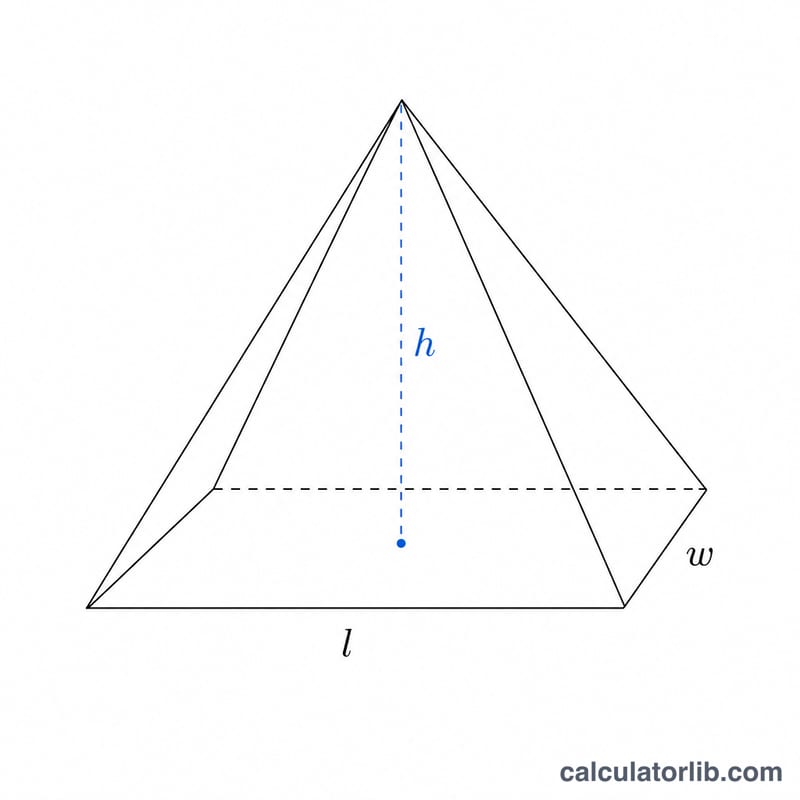
- Base Length (m): the longer side of the rectangular base.
- Base Width (m): the shorter side of the rectangular base.
- Height (m): the vertical (perpendicular) distance from the base to the apex — not the slant height.
All three values must be positive numbers. If any is zero or negative, the calculator returns an error because a pyramid cannot have a non-positive dimension.
The Formulas Used
The volume follows the standard pyramid formula:
$$V = \frac{1}{3} \times \text{Length (m)} \times \text{Width (m)} \times \text{Height (m)}$$
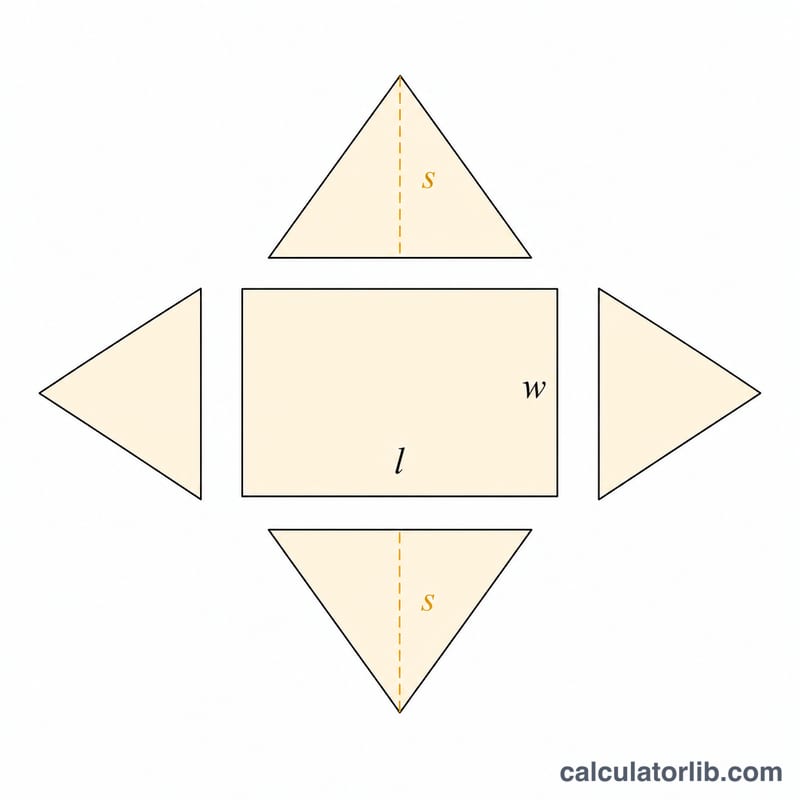
The base area is simply \(\text{Length} \times \text{Width}\). For surface area, the tool first finds two slant heights using the Pythagorean theorem:
- Slant height 1 \(= \sqrt{\text{Height}^{2} + \left(\tfrac{\text{Width}}{2}\right)^{2}}\)
- Slant height 2 \(= \sqrt{\text{Height}^{2} + \left(\tfrac{\text{Length}}{2}\right)^{2}}\)
It then adds the base area to the four triangular faces (two pairs):
$$\text{Surface Area} = (L \times W) + (L \times \text{slant1}) + (W \times \text{slant2})$$
Worked Example
Suppose Length = 6 m, Width = 4 m, Height = 9 m.
- $$V = (6 \times 4 \times 9) \div 3 = 216 \div 3 = \mathbf{72 \text{ m}^3}$$
- Base area \(= 6 \times 4 = \mathbf{24 \text{ m}^2}\)
- Slant1 \(= \sqrt{81 + 4} = \sqrt{85} \approx 9.22 \text{ m}\); Slant2 \(= \sqrt{81 + 9} = \sqrt{90} \approx 9.49 \text{ m}\)
- Surface area \(= 24 + (6 \times 9.22) + (4 \times 9.49) \approx 24 + 55.3 + 37.9 = \mathbf{117.2 \text{ m}^2}\)
Frequently Asked Questions
Do I use the height or the slant height? Enter the vertical height (apex straight down to the base centre). The calculator computes the slant heights internally for surface area.
Can I use other units? The fields are labelled in metres, but the maths works for any consistent unit — just treat volume as the cubed unit and area as the squared unit.
Why divide by 3? Any pyramid holds exactly one-third the volume of a prism with the same base and height, which is why the formula divides the product by 3.