
What this BMR Calculator does
Your Basal Metabolic Rate (BMR) is the number of calories your body burns at complete rest just to stay alive — powering your heart, brain, lungs and other organs. This calculator estimates your BMR in kilocalories per day (kcal/day) from four simple inputs and lets you choose between two well-known equations. The metric units (kg and cm) used here are standard internationally; the formulas themselves are widely applied worldwide.
The inputs you provide
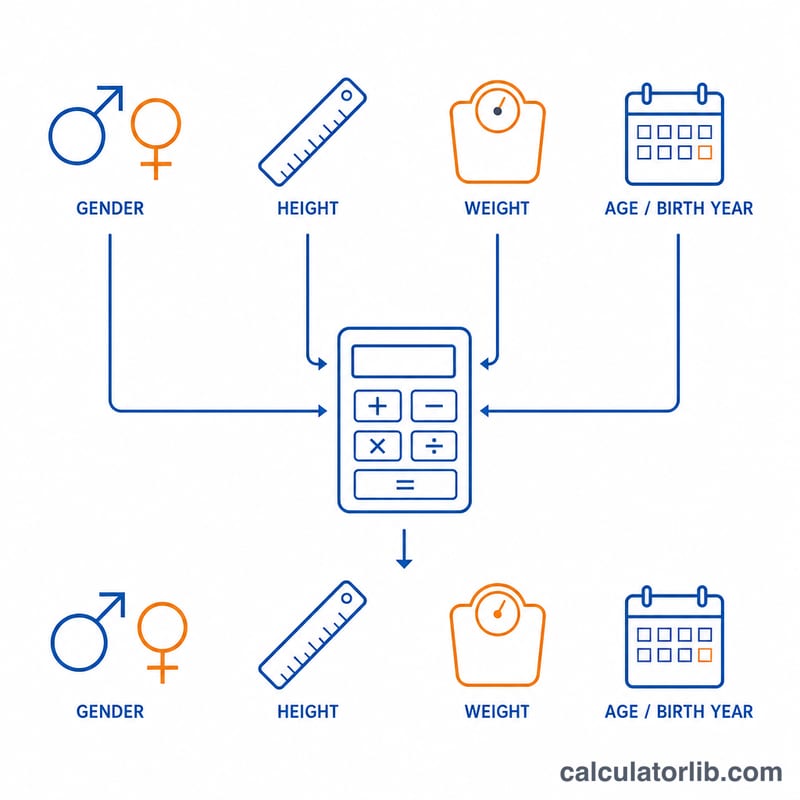
- Sex – male or female; men and women have different metabolic constants.
- Birth year – the tool converts this to your age by subtracting your birth year from the current calendar year.
- Height – in centimetres.
- Weight – in kilograms.
- Formula – Harris–Benedict (revised) or Mifflin–St Jeor.
The formulas explained
The Harris–Benedict equation is the default:
- Men: $$\text{BMR} = 88.362 + (13.397 \times \text{weight}) + (4.799 \times \text{height}) - (5.677 \times \text{age})$$
- Women: $$\text{BMR} = 447.593 + (9.247 \times \text{weight}) + (3.098 \times \text{height}) - (4.330 \times \text{age})$$
The Mifflin–St Jeor equation, often considered more accurate for modern populations:
- Men: $$\text{BMR} = (10 \times \text{weight}) + (6.25 \times \text{height}) - (5 \times \text{age}) + 5$$
- Women: $$\text{BMR} = (10 \times \text{weight}) + (6.25 \times \text{height}) - (5 \times \text{age}) - 161$$
In every formula, weight is in kg, height in cm and age in years. More muscle mass, greater height and younger age all push BMR higher.
Worked example
Take a man born in 1989 (age 36 in 2025), 180 cm tall and weighing 80 kg, using Harris–Benedict:
$$\text{BMR} = 88.362 + (13.397 \times 80) + (4.799 \times 180) - (5.677 \times 36)$$
$$= 88.362 + 1071.76 + 863.82 - 204.37$$
$$\approx \textbf{1{,}819 kcal/day}.$$
Using Mifflin–St Jeor for the same person: $$(10 \times 80) + (6.25 \times 180) - (5 \times 36) + 5 = 800 + 1125 - 180 + 5 = \textbf{1{,}750 kcal/day}.$$
Interpreting Your BMR Result
Basal Metabolic Rate (BMR) is the number of calories your body needs to keep its essential systems running while completely at rest — breathing, circulation, cell repair, brain function and maintaining body temperature. It does not include the energy spent digesting food (the thermic effect of food) or any physical activity.
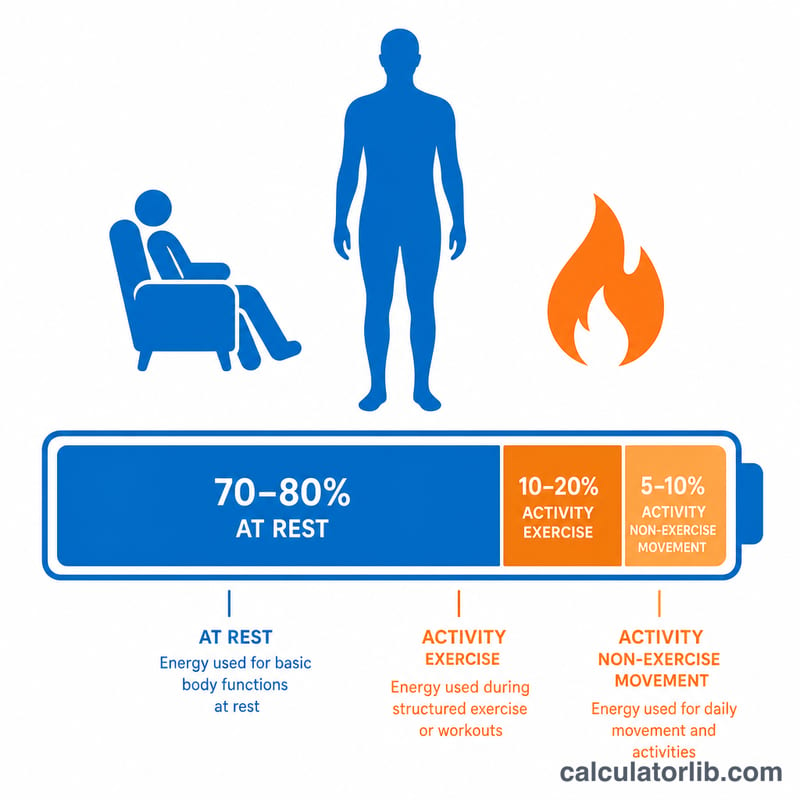
For most people, BMR represents roughly 60–70% of total daily energy expenditure. The remainder comes from the thermic effect of food (about 10%) and physical activity (which varies widely from person to person).
Key factors that influence BMR:
- Muscle mass: Muscle is more metabolically active than fat, so a higher proportion of lean tissue raises BMR. This is one reason two people of the same weight can have different rates.
- Age: BMR tends to decline with age, partly due to loss of muscle mass — reflected in the formulas by a downward adjustment for older ages.
- Sex: On average, men have higher BMR than women of the same height and weight, largely because of greater lean body mass.
- Body size: Greater height and weight increase BMR because there is more tissue to maintain.
Remember that these formulas (Harris–Benedict and Mifflin–St Jeor) provide statistical estimates. Individual variation from genetics, hormones, body composition and other factors means your true BMR may differ. This is general information and not medical or dietary advice.
Frequently asked questions
Is BMR the same as the calories I should eat? No. BMR is calories burned at rest. To estimate your total daily needs, multiply BMR by an activity factor (roughly 1.2 for sedentary up to 1.9 for very active) — that gives your maintenance calories.
Which formula should I pick? Mifflin–St Jeor is generally regarded as more accurate for the average healthy adult. Harris–Benedict is the long-established classic. Comparing both gives you a useful range.
Why does it ask for birth year instead of age? It automatically calculates your current age each year, so the result stays correct over time without you re-entering it.