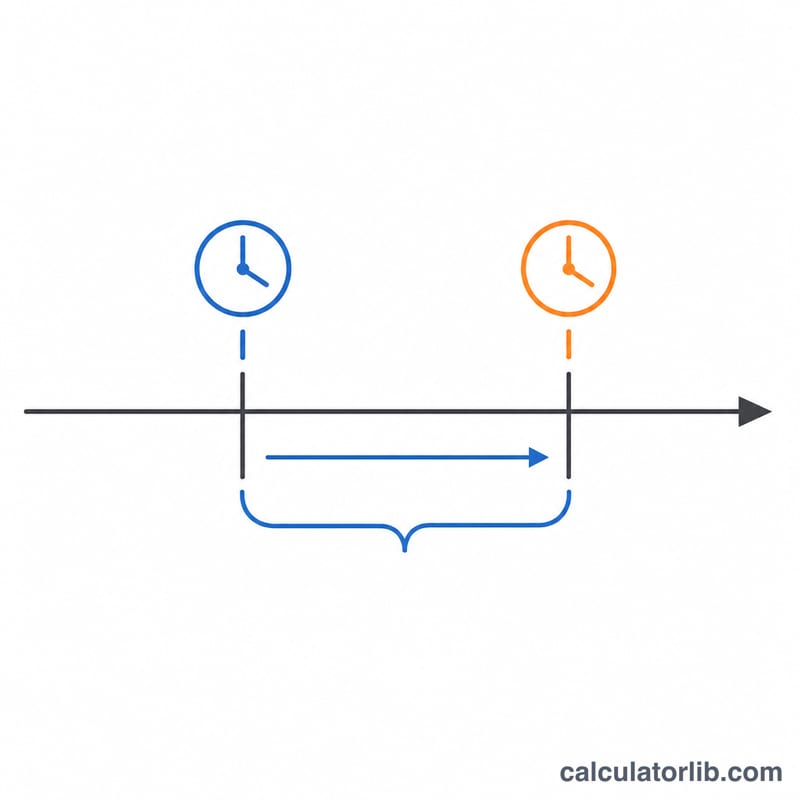
Use this Time Duration Calculator to quickly calculate the total duration between two times. Whether you want to add or subtract hours and minutes, or calculate a span in hours, minutes, seconds, this tool helps you accurately measure time intervals.
It's ideal for figuring out work hours, travel time, or any event duration. Simply enter the start and end times, and the calculator will display the duration between two times in an easy-to-understand format.
What This Calculator Can Do
- Calculate duration in hours and minutes
- Display results in hours, minutes, seconds for longer time periods
- Support both 12-hour and 24-hour time formats
- Works as a time and date duration calculator for more advanced needs
The duration between a start and end time is calculated as:
$$\text{Duration} = \begin{cases} \text{End Time} - \text{Start Time} & \text{if End} \geq \text{Start} \\[1em] \left(\text{End Time} - \text{Start Time}\right) + 24\text{h} & \text{if End} < \text{Start} \end{cases}$$How It Works
- Enter the start time: Use the correct format (e.g., 08:30 AM or 14:45).
- Enter the end time: Specify the ending point for the duration.
- Click "Calculate": The calculator will determine the total elapsed time.
- View the result: You'll get the total time in hours and minutes, or in hours, minutes, seconds if the duration spans across hours.
Example Use Cases
- Calculate work shift hours from 9:00 AM to 5:30 PM
- Determine flight duration between two time zones (if dates are supported)
- Track project or task duration using start and end timestamps
Frequently Asked Questions
1. Can I use this to add or subtract time manually?
Yes. You can enter a start and end time to add or subtract the difference. For manual time math, just set one value as the base and the other as the time you want to offset.
2. Does it work with 24-hour time format?
Absolutely. The calculator supports both 12-hour (AM/PM) and 24-hour formats. Just ensure you input times consistently.
3. Can it calculate across multiple hours?
Yes. If your start and end times span multiple hours, the calculator will return the result in hours, minutes, seconds, making it ideal for long-duration calculations.
Time Unit Conversion Table
Time durations can be expressed in several units. The relationships between them are fixed, which makes converting from one to another straightforward. The table below lists the most commonly used equivalents.
| Unit | Equivalent |
|---|---|
| 1 minute | 60 seconds |
| 1 hour | 60 minutes = 3,600 seconds |
| 1 day | 24 hours = 1,440 minutes = 86,400 seconds |
| 1 week | 7 days = 168 hours |
When working with payroll, scheduling, or spreadsheets, it is often useful to express minutes as a decimal fraction of an hour. To convert minutes to decimal hours, divide the minutes by 60:
$$\text{Decimal Hours} = \frac{\text{Minutes}}{60}$$
| Minutes | Decimal Hours |
|---|---|
| 5 min | 0.0833 h |
| 10 min | 0.1667 h |
| 15 min | 0.25 h |
| 20 min | 0.3333 h |
| 30 min | 0.5 h |
| 40 min | 0.6667 h |
| 45 min | 0.75 h |
| 50 min | 0.8333 h |
| 60 min | 1.0 h |
For example, a duration of 2 hours and 45 minutes equals \(2 + \frac{45}{60} = 2.75\) decimal hours.
More Worked Examples
The following examples show how to apply the duration formula, including the special case where the end time falls on the next calendar day.
Example 1 — A standard workday (End ≥ Start)
A shift runs from 9:00 AM to 5:30 PM. Because the end time is later in the same day, we simply subtract:
$$\text{Duration} = \text{17:30} - \text{09:00} = \text{8 h 30 m}$$
Working it out: from 09:00 to 17:00 is 8 hours, plus the extra 30 minutes gives 8 hours 30 minutes.
Example 2 — An overnight shift (End < Start, +24h branch)
A night shift begins at 10:30 PM (22:30) and ends at 6:15 AM (06:15) the next morning. Since the end time is numerically earlier than the start time, we add 24 hours before subtracting:
$$\text{Duration} = (\text{06:15} - \text{22:30}) + 24\text{h}$$
Converting to minutes: \(6\text{:}15\) is 375 minutes after midnight and \(22\text{:}30\) is 1350 minutes after midnight. So \((375 - 1350) + 1440 = 465\) minutes, which is 7 hours 45 minutes.
Example 3 — Seconds precision
A process starts at 08:15:20 and finishes at 08:47:05. Convert each time to seconds and subtract:
$$(8 \cdot 3600 + 47 \cdot 60 + 05) - (8 \cdot 3600 + 15 \cdot 60 + 20)$$
$$= 31625 - 29720 = 1905 \text{ seconds}$$
Since \(1905 = 31 \cdot 60 + 45\), the elapsed time is 31 minutes 45 seconds.
Key Terms Explained
- Start Time
- The earlier point in time that marks the beginning of the interval being measured — for example, a clock-in time or the moment an event begins.
- End Time
- The later point in time that marks the end of the interval — for example, a clock-out time or the moment an event concludes.
- Duration (Elapsed Time)
- The amount of time that passes between the start time and the end time. It is the result of subtracting the start time from the end time and is typically expressed in hours, minutes, and seconds, or as a decimal number of hours.
- 12-Hour Format
- A clock convention that divides the day into two 12-hour periods labeled AM (midnight to noon) and PM (noon to midnight). For example, 5:30 PM. Because the same numbers repeat twice a day, the AM/PM label is essential to avoid ambiguity.
- 24-Hour Format
- Also called military time, this convention numbers the hours from 00:00 (midnight) to 23:59, with no AM/PM label. For example, 5:30 PM becomes 17:30. This format makes arithmetic simpler because every time has a single unique value.
- Cross-Midnight Adjustment
- When the end time is numerically smaller than the start time, the interval spans midnight into the next calendar day. To calculate the correct duration, 24 hours (1,440 minutes) is added to the difference. For instance, an interval from 22:30 to 06:15 uses this adjustment to yield 7 hours 45 minutes rather than a negative value.