
What This Calculator Does
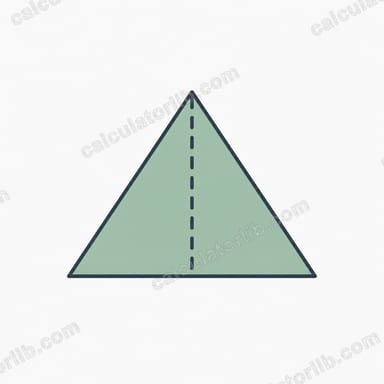
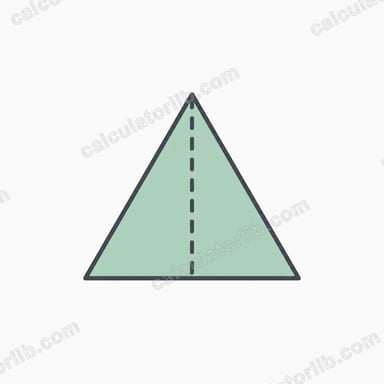
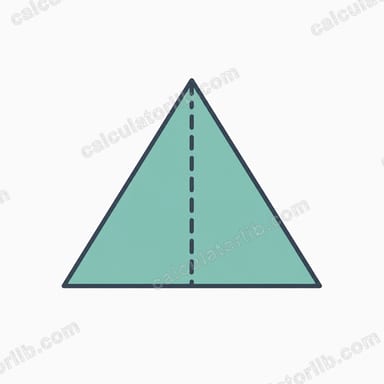
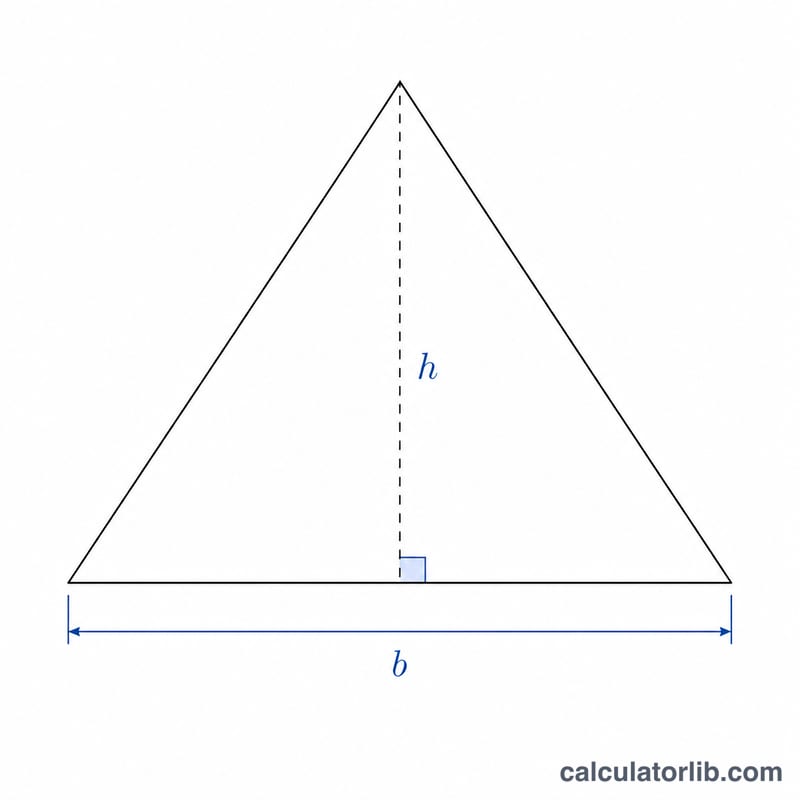
The Isosceles Triangle Area Calculator finds the area of an isosceles triangle from just two measurements: the base and the height. An isosceles triangle has two equal sides, so the perpendicular height drawn from the apex meets the base at its exact midpoint. This calculator uses that geometry to compute both the area and, as a bonus, the full perimeter — so you get a complete picture from two simple inputs.
The Inputs You Provide
- Base: the length of the bottom (unequal) side of the triangle.
- Height: the perpendicular distance from the base up to the apex (the top vertex).
Use the same unit for both — centimetres, metres, inches, etc. The area will be in those units squared.
The Formula
The area uses the standard triangle formula:
$$A = \frac{1}{2} \times b \times h$$
Behind the scenes the tool also calculates the perimeter. Because the height splits the base into two equal halves of \(b/2\), each of the two equal sides is found with the Pythagorean theorem:
$$P = b + 2 \times \sqrt{h^2 + \left(\frac{b}{2}\right)^2}$$
Worked Example
Suppose your isosceles triangle has a base of 10 and a height of 12.
- Area $$= \frac{1}{2} \times 10 \times 12 = \textbf{60 square units}$$
- Each equal side $$= \sqrt{12^2 + 5^2} = \sqrt{144 + 25} = \sqrt{169} = 13$$
- Perimeter $$= 10 + 2 \times 13 = \textbf{36 units}$$
So with two quick measurements you instantly know both the area (60) and the perimeter (36).
Frequently Asked Questions
Does this work for any triangle, or only isosceles? The area formula \(A = \frac{1}{2}bh\) works for any triangle. However, the perimeter result is only correct for an isosceles triangle, since it assumes the height bisects the base into two equal halves.
What is "height" exactly? It is the perpendicular distance from the base to the opposite vertex — not the length of a slanted side. If you only know the slant side, use the Pythagorean theorem to find the height first.
What units does the answer use? Whatever unit you enter for base and height. If both are in centimetres, the area is in square centimetres and the perimeter is in centimetres.