What the Circle Area Calculator Does
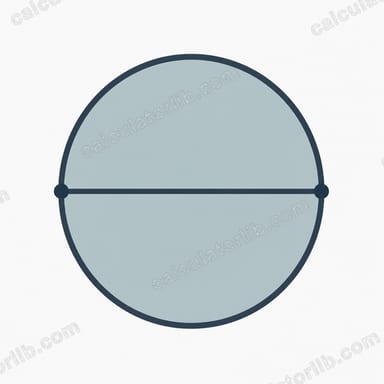
This Circle Area Calculator finds the area enclosed by a circle from a single measurement: the radius. The radius is the distance from the centre of the circle to its edge. Enter that value and the calculator instantly returns the area, and as a useful bonus it also works out the circumference and the diameter from the same input.
How to Use It
- Radius: Type the radius of your circle in whatever unit you are working in (cm, m, inches, etc.).
- The result is returned in those same units squared — for example, a radius in metres gives an area in square metres.
- If no value is entered, the tool defaults the radius to 3.
The Formula Explained
The area of a circle is calculated with the classic geometry formula:
A = π r²
Here r is the radius and π (pi) is approximately 3.14159. The calculator multiplies pi by the radius squared (radius × radius). Behind the scenes it also derives:
- Circumference: C = 2 π r — the distance around the circle.
- Diameter: D = 2 r — the full width across the centre.

Worked Example
Suppose you enter a radius of 5:
- Area = π × 5 × 5 = π × 25 ≈ 78.54 square units.
- Circumference = 2 × π × 5 ≈ 31.42 units.
- Diameter = 2 × 5 = 10 units.
So a circle with a 5 cm radius has an area of about 78.54 cm², a circumference of roughly 31.42 cm, and a diameter of 10 cm.

Square Unit Conversions for Circle Area
The circle area formula \(A = \pi r^{2}\) gives a result in the square of whatever unit the radius uses. A radius in centimetres gives cm², a radius in inches gives in², and so on. Use the table below to convert the result to another area unit. The inch-based factors are exact because 1 in = 2.54 cm by definition.
| 1 unit of area | Equals |
|---|---|
| 1 cm² | 100 mm² = 0.0001 m² ≈ 0.155000 in² |
| 1 mm² | 0.01 cm² = 0.000001 m² ≈ 0.00155 in² |
| 1 m² | 10,000 cm² = 1,000,000 mm² ≈ 1,550.0031 in² ≈ 10.7639 ft² ≈ 1.19599 yd² |
| 1 in² | 6.4516 cm² = 645.16 mm² = 0.00064516 m² |
| 1 ft² | 144 in² = 929.0304 cm² = 0.09290304 m² |
| 1 yd² | 9 ft² = 1,296 in² = 8,361.2736 cm² = 0.83612736 m² |
Warning: square the linear factor
Area conversion factors are the square of the linear factors. Since 1 m = 100 cm, 1 m² = 100² = 10,000 cm², not 100 cm². Likewise 1 in = 2.54 cm gives 1 in² = 2.54² = 6.4516 cm², and 1 ft = 12 in gives 1 ft² = 12² = 144 in². Applying the linear factor to an area is a common error and understates or overstates the result by a large margin.
Worked example
A circle has a radius of 5 cm.
$$A = \pi \times 5^{2} = 25\pi \approx 78.54\ \text{cm}^2$$
- In m²: \(78.54 \div 10{,}000 = 0.007854\ \text{m}^2\)
- In mm²: \(78.54 \times 100 = 7{,}854\ \text{mm}^2\)
- In in²: \(78.54 \div 6.4516 \approx 12.17\ \text{in}^2\)
Tip: it is usually more accurate to convert the radius to your target unit first and then apply \(\pi r^{2}\), or to convert the final area using the squared factors above. Do not mix the two methods.
Conventions and edge cases
Each case below was run through this calculator; the result column is what it actually returns.
| Case | Input | Result |
|---|---|---|
| Decimal value (2.5) | 2.5 | Circle Area: 19.635 |
| Negative length | -5 | A length cannot be negative. Enter 0 or a positive number. |
| Typical value (10) | 10 | Circle Area: 314.159 |
| Zero: a degenerate circle | 0 | Circle Area: 0 |
Checked on 2026-11-08
Frequently Asked Questions
What if I only know the diameter? Divide the diameter by 2 to get the radius, then enter that. For example, a 10 cm diameter means a 5 cm radius.
Why is the area squared? Area measures a two-dimensional surface, so the unit is always squared — square centimetres, square metres, and so on. The radius is multiplied by itself, which is why the unit gains its second dimension.
How accurate is the result? The calculator uses the full precision value of pi (Math.PI), so the answer is accurate to many decimal places. Any rounding you see is only for display.