Rectangle Area Calculator
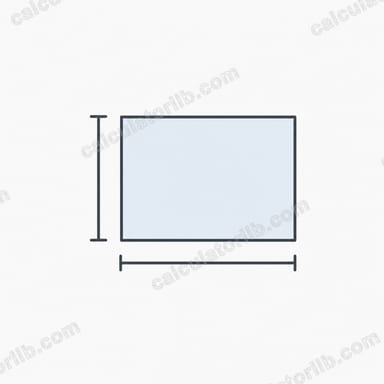
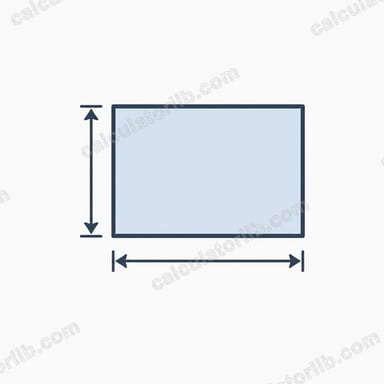
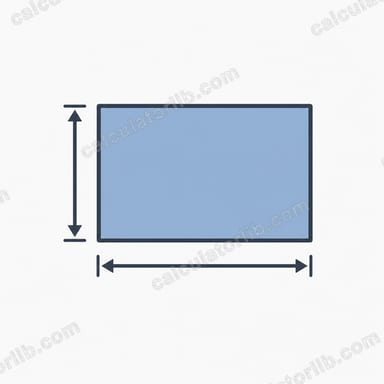
A rectangle area calculator is a tool that computes the area and perimeter of a rectangle based on its length and width. This simple geometric calculator helps in various applications where rectangular measurements are needed.
When to Use a Rectangle Area Calculator
This calculator is useful in several scenarios:
- Home improvement projects to calculate flooring, painting, or wallpaper requirements
- Construction and architectural planning to determine material quantities
- Educational purposes to understand basic geometric concepts
How to Calculate
The calculations for a rectangle are based on two primary formulas:
Area of a Rectangle:
$$\text{Area} = \text{Length} \times \text{Width}$$Perimeter of a Rectangle:
$$\text{Perimeter} = 2 \times \left( \text{Length} + \text{Width} \right)$$When using this calculator, you'll need to input:
- Length of the rectangle
- Width of the rectangle
Examples
Example 1: Small Room Flooring
Calculate the area and perimeter of a rectangular room measuring 12 feet in length and 10 feet in width.
$$\text{Area} = 12 \times 10 = 120 \text{ square feet}$$ $$\text{Perimeter} = 2 \times \left( 12 + 10 \right) = 44 \text{ feet}$$| Measurement | Value |
|---|---|
| Length | 12 feet |
| Width | 10 feet |
| Area | 120 square feet |
| Perimeter | 44 feet |
Example 2: Garden Plot
Find the area and perimeter of a rectangular garden plot with a length of 5.5 meters and a width of 3.2 meters.
$$\text{Area} = 5.5 \times 3.2 = 17.6 \text{ square meters}$$ $$\text{Perimeter} = 2 \times \left( 5.5 + 3.2 \right) = 17.4 \text{ meters}$$| Measurement | Value |
|---|---|
| Length | 5.5 meters |
| Width | 3.2 meters |
| Area | 17.6 square meters |
| Perimeter | 17.4 meters |
Example 3: Poster Design
Calculate the area and perimeter of a rectangular poster with dimensions of 24 inches in length and 36 inches in width.
$$\text{Area} = 36 \times 24 = 864 \text{ square inches}$$ $$\text{Perimeter} = 2 \times \left( 36 + 24 \right) = 120 \text{ inches}$$| Measurement | Value |
|---|---|
| Length | 36 inches |
| Width | 24 inches |
| Area | 864 square inches |
| Perimeter | 120 inches |

Area and Length Unit Conversions
A rectangle's area is only meaningful once both dimensions are expressed in the same unit. Measuring a room as 12 ft by 90 in and multiplying directly gives a number that means nothing — convert the 90 in to 7.5 ft first, then multiply.
Length conversions
| Unit | Equivalent |
|---|---|
| 1 foot (ft) | 12 inches (in) = 0.3048 metres (m) |
| 1 yard (yd) | 3 ft = 36 in = 0.9144 m |
| 1 inch (in) | 2.54 centimetres (cm) = 25.4 millimetres (mm) |
| 1 metre (m) | 100 cm = 1,000 mm ≈ 3.28084 ft |
Area conversions
| Unit | Equivalent |
|---|---|
| 1 square foot (sq ft) | 144 sq in = 0.092903 sq m |
| 1 square yard (sq yd) | 9 sq ft = 1,296 sq in = 0.836127 sq m |
| 1 square metre (sq m) | 10,000 sq cm ≈ 10.7639 sq ft |
| 1 acre | 43,560 sq ft = 4,840 sq yd ≈ 4,046.86 sq m |
| 1 hectare (ha) | 10,000 sq m ≈ 2.47105 acres |
Why area factors are the square of length factors
Every area factor above is simply its length factor multiplied by itself. Because area scales with two dimensions, converting an area means applying the length conversion twice:
$$1\ \text{sq ft} = (1\ \text{ft})^2 = (12\ \text{in})^2 = 144\ \text{sq in}$$
$$1\ \text{sq ft} = (0.3048\ \text{m})^2 = 0.09290304\ \text{sq m}$$
$$1\ \text{sq yd} = (3\ \text{ft})^2 = 9\ \text{sq ft}, \qquad 1\ \text{sq m} = (100\ \text{cm})^2 = 10{,}000\ \text{sq cm}$$
This is a common source of error: 1 m is about 3.28 ft, so people assume 1 sq m is about 3.28 sq ft. It is actually \(3.28084^2 \approx 10.7639\) sq ft — more than three times larger than the mistaken figure.
Worked conversion
A room measured as 14 ft 6 in by 11 ft 3 in becomes 14.5 ft by 11.25 ft (dividing the inches by 12). The area is then
$$\text{Area} = 14.5\ \text{ft} \times 11.25\ \text{ft} = 163.125\ \text{sq ft}$$
which is 163.125 sq ft, or \(163.125 \times 0.092903 \approx 15.15\) sq m, or \(163.125 \div 9 \approx 18.13\) sq yd. The perimeter of the same room is \(2 \times (14.5 + 11.25) = 51.5\) ft.
Note that the acre and the customary foot/yard units are used mainly in the United States and, in some everyday contexts, the United Kingdom; most countries specify flooring, land and building areas in square metres or hectares. Product coverage figures on packaging follow the local convention, so check which unit the label uses before dividing.