
What the Quadrilateral Area Calculator Does
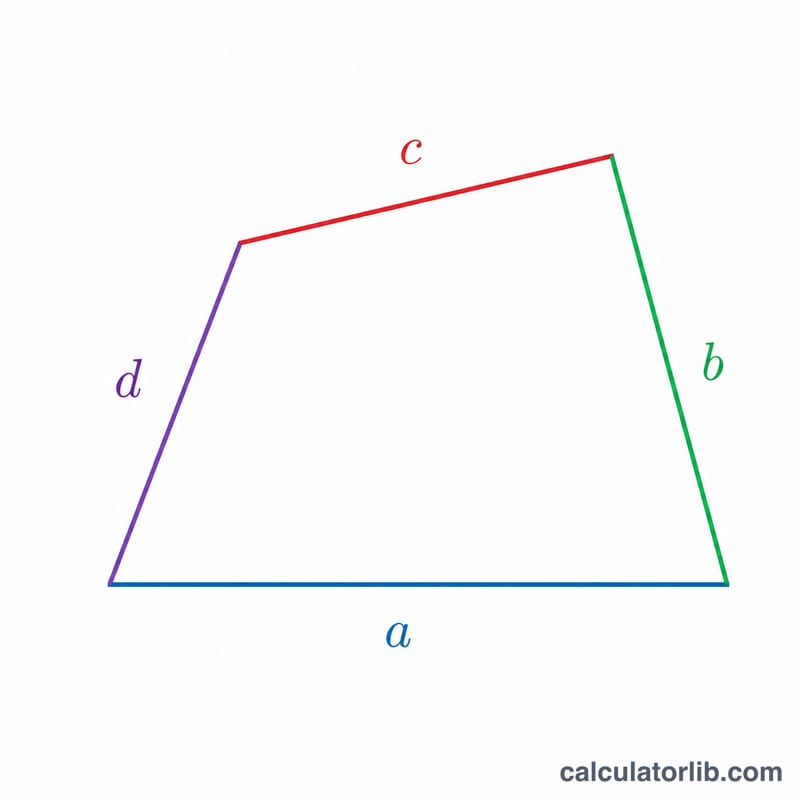
This calculator estimates the area of a four-sided shape (a quadrilateral) using only its four side lengths. You enter the four sides and it returns the area in square units. It is a quick tool for students, builders, surveyors and DIY planners who know the perimeter measurements of a plot, panel or polygon but not its diagonals or angles.
The Inputs You Provide
- Side 1 (units): the length of the first edge.
- Side 2 (units): the length of the second edge.
- Side 3 (units): the length of the third edge.
- Side 4 (units): the length of the fourth edge.
Use any single unit (metres, feet, cm) consistently across all four boxes — the result comes back in that unit squared.
The Formula It Uses
The tool applies a Brahmagupta-style formula based on the four sides and the semi-perimeter:
$$A = \sqrt{(s - a)(s - b)(s - c)(s - d)}$$ where \(s = \dfrac{a + b + c + d}{2}\).
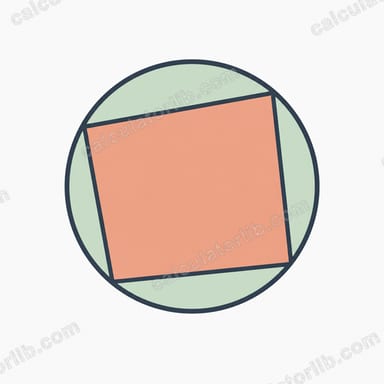
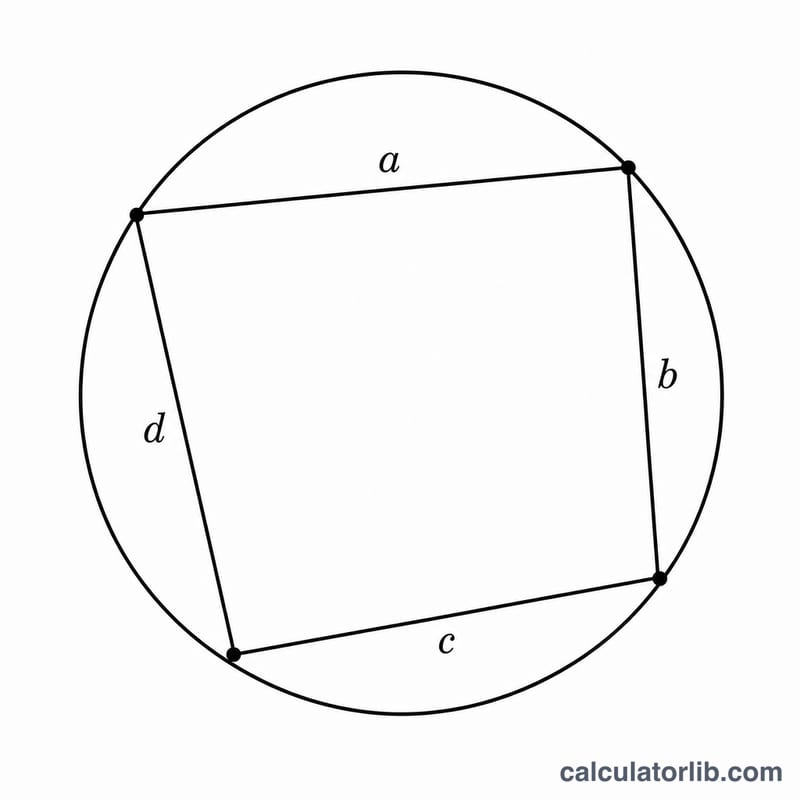
This is the area of a cyclic quadrilateral — one whose corners all lie on a single circle, which gives the maximum possible area for a given set of four sides. Because side lengths alone do not fix a quadrilateral's shape (it can flex like a hinge), the calculator returns this maximum-area case as a clear, single answer.
Worked Example
Suppose a four-sided plot has sides of 5, 6, 7 and 8 units.
- Semi-perimeter: \(s = \dfrac{5 + 6 + 7 + 8}{2} = 13\)
- \((s - a) = 8\), \((s - b) = 7\), \((s - c) = 6\), \((s - d) = 5\)
- Product \(= 8 \times 7 \times 6 \times 5 = 1680\)
- $$A = \sqrt{1680} \approx \textbf{40.99 square units}$$
Frequently Asked Questions
Is this exact for any quadrilateral? No. Four sides do not uniquely define a quadrilateral. The formula gives the area assuming a cyclic shape (the maximum), so it is exact only when the quadrilateral can be inscribed in a circle.
Why did I get an error or zero? If any side is longer than the sum of the other three, no valid quadrilateral exists and the term under the square root becomes negative, producing an invalid result.
Does it work for a square or rectangle? Yes — a square with side 4 gives \(s = 8\) and \(A = \sqrt{4 \times 4 \times 4 \times 4} = 16\), matching the expected area.