
What the Torus Area Calculator Does
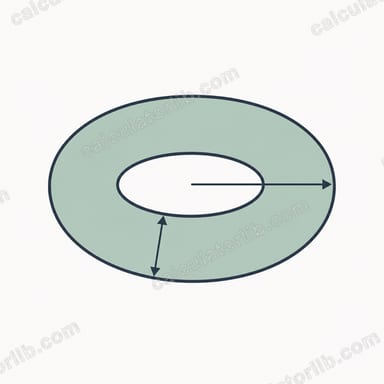
A torus is the doughnut-shaped surface formed when a circle is rotated around an axis that lies in the same plane but does not touch it. This calculator computes the total surface area of a torus — plus several related geometric measurements — from just two inputs. It works with any consistent unit (centimetres, metres, inches), so your answer comes back in those units squared.
The Two Inputs You Provide
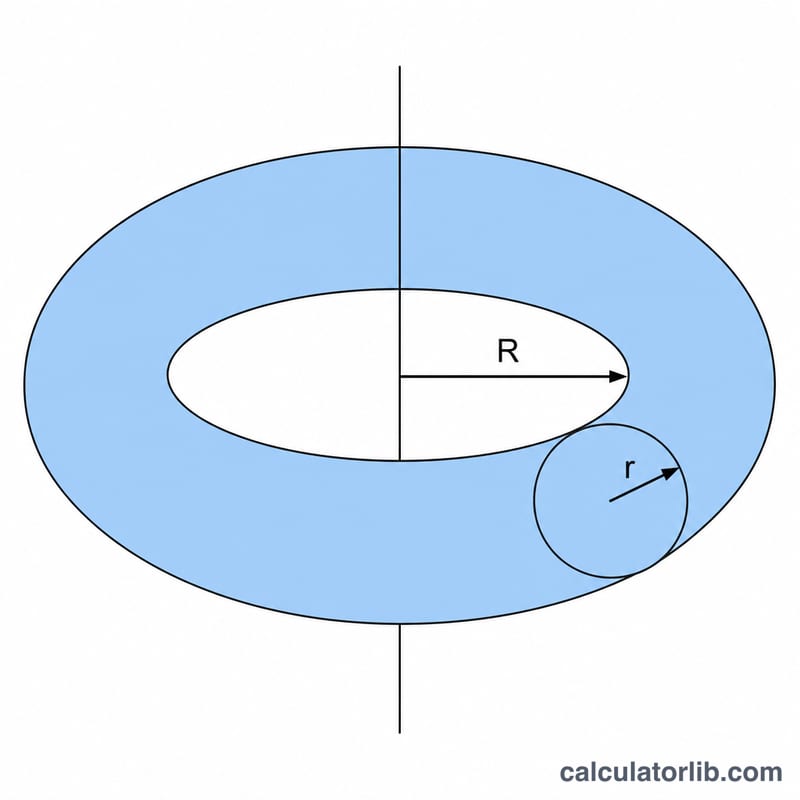
- Major Radius (R): the distance from the centre of the torus (the central hole) to the centre of the tube.
- Minor Radius (r): the radius of the tube itself — how thick the ring is.
For a valid torus, R should be larger than r. If r equals R the inner hole closes up, and if r exceeds R the surface self-intersects.
The Formula Explained
The total surface area uses the formula:
A = 4π²Rr
This comes from Pappus's theorem: the surface area of a shape generated by rotating a curve equals the curve's length (the tube circumference, 2πr) multiplied by the distance its centroid travels (2πR). Multiplying those gives 4π²Rr.
The calculator also reports useful extras derived from R and r:
- Inner circumference: 2π(R−r)
- Outer circumference: 2π(R+r)
- Cross-sectional area of the tube: πr²
- Centre-line length: 2πR
- Inner and outer surface area: 2π²(R−r)r and 2π²(R+r)r
Worked Example
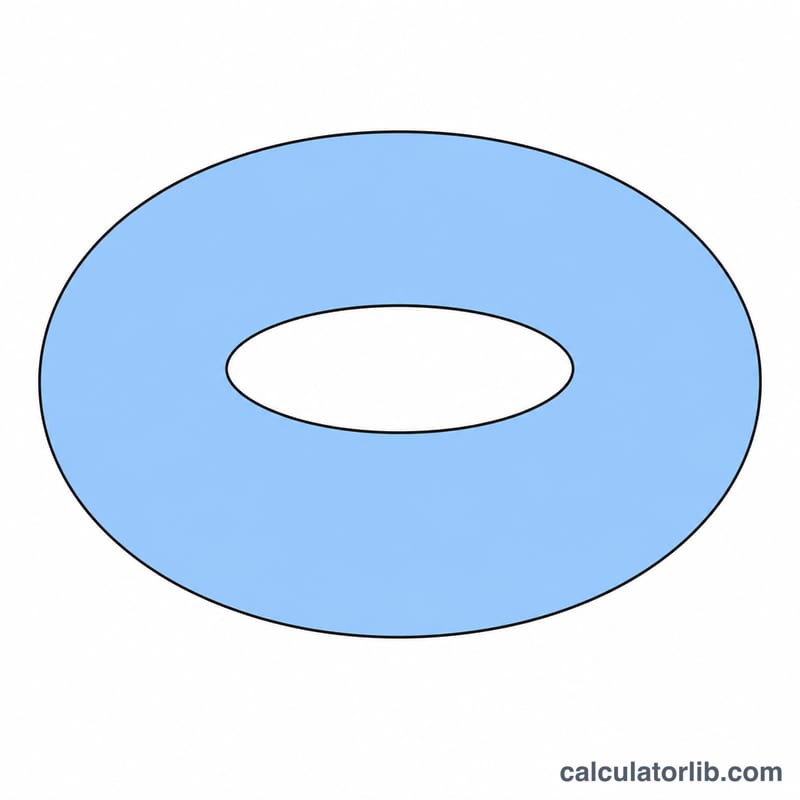
Suppose a doughnut-shaped ring has a major radius R = 10 cm and a minor radius r = 3 cm.
- Surface area: A = 4 × π² × 10 × 3 = 1184.35 cm²
- Inner circumference: 2π(10−3) = 43.98 cm
- Outer circumference: 2π(10+3) = 81.68 cm
- Cross-sectional area: π × 3² = 28.27 cm²
- Centre-line length: 2π × 10 = 62.83 cm
Frequently Asked Questions
What units does the result use? Whatever unit you enter R and r in, the surface area is returned in that unit squared, and the circumferences and centre-line length in that unit.
Does this give volume too? No — this tool focuses on surface area and related lengths. Torus volume uses a different formula, V = 2π²Rr².
Why must R be greater than r? When R > r the tube clears the central axis and forms a true ring (a "ring torus"). If R ≤ r the surface overlaps itself and the standard area formula no longer describes a simple doughnut shape.