What the Doubling Time Calculator Does
This calculator tells you how many periods it takes for a value growing at a fixed percentage rate to become twice its starting size. It is not country-specific — the math applies to any currency, population, subscriber count, or bacterial culture. The only thing that matters is that the growth rate is constant and compounds once per period.
You enter two things:
- Initial Amount — the starting value. It does not change the doubling time, but it drives the growth table and the target value the calculator shows you.
- Growth Rate (% per period) — the compound growth per period. A "period" is whatever unit you choose: years, months, quarters or days. The answer comes back in that same unit.
The Formula
The calculator solves the compound growth equation \(2 = \left(1 + \frac{r}{100}\right)^t\) for \(t\), which gives:
$$t = \frac{\ln 2}{\ln\left(1 + \frac{r}{100}\right)}$$
Here \(r\) is the growth rate in percent and \(t\) is the number of periods. Notice the initial amount is absent — doubling time depends only on the rate. The calculator also builds a period-by-period table using \(A_i = A_0 \times \left(1 + \frac{r}{100}\right)^i\), running up to the next whole period above the answer, plus the target value \(A_0 \times 2\).
Worked Example
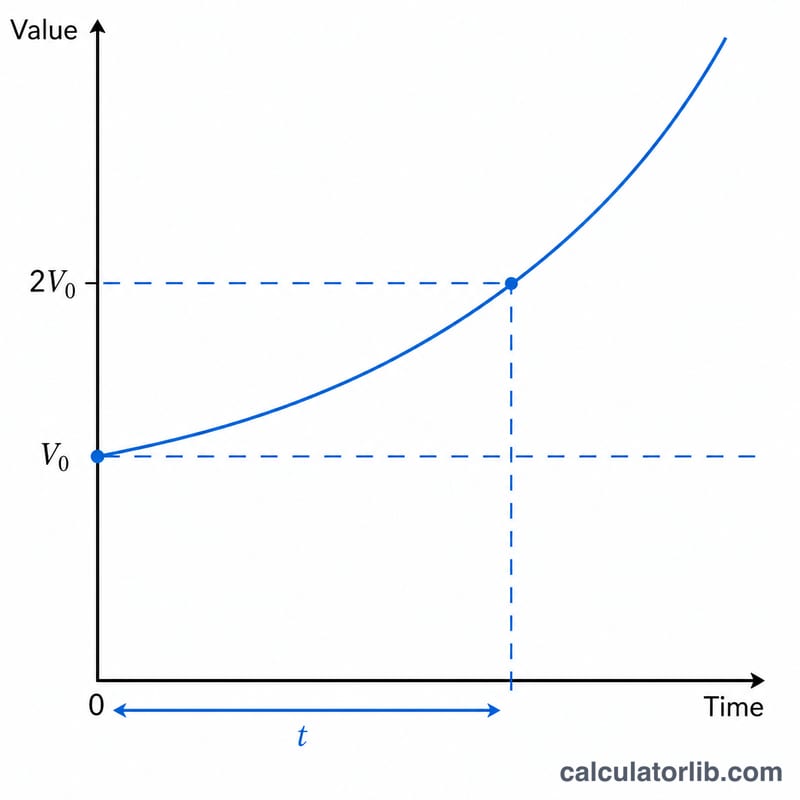
Suppose you invest an initial amount of 10,000 at 7% per year.
$$t = \frac{\ln 2}{\ln(1 + 0.07)} = \frac{0.6931}{0.06766} \approx 10.24 \text{ years}$$
So 10,000 becomes 20,000 in a little over 10 years. Checking with the growth table: after 10 years the balance is \(10{,}000 \times 1.07^{10} \approx 19{,}672\), and after 11 years \(\approx 21{,}049\) — the crossing point sits between them, exactly as predicted.
Key Terms
- Doubling time
- The length of time a quantity growing at a constant rate takes to become twice its starting value. It does not depend on how large the starting value is.
- Compound growth
- Growth in which each period's increase is calculated on the current total, including earlier growth, not just on the original amount. After \(t\) periods the value is \(\text{initial} \times (1 + r)^t\), where \(r\) is the rate as a decimal.
- Growth rate per period
- The percentage by which the value increases in each period, for example 7% per year. The calculator's rate field takes this percentage, so enter 7 for 7%.
- Period
- The unit of time over which the rate applies, such as a day, month, or year. The doubling time is returned in this same unit.
- Initial amount
- The starting value of the quantity, such as a balance, population, or user count. With a constant rate it does not change the doubling time, because doubling is a ratio.
- Natural logarithm (ln)
- The logarithm to base \(e \approx 2.71828\). It turns the exponent in \((1 + r)^t = 2\) into a multiplier we can solve for. \(\ln 2 \approx 0.6931\).
- Rule of 72 / Rule of 70
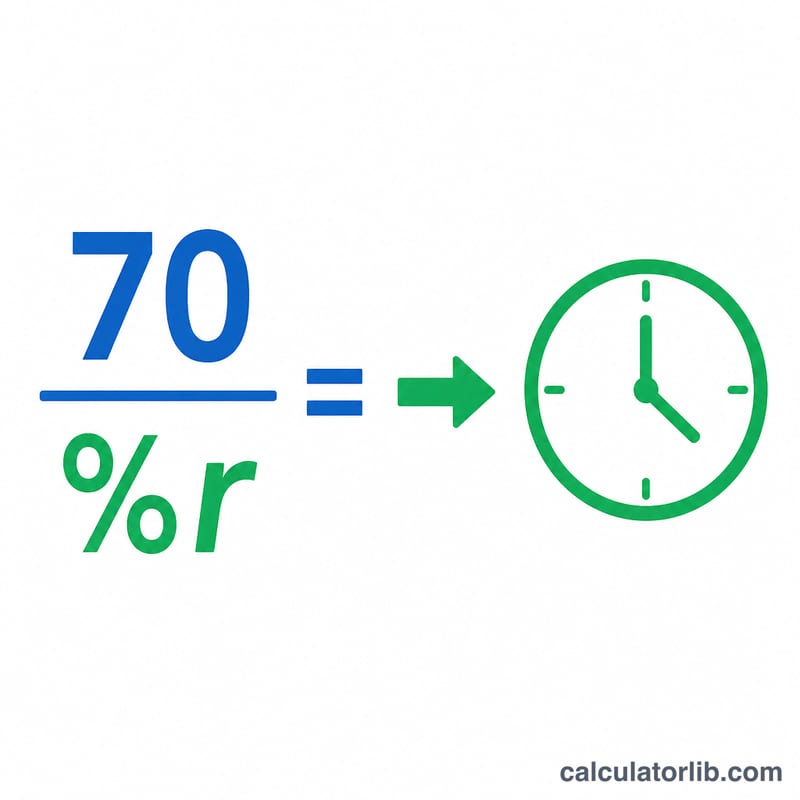
- Mental shortcuts: doubling time \(\approx 72 \div\) rate (in %), or \(70 \div\) rate. The number 72 works well for rates around 6% to 10%, and 70 is closer for low rates or continuous growth. The exact value of the numerator is about 69.3 for continuous compounding. These are estimates, and the logarithm formula is exact.
- Half-life
- The decay counterpart of doubling time: the time for a quantity that shrinks at a constant rate to fall to half its value. For a per-period decay rate \(d\) (as a decimal), it is \(\ln 2 \div (-\ln(1 - d))\).
How to Calculate Doubling Time by Hand
The doubling time \(t\) solves \((1 + r)^t = 2\), which gives:
$$t = \frac{ \ln 2 }{ \ln\left(1 + \frac{ \text{rate} }{100}\right) }$$
- Convert the rate and add 1. Divide the percentage by 100 and add 1. For a 7% rate: \(1 + 7/100 = 1.07\).
- Take the natural logarithm. \(\ln(1.07) \approx 0.067659\).
- Divide ln(2) by it. \(t = 0.6931 \div 0.067659 \approx 10.24\).
- Read the result in the rate's period unit. The rate was 7% per year, so the doubling time is about 10.24 years. A monthly rate would give months.
- Check the answer. Raise the growth factor to the result: \(1.07^{10.24} \approx 2.00\). If it comes out near 2, the calculation is right.
Worked example: at 7% growth per period, doubling time = \(\dfrac{0.6931}{0.067659}\) = 10.24 periods. The Rule of 72 estimate is \(72 \div 7 \approx 10.29\), which is close.
If the value only compounds at the end of each whole period, round the result up. In the example, the value first reaches double at the end of period 11, because \(1.07^{10} \approx 1.967\) is still below 2 and \(1.07^{11} \approx 2.105\) is above it.
FAQ
How does this compare to the "Rule of 72"? The rule of 72 estimates \(72 \div 7 \approx 10.3\) years, very close to the exact 10.24. The rule drifts at high rates: at 20%, it says 3.6 years while the exact answer is 3.80.
Can I use a monthly rate? Yes. Enter 1.5 for 1.5% per month and the result, about 46.6, is in months. Never mix a yearly rate with a monthly interpretation.
What if the rate is 0 or negative? At 0% the denominator is zero and the value never doubles. A negative rate makes \(\ln(1 + r/100)\) negative, so the result is negative and meaningless — for shrinking values you want half-life instead.