

What the ROI Calculator Does
Return on Investment (ROI) is a universal measure of how profitable an investment has been relative to its cost. This calculator takes three simple inputs and returns two useful figures: your total ROI over the entire holding period and your annualized ROI, which lets you compare investments held for different lengths of time on an equal footing. The math is currency-neutral, so you can enter values in any currency — the fields are labelled in dollars purely as a default.
The Inputs You Provide
- Investment Amount ($) — the money you originally put in (your cost basis).
- Amount Returned ($) — the total value you received back, including your original capital plus any gain.
- Time Period (years) — how long you held the investment, used to annualize the return.
The Formulas Explained
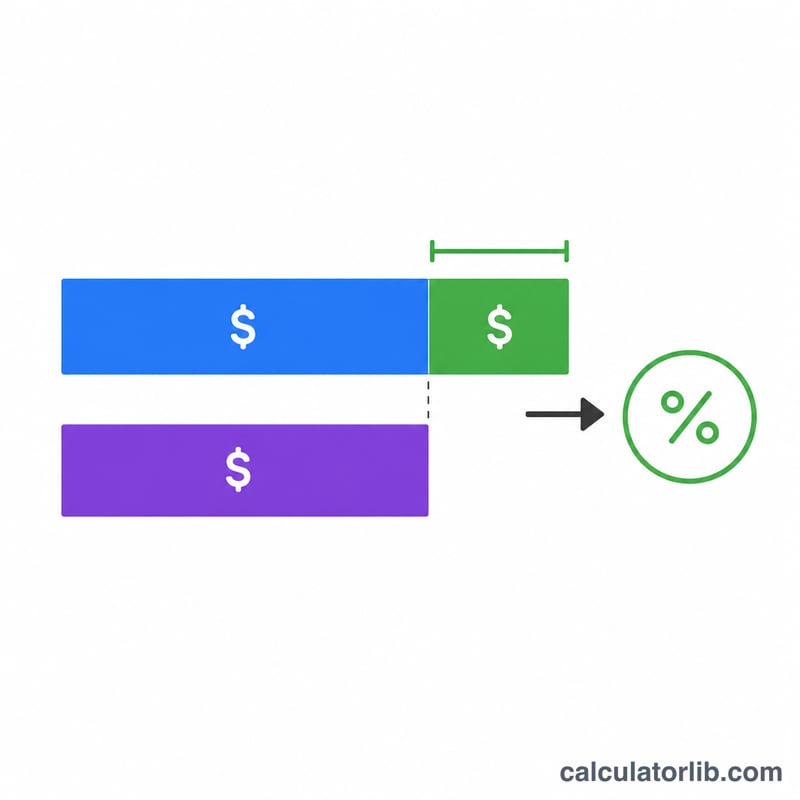
Total ROI uses the headline formula:
$$\text{ROI} = \frac{\text{Amount Returned} - \text{Investment}}{\text{Investment}} \times 100\%$$
To make different holding periods comparable, the tool also computes an annualized (compound) rate:
$$\text{Annualized ROI} = \left[\left(\frac{\text{Amount Returned}}{\text{Investment}}\right)^{\frac{1}{\text{Years}}} - 1\right] \times 100\%$$
This applies the geometric mean, so a doubling over two years isn't simply halved — it reflects compound growth.
Worked Example
Suppose you invest $10,000, and after 3 years it is worth $15,000.
- Total return: \(\$15{,}000 - \$10{,}000 = \$5{,}000\)
- Total ROI: \((5{,}000 \div 10{,}000) \times 100 = \) 50%
- Annualized ROI: \(((15{,}000 \div 10{,}000)^{1/3} - 1) \times 100 = (1.5^{0.333} - 1) \times 100 \approx\) 14.47% per year
So while your money grew 50% in total, it earned roughly 14.5% each year on a compounded basis.
Frequently Asked Questions
Why is the annualized ROI lower than the total ROI? Because the annualized figure spreads the gain across each year using compounding. A 50% total return over three years equals about 14.5% per year, since each year's growth builds on the previous year's.
What if my investment lost money? Enter an Amount Returned lower than your Investment. Both the total and annualized ROI will be negative, showing the size of the loss.
Should the Amount Returned include my original capital? Yes. Enter the full ending value (principal plus profit). The calculator subtracts your original investment internally to find the net gain.