
What Is the Stock Average Calculator?
The Stock Average Calculator works out the true average price you have paid for a stock when you buy the same company's shares at two different prices. This is often called "averaging down" (when the second purchase is cheaper) or "averaging up" (when it's more expensive). Instead of guessing your blended cost, the calculator gives you an exact figure based on how many shares you bought at each price. It works with any currency, so it's useful for investors anywhere — just enter your own price and quantity values.
The Inputs You Provide
- Stock Price 1 — the price per share of your first purchase.
- Quantity 1 — the number of shares bought in that first purchase.
- Stock Price 2 — the price per share of your second purchase.
- Quantity 2 — the number of shares bought in that second purchase.
Quantities are treated as whole numbers of shares, while prices can include decimals.
The Formula Explained
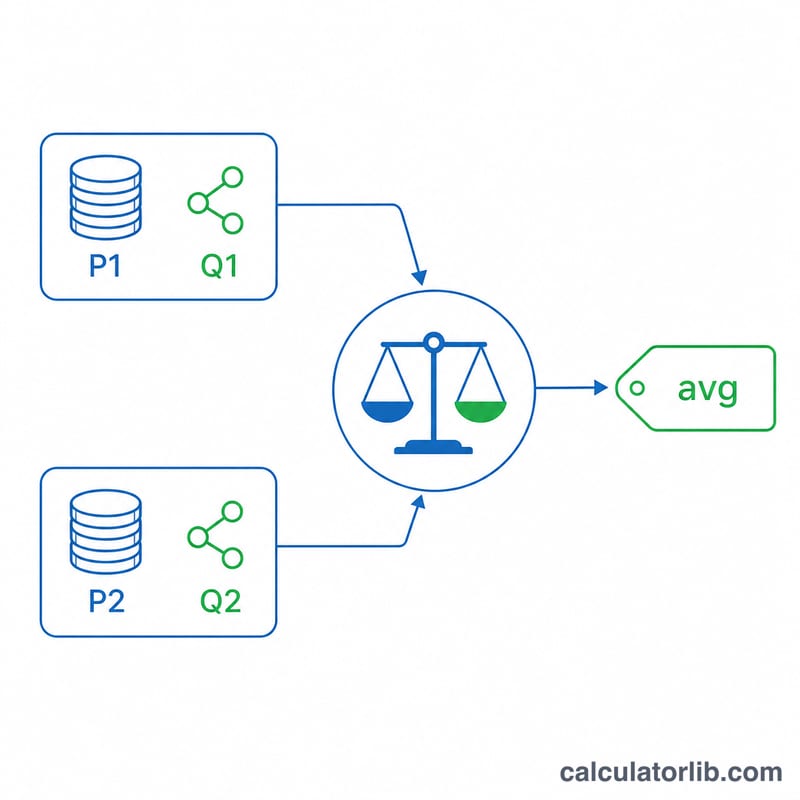
The calculator uses a weighted average — not a simple average of the two prices — because the number of shares at each price affects your real cost:
$$\text{Average Price} = \frac{\text{Price 1} \times \text{Qty 1} + \text{Price 2} \times \text{Qty 2}}{\text{Qty 1} + \text{Qty 2}}$$
Behind the scenes it calculates your total cost (the money spent on both lots combined) and your total quantity (all shares held), then divides total cost by total quantity. The result is your average cost per share.
Worked Example
Suppose you first buy 10 shares at a price of 100, then buy 20 more shares when the price drops to 70.
- First lot cost: \(100 \times 10 = 1{,}000\)
- Second lot cost: \(70 \times 20 = 1{,}400\)
- Total cost: \(1{,}000 + 1{,}400 = 2{,}400\)
- Total shares: \(10 + 20 = 30\)
- Average price: \(2{,}400 \div 30 = \) 80
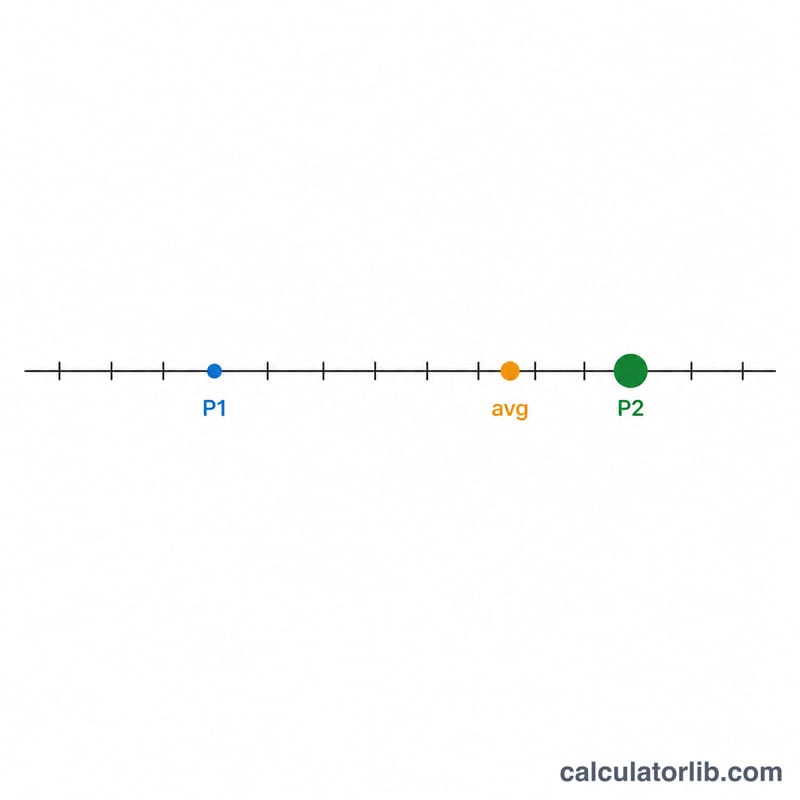
So your average buying price is 80 per share — lower than your first price of 100, because the bigger, cheaper purchase pulled your average down.
Frequently Asked Questions
Why not just average the two prices? A plain average of 100 and 70 would give 85, but that ignores that you bought twice as many shares at 70. The weighted average of 80 reflects your real money outlay.
Does this include broker fees or taxes? No. The calculator uses only your share prices and quantities. If you want your true break-even cost, add any commissions or charges to your purchase amounts before entering them.
Can I use it for averaging up? Yes. Whether your second purchase is higher or lower than the first, the formula returns the correct blended cost per share.