

What the Stock Investment Calculator Does
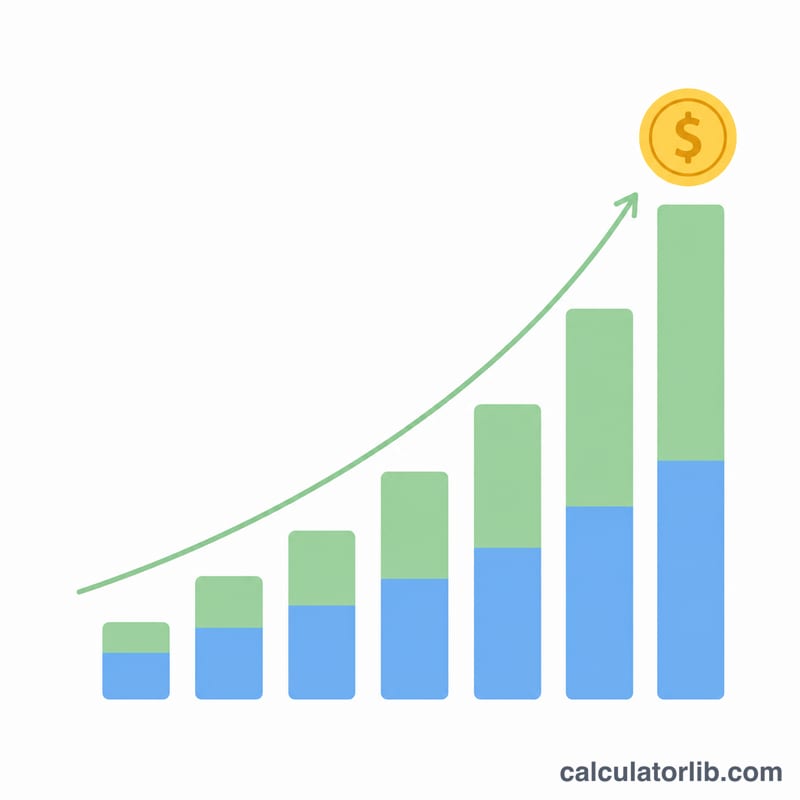
This calculator projects how a stock investment could grow over time when you start with a lump sum and keep adding money every month. It combines compound growth on your initial deposit with regular monthly contributions, then shows you the final balance, how much you actually put in, and how much of the result is pure investment earnings. It also builds a year-by-year breakdown so you can see the balance climb over the investment period. The dollar sign and percentages are generic, so you can use it in any country.
The Inputs You Provide
- Initial Investment ($): the lump sum you invest on day one.
- Monthly Contribution ($): the amount you add at the end of each month.
- Annual Return (%): your expected average yearly return, which the tool divides by 12 to get a monthly rate.
- Investment Period (Years): how long you stay invested; this is multiplied by 12 to get the number of compounding months.
The Formula Explained
The calculator first converts your annual return into a monthly rate: \(\text{monthlyRate} = \text{annualReturn} / 12 / 100\), and works out \(\text{numberOfMonths} = \text{years} \times 12\).
The complete projection is given by:
$$ FV = P\,(1+r)^{n} + \sum_{i=0}^{n-1} C\,(1+r)^{\,n-i} $$ $$ \text{where}\quad \left\{ \begin{aligned} P &= \text{Initial Investment} \\ C &= \text{Monthly Contribution} \\ r &= \dfrac{\text{Annual Return (\%)}}{1200} \\ n &= 12 \times \text{Years} \end{aligned} \right. $$Your initial investment compounds for the full term: \(\text{initial} \times (1 + \text{monthlyRate})^{\text{months}}\). Each monthly contribution is then compounded for the remaining months and added on. Total contributions are simply your initial deposit plus every monthly payment, and total earnings are the final balance minus those contributions.
$$ \text{Contributions} = \text{Initial Investment} + \text{Monthly Contribution} \times 12 \times \text{Years} $$ $$ \text{Earnings} = FV - \text{Total Contributions} $$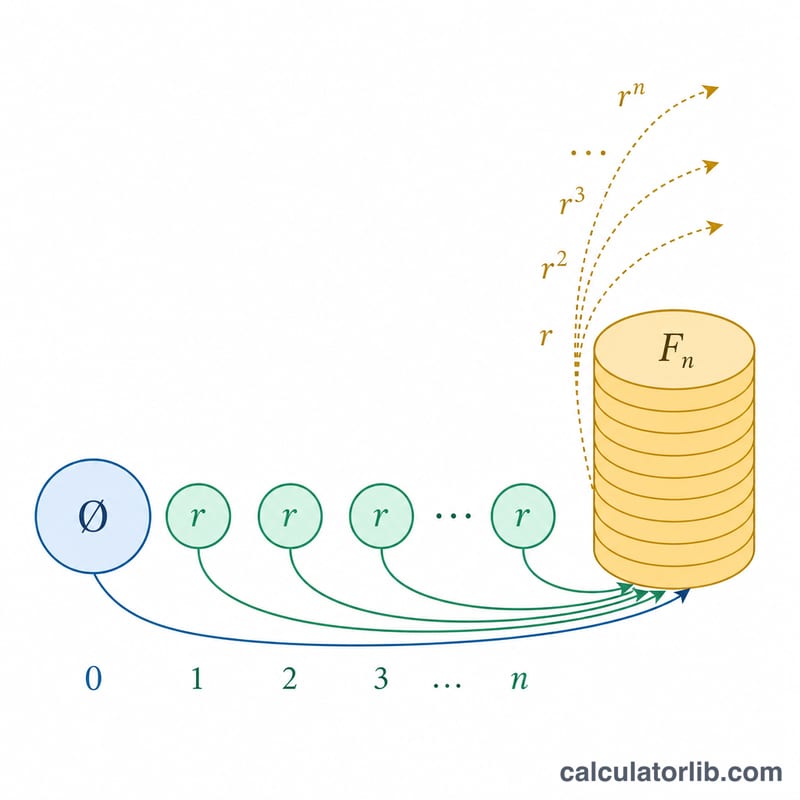
Worked Example
Suppose you start with $5,000, add $200 per month, expect an 8% annual return, and invest for 10 years.
- Monthly rate = \(8 / 12 / 100 = 0.006667\); months = \(120\).
- Total contributions = \(5{,}000 + (200 \times 120) = \mathbf{29{,}000}\) dollars.
- Final balance \(\approx\) $48,000 after compounding.
- Total earnings \(\approx\) $19,000 — the growth on top of what you contributed.
Frequently Asked Questions
Are the monthly contributions compounded? Yes. Each contribution earns growth for the months remaining until the end of the period, so earlier contributions grow more than later ones.
Is the 8% return guaranteed? No. Stock returns vary year to year and can be negative. The calculator assumes a steady average rate for planning purposes, so treat the result as an estimate, not a promise.
Does it account for taxes or fees? No. The figures are gross. Reduce your assumed annual return to roughly factor in fund fees, and remember investment gains may be taxed depending on your country.