
What Is a Stock Split?
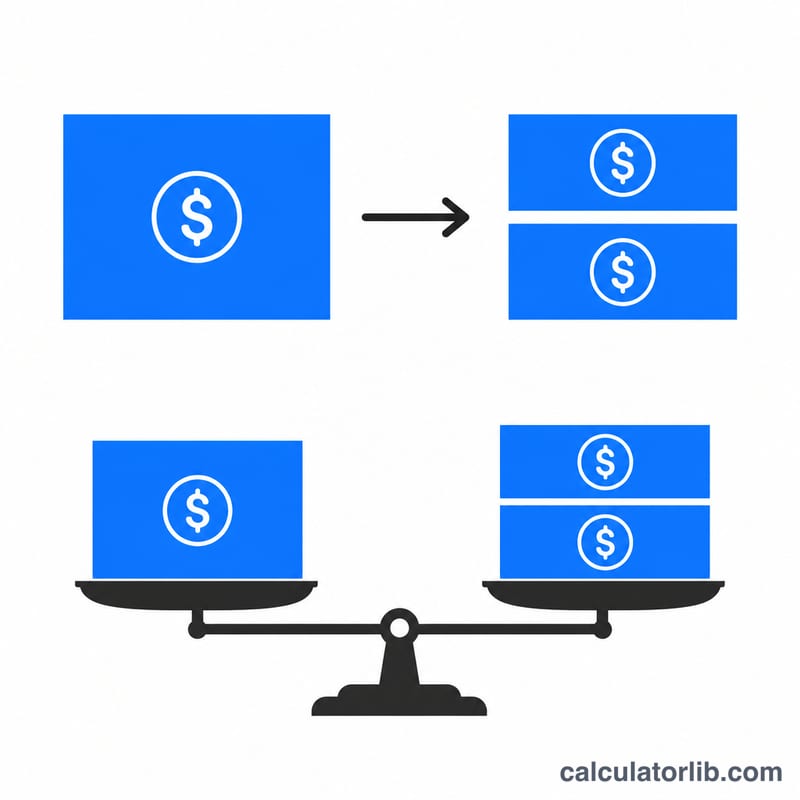
A stock split changes the number of shares a company has outstanding without changing the total market value of the company or your position. In a forward split (e.g. 2-for-1), you receive more shares at a proportionally lower price. In a reverse split (e.g. 1-for-10), you end up with fewer shares at a proportionally higher price. This calculator works for both — just enter the split ratio as New and Old.
How to Use It
Enter how many shares you currently own and the current price per share. Then enter the split ratio: for a 3-for-1 split, set New = 3 and Old = 1; for a 1-for-5 reverse split, set New = 1 and Old = 5. The calculator returns your new share count, the adjusted price per share, and confirms your total position value before and after the split.
The Formula Explained
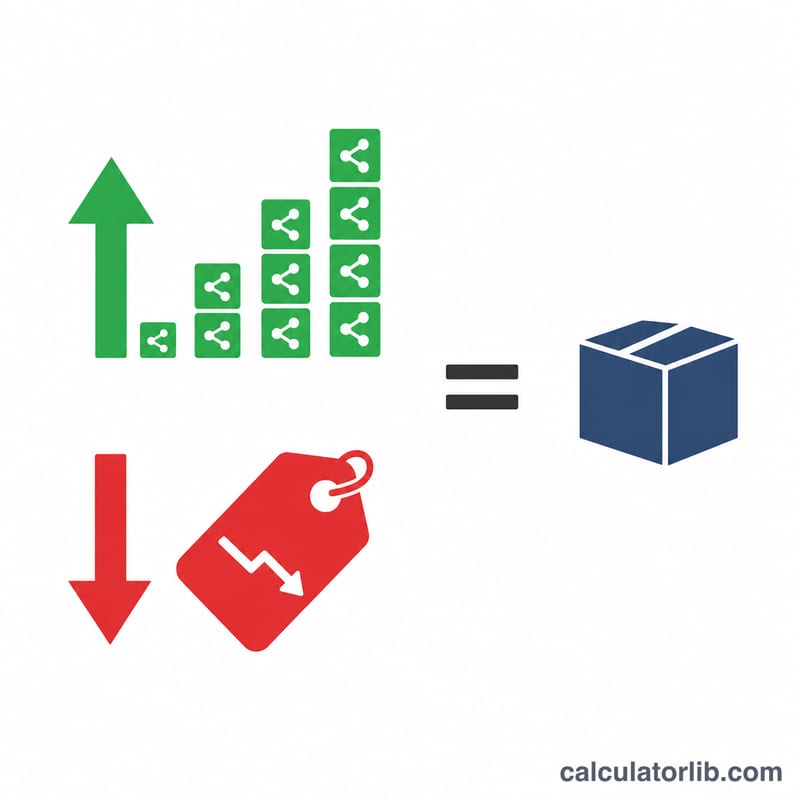
Your new share count is Old Shares × (New ÷ Old). Because a split only redivides the same pie, the price moves the opposite way: New Price = Old Price × (Old ÷ New). The product of shares and price — your total value — stays constant aside from rounding.
$$\begin{gathered} \text{New Shares} = \text{Shares} \times \frac{\text{New}}{\text{Old}} \\[1em] \text{New Price} = \text{Price} \times \frac{\text{Old}}{\text{New}} \end{gathered}$$
Worked Example
You own 100 shares at $50 (total $5,000) and the company announces a 2-for-1 split. New shares = $$100 \times (2 \div 1) = \textbf{200}$$ New price = $$\$50 \times (1 \div 2) = \textbf{\$25}$$ Total value = $$200 \times \$25 = \$5{,}000$$ — unchanged.
FAQ
Do stock splits make me richer? No. Splits are cosmetic — your total value is the same immediately after the split.
What about a reverse split? Enter the smaller number as New and the larger as Old (e.g. 1 and 10). You'll get fewer, higher-priced shares.
What if the split creates a fractional share? Brokers usually pay cash in lieu of fractional shares or credit fractional positions; this tool shows the exact mathematical figure.