
What Is Bond Equivalent Yield?
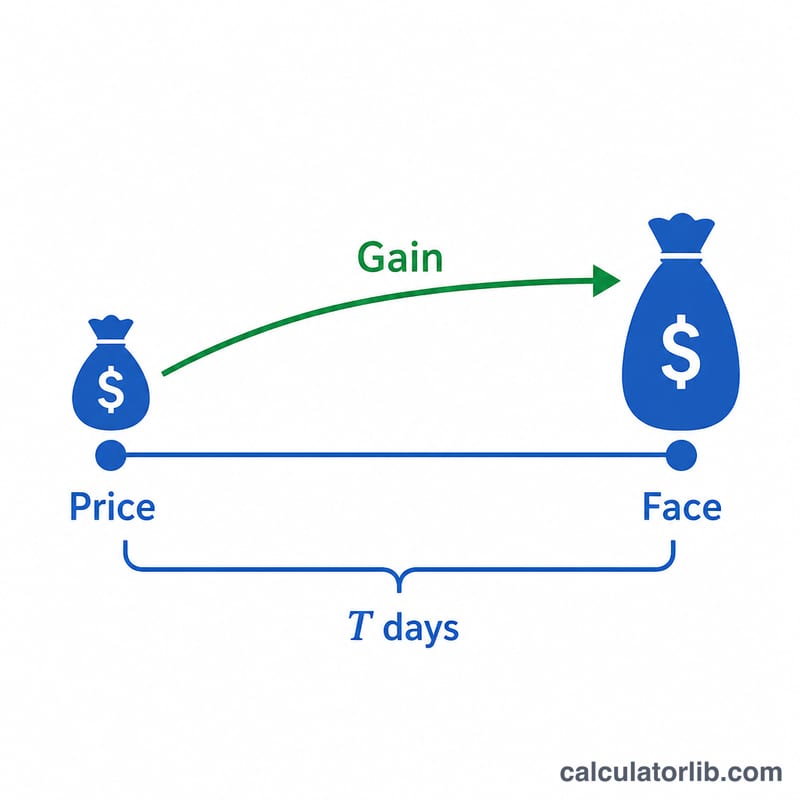
Bond equivalent yield (BEY) converts the return on a discount instrument — such as a U.S. Treasury bill, commercial paper, or any zero-coupon security bought below par — into a comparable annualized percentage. Because these securities pay no periodic coupon and are simply purchased at a discount and redeemed at face value, BEY lets you compare them on a 365-day basis against ordinary coupon-bearing bonds.
How to Use the Calculator
Enter three values: the face value (the amount you receive at maturity), the purchase price (what you pay today), and the days to maturity (calendar days until redemption). The calculator returns the annualized bond equivalent yield as a percentage, plus the raw dollar gain.
The Formula Explained
$$\text{BEY} = \frac{\text{Face Value} - \text{Price}}{\text{Price}} \times \frac{365}{\text{Days}} \times 100\%$$ The first term, \(\frac{\text{Face} - \text{Price}}{\text{Price}}\), is the holding-period return — your profit relative to what you invested. Multiplying by \(\frac{365}{\text{Days}}\) scales that period return up to a full year. Multiplying by 100 expresses it as a percentage. The 365-day convention is what distinguishes BEY from the bank discount yield, which uses 360 days and the face value as the base.
Worked Example
Suppose you buy a T-bill with a $10,000 face value for $9,700, maturing in 180 days. The gain is $300. The period return is \(300 / 9{,}700 = 0.030928\). Annualizing: $$0.030928 \times \frac{365}{180} = 0.062716$$ Times 100 gives a bond equivalent yield of about 6.27%.
Interpreting Your BEY Result
A BEY of, say, 5.20% means that if you bought the instrument at its discounted price and held it to maturity, the gain you earn is equivalent to a 5.20% simple annual return on the price you paid, scaled to a 365-day year. It answers the question: "What annual rate am I really earning on the cash I put in?"
The BEY is built on two deliberate choices that make it useful for comparison:
- It divides by the purchase price, not the face value. Your invested capital is the price you actually paid, so the return is measured against that base. This is the key difference from the bank discount yield, which divides the discount by face value and therefore understates the true return.
- It uses a 365-day year. Coupon bonds and most consumer yields are quoted on a 365-day (actual) basis, whereas the traditional bank discount yield uses 360 days. Putting BEY on 365 days lets you line it up directly against a coupon bond's yield or a bank account's APY.
Because of these conventions, the BEY on a T-bill is the standard figure for an apples-to-apples comparison with the yield on a coupon-bearing Treasury note or corporate bond of similar maturity. If a short T-bill shows a BEY of 5.20% and a one-year coupon note yields 5.00%, the bill is offering the higher annualized return for that horizon. By contrast, the same bill's bank discount yield will always be a lower number than its BEY for the same instrument, so never compare a discount yield against a coupon yield without first converting it.
One caution when interpreting very short maturities: a high BEY on a 30-day bill reflects strong annualization of a small absolute gain. You can only actually capture that annual rate if you can reinvest the proceeds at a comparable rate when the bill matures — the BEY itself assumes nothing about reinvestment. This is general educational information about yield conventions, not personalized financial advice.
Key Terms & Definitions
- Face value (par)
- The amount the issuer pays the holder at maturity — $1,000 for many bonds, $10,000 or more for Treasury bills. For a discount instrument this is the redemption amount, not what you pay up front.
- Purchase price
- The amount you actually pay to buy the instrument today. For a discount bond or bill this is below face value; the difference between price and face is your entire return.
- Days to maturity
- The number of calendar days from the settlement (purchase) date to the date the issuer redeems the instrument at face value. BEY annualizes the holding-period gain over this span using a 365-day year.
- Discount instrument
- A security that pays no periodic coupon and is sold below face value, with the investor's entire return coming from the price appreciation to par at maturity. Treasury bills, commercial paper, and zero-coupon bonds are common examples.
- Holding-period return
- The total return over the actual time the instrument is held, here \((\text{Face} - \text{Price})/\text{Price}\), before any annualization. BEY simply scales this figure up to a yearly rate.
- Bond equivalent yield (BEY)
- The annualized return on a discount instrument computed as the holding-period gain divided by purchase price, multiplied by \(365/\text{Days}\). Its purpose is to express a discount security's yield on the same 365-day, price-based footing as a coupon bond.
- Bank discount yield
- An older quoting convention that divides the discount by face value (not price) and annualizes on a 360-day year. Because of the larger denominator and shorter year, it is always lower than the BEY for the same instrument and is not directly comparable to coupon yields.
FAQ
How is BEY different from the discount yield? The discount yield uses the face value as the denominator and a 360-day year; BEY uses the price paid and a 365-day year, generally producing a slightly higher figure.
Can BEY be negative? Yes — if you pay more than face value (a premium), the gain is negative and so is the yield.
What days count toward maturity? Use actual calendar days remaining until the redemption date, not business days.