
What Is the Coupon Rate?
The coupon rate is the annual interest a bond pays expressed as a percentage of its face (par) value. It is fixed at issuance and tells you the income a bondholder receives each year relative to the bond's nominal value — regardless of the price you actually paid in the market. This calculator works for any currency and any country; just keep the coupon payment and face value in the same units.
How to Use This Calculator
Enter the total annual coupon payment (all coupons paid in a year added together) and the bond's face value. The calculator divides the payment by the face value and multiplies by 100 to give the coupon rate as a percentage. If a bond pays semi-annual coupons, add both payments to get the annual figure before entering it.
The Formula Explained
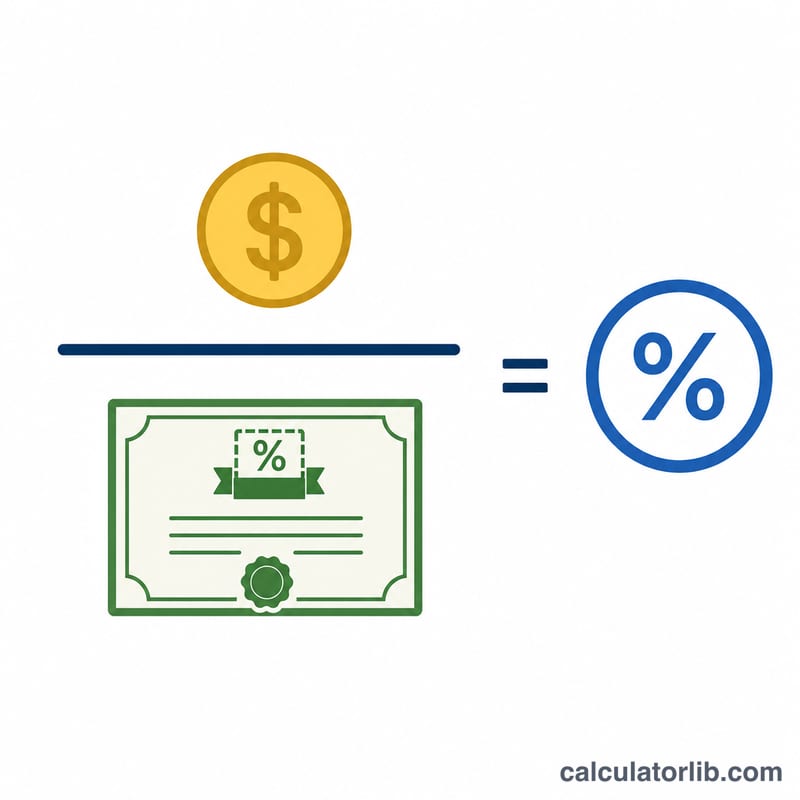
$$\text{Coupon Rate} = \frac{\text{Annual Coupon Payment}}{\text{Face Value}} \times 100$$ The numerator is the cash interest paid per year; the denominator is the par value printed on the bond (commonly $1,000). Because both are fixed, the coupon rate never changes over the bond's life, unlike the yield, which moves with the market price.
Worked Example
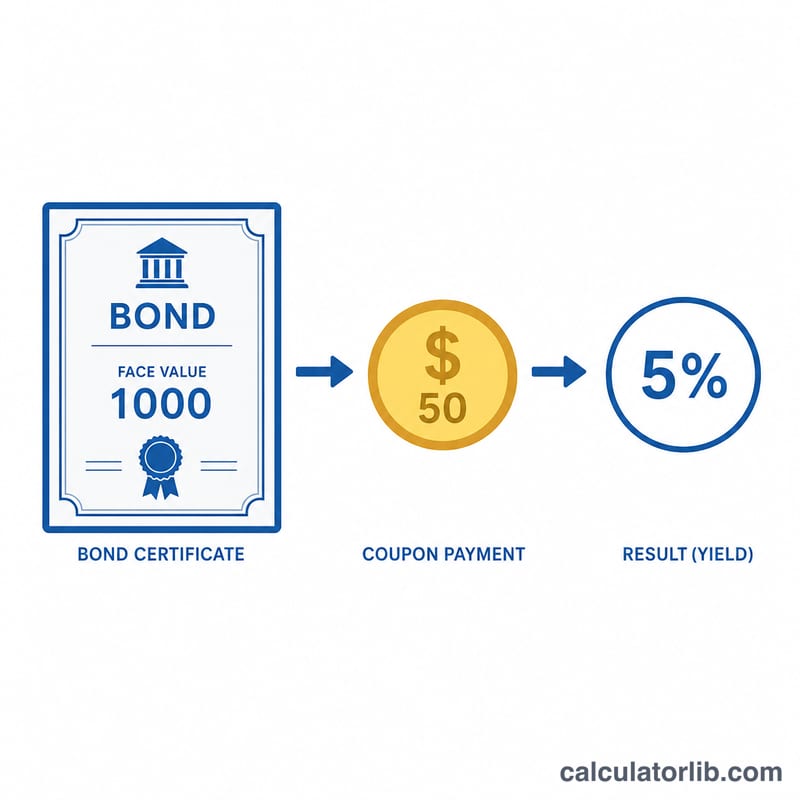
A bond has a face value of $1,000 and pays $50 in coupons per year. $$\text{Coupon Rate} = \frac{50}{1{,}000} \times 100 = 5\%$$ If instead it paid two semi-annual coupons of $30 each ($60 total), the rate would be \(\frac{60}{1{,}000} \times 100 = 6\%\).
FAQ
Is the coupon rate the same as yield? No. The coupon rate is based on face value and is fixed. Yield (such as current yield or yield to maturity) is based on the market price you pay and changes over time.
What face value should I use? Use the bond's par value — typically $1,000 for corporate bonds or $100 for some government bonds. Use whatever value is printed on the bond.
How do I handle semi-annual coupons? Add up all coupon payments made during one year and enter that total as the annual coupon payment.