
What the Discount Rate Calculator Does
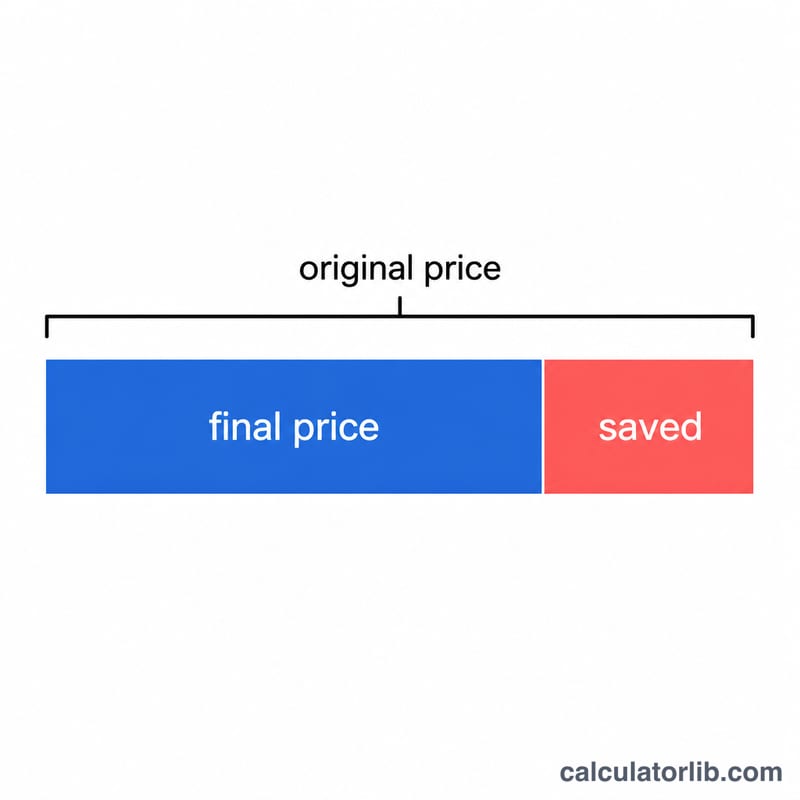
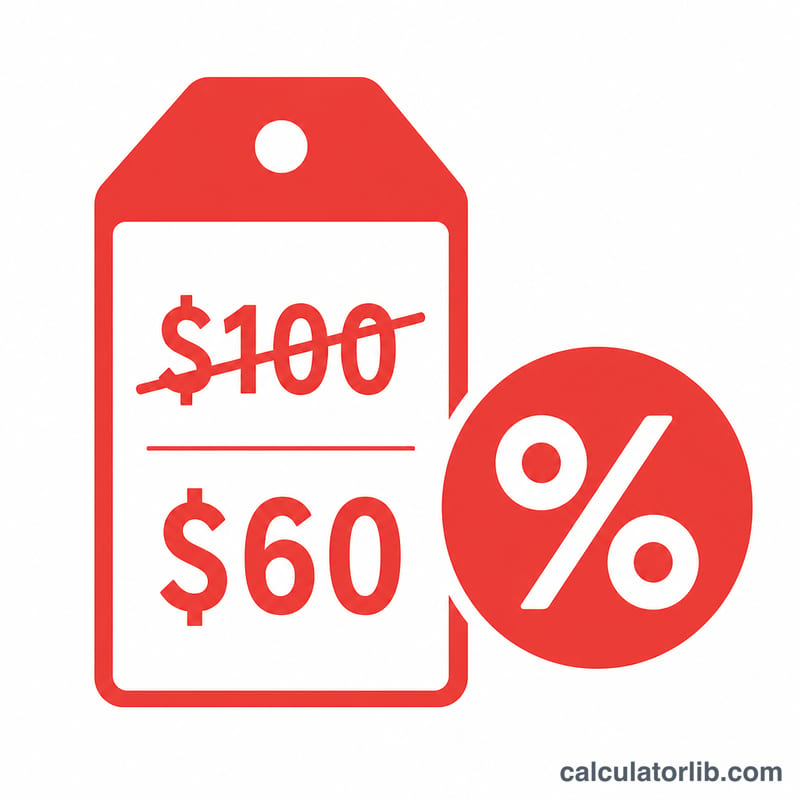
This calculator tells you what percentage you save when an item drops from its original price to a sale price. You enter just two numbers—the Original Price and the Price After Discount—and it instantly returns four results: the discount percentage (percent off), the dollar amount saved, the savings rate as a decimal, and the discount multiplier. It works with any currency, since the math is purely proportional.
The Inputs Explained
- Original Price – the regular, pre-sale price of the item (Po).
- Price After Discount – the price you actually pay at checkout (Pf).
If you leave the original price at zero or below, the calculator safely returns 0% instead of dividing by zero.
The Formula
The core calculation is:
r = (Po − Pf) ÷ Po × 100
From this single formula the tool derives all four outputs:
- Discount amount = Po − Pf (how much money you save).
- Discount percentage = the result of the formula above.
- Savings rate = the same value expressed as a decimal (percentage ÷ 100).
- Discount multiplier = 1 − (percentage ÷ 100), the factor you multiply the original price by to get the sale price.
Worked Example
Suppose a jacket is marked down from an original price of 120 to a sale price of 90.
- Discount amount = 120 − 90 = 30 saved.
- Discount percentage = (120 − 90) ÷ 120 × 100 = 25% off.
- Savings rate = 0.25.
- Discount multiplier = 1 − 0.25 = 0.75 (so 120 × 0.75 = 90, confirming the sale price).
Frequently Asked Questions
What is the discount multiplier used for? It is a quick shortcut: multiply any original price by the multiplier to get the sale price. A 0.75 multiplier means you pay 75% of the listed price.
Can the discount percentage be negative? Yes. If the "after discount" price is higher than the original, the formula returns a negative percentage, signalling a price increase rather than a saving.
Does the currency matter? No. Because the result is a ratio, it works identically whether your prices are in dollars, euros, pounds, or any other currency—just keep both inputs in the same units.