
What Is the Exponential Decay Calculator?
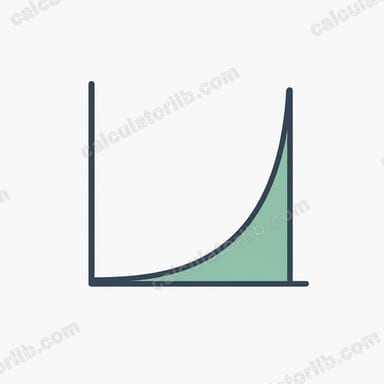
The Exponential Decay Calculator estimates how much of a quantity remains after a given amount of time, when that quantity shrinks by a fixed percentage each period. Exponential decay describes anything that loses a consistent fraction of its value over time rather than a fixed amount. Common examples include radioactive isotopes, the cooling of objects, drug concentration in the bloodstream, asset depreciation, and the gradual decline of a customer base. This tool works for any of these scenarios because the underlying math is the same.
How to Use It
- Initial value (N₀): Enter the starting amount — grams, dollars, users, or any unit.
- Decay rate (r): Enter the percentage lost each time period (for example, 5% per year).
- Time (t): Enter the number of periods that have passed, using the same time unit as your rate.
The calculator returns the remaining amount in the same units you started with. Keep your rate and time units consistent — if the rate is per year, time must also be in years.
The Formula Explained
The calculator uses the standard exponential decay equation:
$$N(t) = N_0 \times (1 - r)^{t}$$
- \(N(t)\) = amount remaining after time t
- \(N_0\) = initial amount
- \(r\) = decay rate as a decimal (5% = 0.05)
- \(t\) = elapsed time in periods
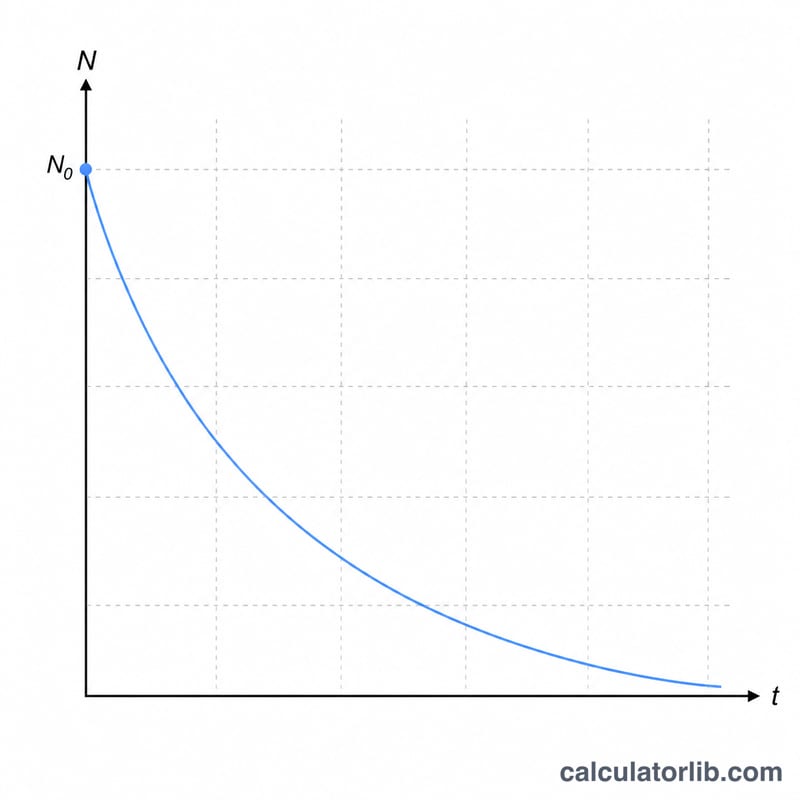
Each period multiplies the previous amount by \((1 - r)\), so the decline compounds — losses get smaller in absolute terms as the base shrinks, but the percentage stays constant.
Worked Example
Suppose a machine worth $20,000 depreciates 12% per year. After 4 years:
$$N(4) = 20{,}000 \times (1 - 0.12)^{4} = 20{,}000 \times (0.88)^{4} = 20{,}000 \times 0.5997 \approx \mathbf{\$11{,}994}$$
So roughly $11,994 of value remains after four years.
FAQ
What is the difference between decay rate and decay constant? The decay rate (r) used here is a per-period percentage. A decay constant (λ) appears in the continuous formula \(N = N_0 e^{-\lambda t}\). This calculator uses the simpler discrete percentage model.
Can I use this for half-life problems? Yes. A half-life is just the time at which the remaining amount equals 50% of the original. Adjust your rate and time to model it, or use a dedicated half-life tool for direct results.
What if the value is growing instead of shrinking? Use a growth calculator with \((1 + r)\) instead. This tool only models decline \((1 - r)\).