
What is the Radioactive Decay Calculator?
Radioactive decay is the spontaneous breakdown of unstable atomic nuclei. This calculator tells you how much of a sample remains after a given time, based on its half-life. It uses the universal exponential decay law and works for any unit (atoms, grams, becquerels, moles) as long as you stay consistent.
How to use it
Enter the initial quantity (N₀), the half-life of the isotope, and the elapsed time. Make sure the half-life and elapsed time use the same time unit (the unit dropdown is just a label). The calculator returns the remaining quantity, the amount decayed, the fraction left as a percentage, how many half-lives have passed, and the decay constant \(\lambda\).
The formula explained
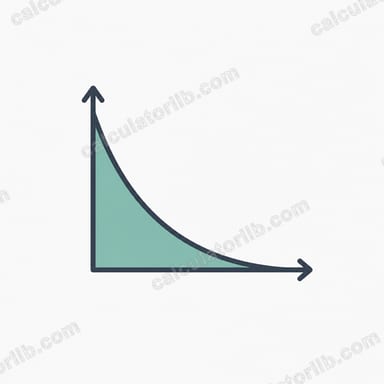
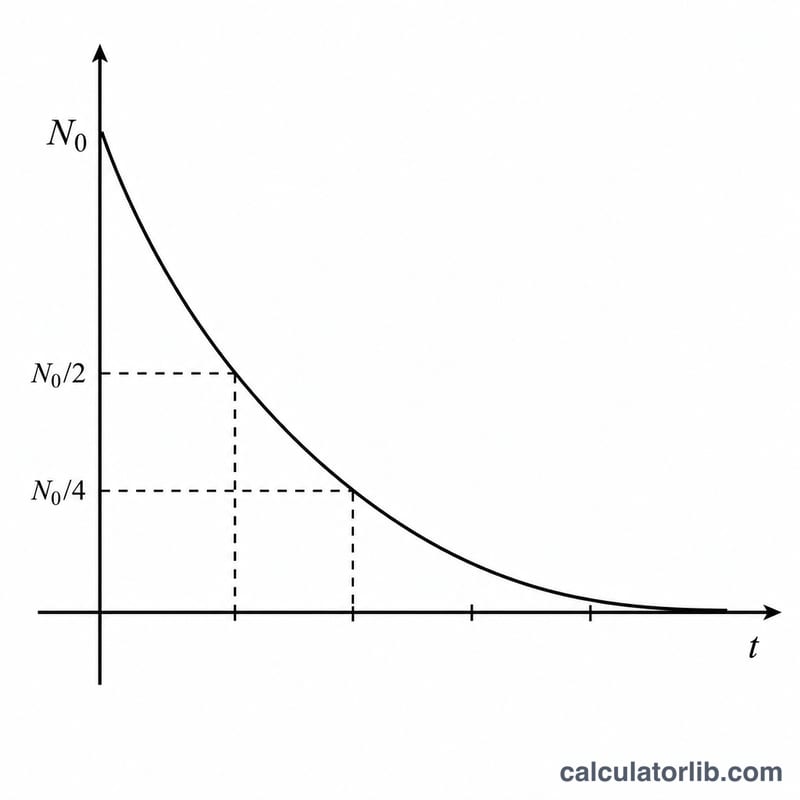
The amount remaining follows $$N = N_0 \, e^{-\lambda t}$$ where the decay constant is $$\lambda = \frac{\ln 2}{t_{1/2}}$$ After exactly one half-life, \(e^{-\lambda t} = e^{-\ln 2} = \tfrac{1}{2}\), so half the sample remains — which is the definition of half-life. Each successive half-life again halves what is left.
Worked example
Carbon-14 has a half-life of 5730 years. Starting with 1000 atoms, after 5730 years: \(\lambda = \ln(2)/5730 \approx 0.000121\), and $$N = 1000 \cdot e^{-0.000121 \cdot 5730} = 1000 \cdot 0.5 = 500 \text{ atoms}$$ After 11460 years (two half-lives) only 250 would remain.
FAQ
Does the unit of N₀ matter? No — the math is the same for grams, atoms or activity. The result comes out in whatever unit you entered.
What if elapsed time is zero? The fraction remaining is 100% and \(N = N_0\), since no time has passed.
Can I find the time from a remaining amount? Rearrange to \(t = -\ln(N/N_0)/\lambda\). This tool solves for the remaining quantity given time, which is the most common direction.