
What this calculator does
This tool applies the radioactive decay law to find how much of a radioactive element is left after a given amount of time has passed. You supply the element's half-life, how much time has elapsed, and the initial quantity, and it returns the remaining quantity together with the percent remaining and the number of half-lives that have gone by. The physics is universal: it works the same way everywhere, whether you measure the substance in becquerels, grams, atoms, or percent.
How to use it
Pick a nuclide from the dropdown to auto-fill a standard literature half-life and its time unit, or choose "Custom" and type your own. Enter the calculation period (elapsed time) with its own unit, then the initial quantity. The half-life and elapsed time can use different units; the calculator converts both to seconds internally before taking the ratio, so the answer is always correct.
The formula explained
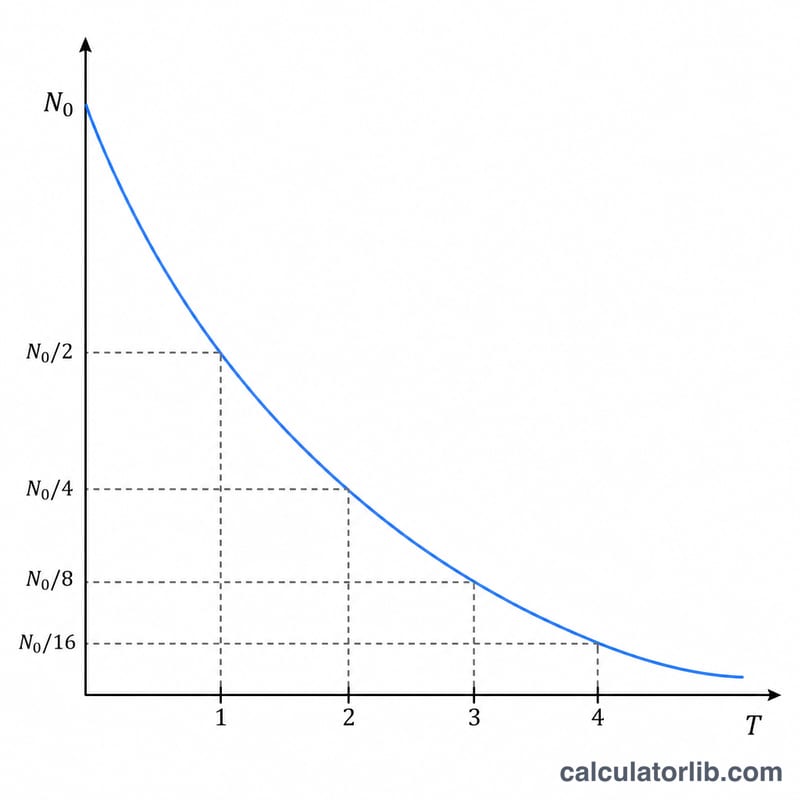
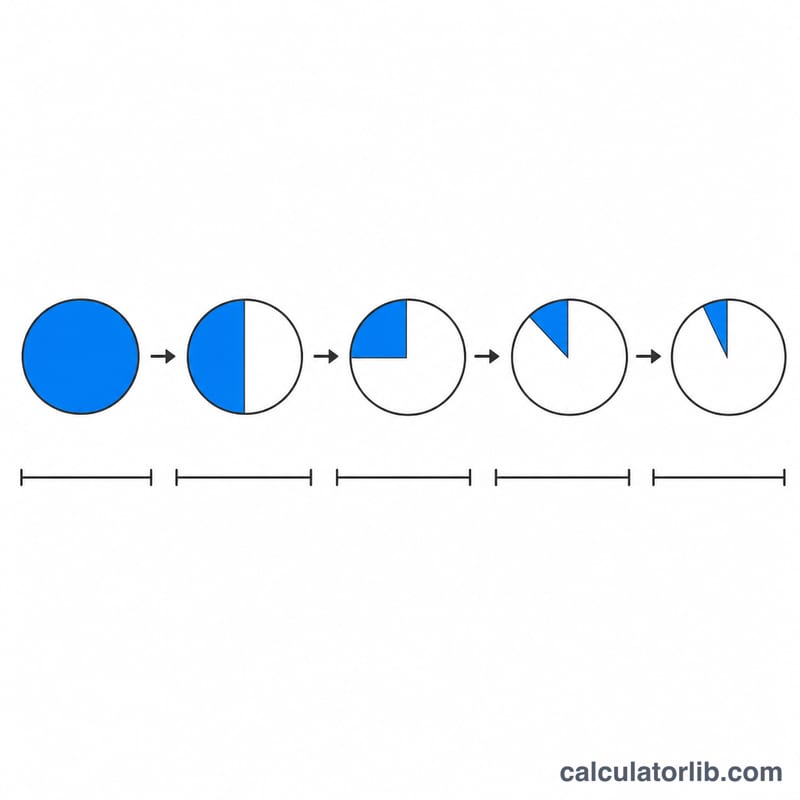
The amount remaining follows $$N(t) = N_0 \times \left(\frac{1}{2}\right)^{t / T_{1/2}}$$ The exponent \(t/T_{1/2}\) is simply the number of half-lives that have elapsed; every whole half-life multiplies the amount by one-half. An equivalent exponential form is \(N(t) = N_0 \times e^{-\lambda t}\), where the decay constant \(\lambda = \ln(2) / T_{1/2}\). Percent remaining is just \(N(t)/N_0 \times 100\).
Worked example (Iodine-131)
Iodine-131 has a half-life of 8.0252 days. After 30 days with an initial 100 units: \(t/T_{1/2} = 30 / 8.0252 = 3.7382\) half-lives. $$N(t) = 100 \times 2^{-3.7382} = 100 \times 0.07491 \approx 7.49 \text{ units}$$ i.e. about 7.49% remaining.
FAQ
Can elapsed time and half-life use different units? Yes. The calculator converts both to seconds, so days vs. years (etc.) are handled automatically.
Does the amount ever reach zero? No. Exponential decay approaches zero but never reaches it exactly; it just keeps halving.
What if I enter a negative elapsed time? The math still works and gives a value larger than the initial quantity, which represents a back-calculation to an earlier moment.