
What Is a Terminating Decimal?
A terminating decimal is a decimal number that has a finite number of digits after the decimal point — for example 0.75 or 0.125. A repeating (non-terminating) decimal continues forever with a recurring block, such as 0.3333… or 0.142857142857…. This calculator takes any fraction a/b, computes its decimal value, and tells you whether that decimal terminates or repeats.
How to Use It
Enter the numerator (the top number, a) and the denominator (the bottom number, b). The tool reduces the fraction to lowest terms, evaluates the decimal, and reports whether it terminates. The denominator cannot be zero.
The Rule Explained
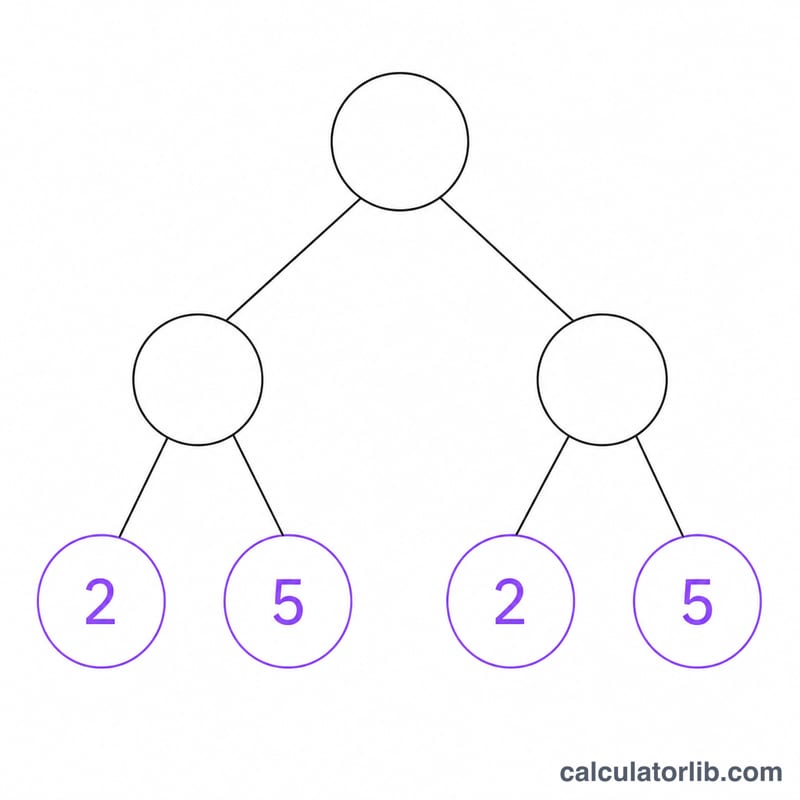
First reduce the fraction to lowest terms by dividing both numbers by their greatest common divisor (GCD). Then look only at the new denominator. A fraction in lowest terms produces a terminating decimal if and only if its denominator's only prime factors are 2 and 5. That is, the denominator must be writable as \(2^{m}\times 5^{n}\). Any other prime factor (3, 7, 11, …) forces the decimal to repeat.
$$\frac{\text{Numerator }a}{\text{Denominator }b} \text{ terminates} \iff \frac{b}{\gcd(a,b)} = 2^{m}\cdot 5^{n}$$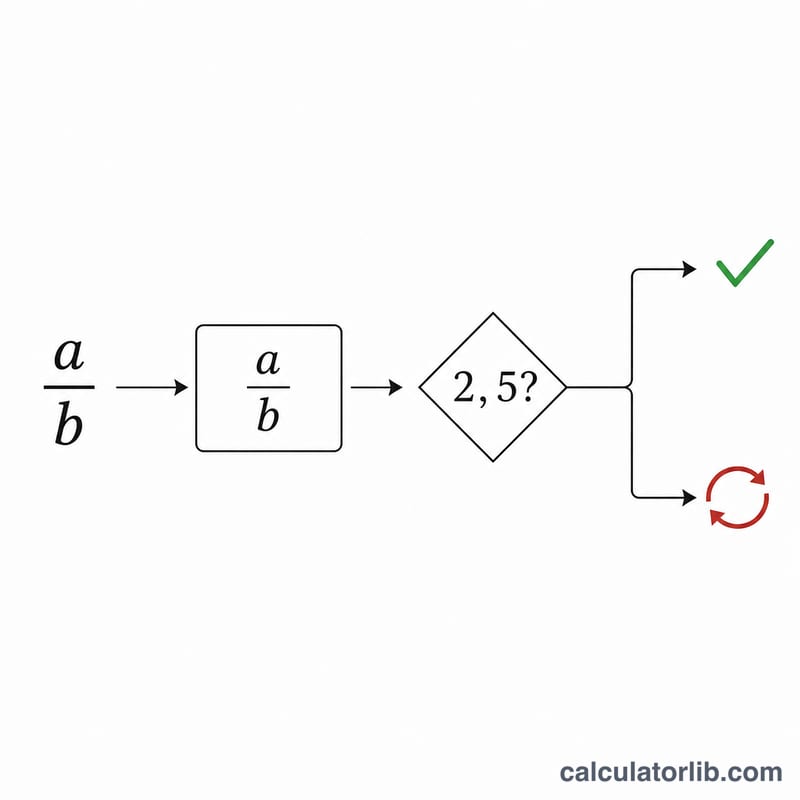
Worked Example
Take 3/8. The GCD of 3 and 8 is 1, so it is already reduced. The denominator \(8 = 2^{3}\) has only the prime factor 2, so 3/8 terminates:
$$3 \div 8 = 0.375$$By contrast, 1/6 reduces to 1/6; since \(6 = 2 \times 3\) contains the prime factor 3, it does not terminate — it equals 0.1666….
FAQ
Does the numerator affect whether it terminates? No. Only the reduced denominator's prime factors matter, though the numerator can change the GCD and thus the reduced denominator.
Is every fraction either terminating or repeating? Yes. Every rational number has a decimal expansion that either terminates or eventually repeats.
What about 10/4? It reduces to 5/2; the denominator 2 has only the factor 2, so it terminates: 2.5.