
What is the Vertex Form Calculator?
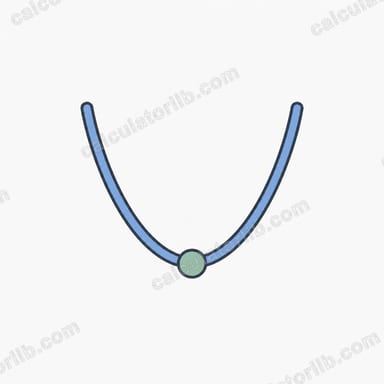
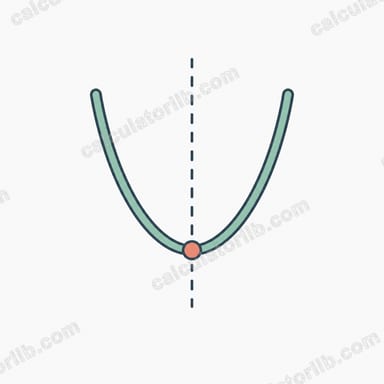
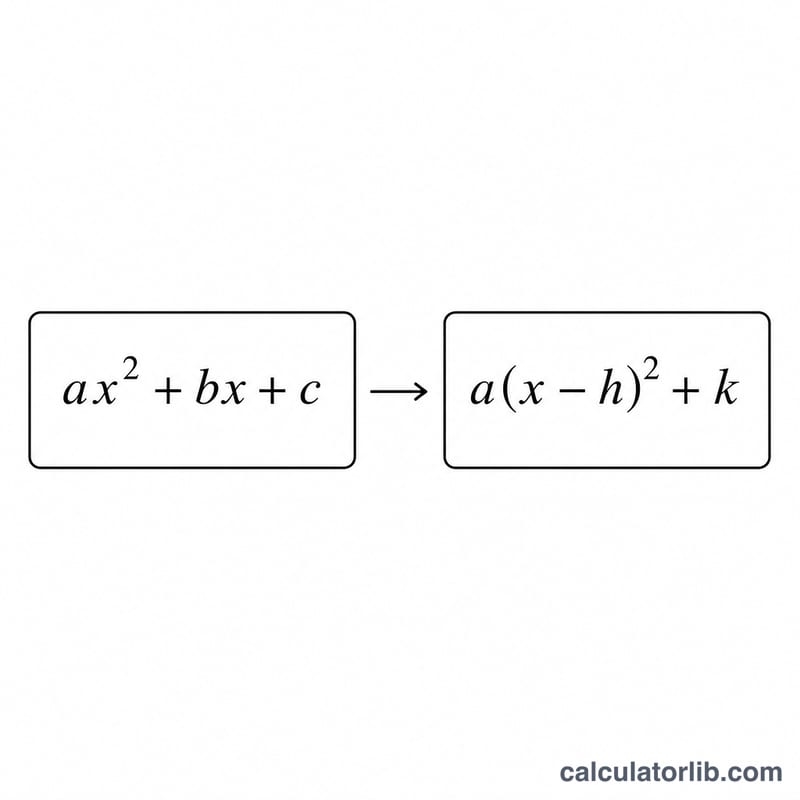
This calculator converts a quadratic equation written in standard form, \(y = ax^2 + bx + c\), into vertex form, \(y = a(x - h)^2 + k\). The vertex form instantly reveals the turning point (vertex) of the parabola and its axis of symmetry, which is useful for graphing, optimization problems, and solving for maximum or minimum values.
How to use it
Enter the three coefficients a, b, and c from your quadratic. The calculator computes the vertex coordinates h and k and rewrites the equation in vertex form. The value of a is carried over unchanged because it controls how wide the parabola is and whether it opens upward (\(a > 0\)) or downward (\(a < 0\)).
The formula explained
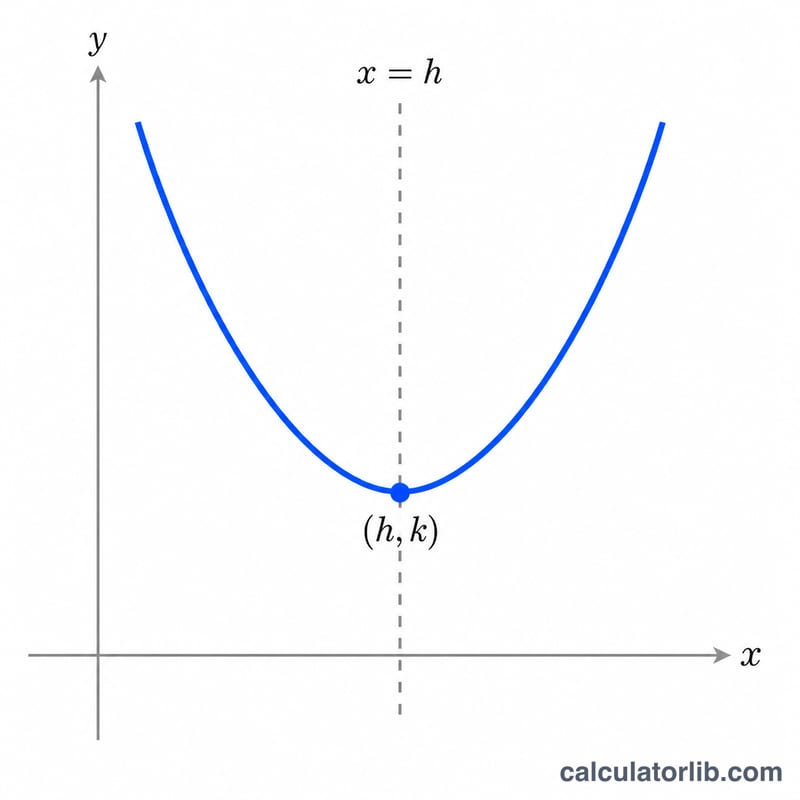
Completing the square on \(y = ax^2 + bx + c\) gives \(y = a(x - h)^2 + k\). The horizontal shift is $$y = \text{a}\,(x - h)^2 + k \\[1.5em] \text{where}\quad \left\{ \begin{aligned} h &= -\dfrac{\text{b}}{2\,\text{a}} \\ k &= \text{c} - \dfrac{\text{b}^2}{4\,\text{a}} \end{aligned} \right.$$ the same expression as the axis of symmetry. The vertical position is \(k = c - \frac{b^2}{4a}\). Substituting h back into the original equation gives the same k, so the vertex is exactly \((h, k)\).
Worked example
Take \(y = x^2 - 4x + 3\), so \(a = 1\), \(b = -4\), \(c = 3\). Then $$h = -\frac{-4}{2\cdot 1} = 2$$ and $$k = 3 - \frac{(-4)^2}{4\cdot 1} = 3 - \frac{16}{4} = 3 - 4 = -1.$$ The vertex form is \(y = (x - 2)^2 - 1\), with vertex at \((2, -1)\).
FAQ
What if \(a = 0\)? Then the equation is linear, not quadratic, and has no vertex — enter a nonzero value for a.
Is h the axis of symmetry? Yes. The vertical line \(x = h\) is the parabola's axis of symmetry.
Can a be negative? Absolutely. A negative a means the parabola opens downward and the vertex is a maximum point.