
What this calculator does
The Dividing Fractions Calculator divides one fraction by another and returns the answer as a fully simplified fraction together with its decimal equivalent. Enter the numerator and denominator of each fraction and the tool handles the arithmetic — including reducing the result to lowest terms and managing negative signs.
How to use it
Type the first fraction as a/b (numerator a over denominator b) and the second as c/d. Press calculate. The result shows the simplified quotient and a decimal approximation. Whole numbers can be entered as themselves over 1 — for example, 5 is 5/1.
The formula explained
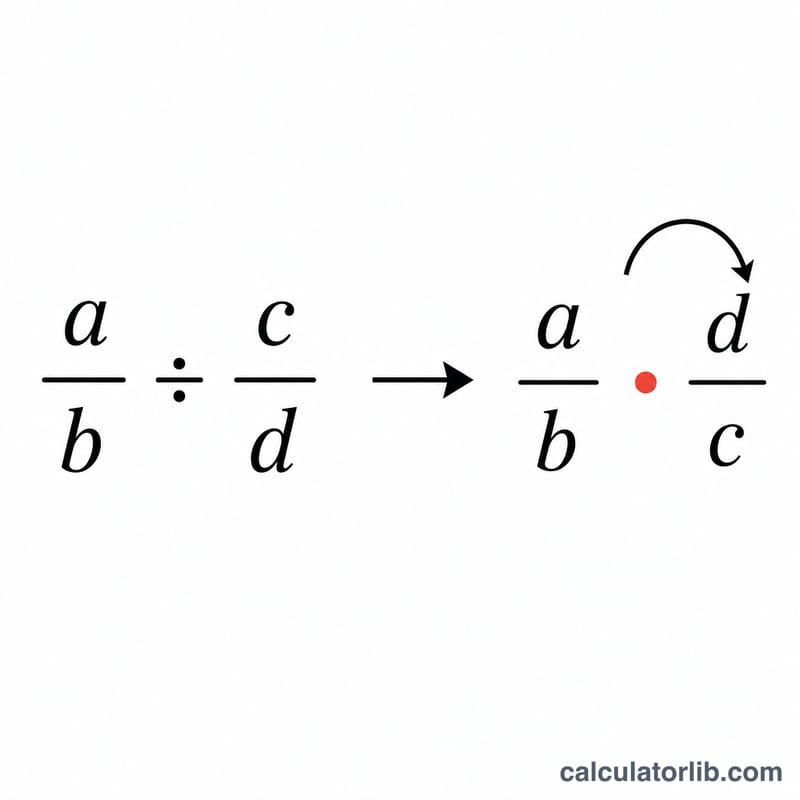
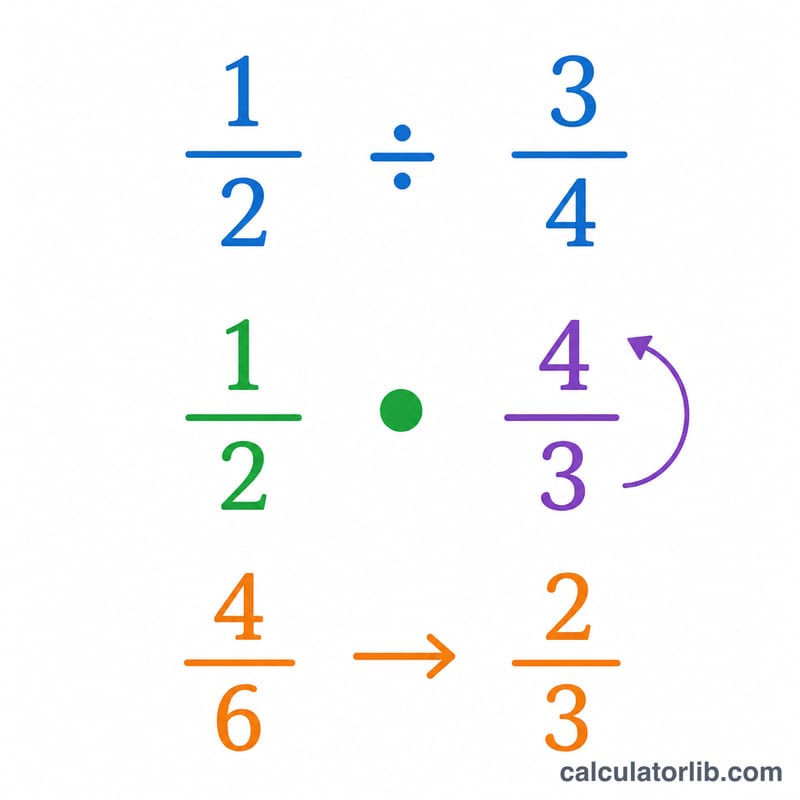
Dividing by a fraction is the same as multiplying by its reciprocal — the classic "keep, change, flip" rule. Keep the first fraction, change division to multiplication, and flip the second fraction:
$$\dfrac{a}{b} \div \dfrac{c}{d} = \dfrac{a}{b} \times \dfrac{d}{c} = \dfrac{a \cdot d}{b \cdot c}$$
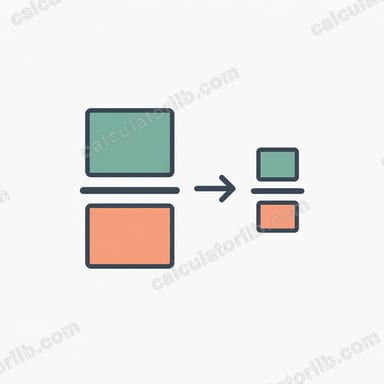
After cross-multiplying, the calculator finds the greatest common divisor (gcd) of the numerator and denominator and divides both by it to give the reduced fraction.
Worked example
Divide 2/3 by 4/9. Flip the second fraction: $$\dfrac{2}{3} \times \dfrac{9}{4} = \dfrac{2 \cdot 9}{3 \cdot 4} = \dfrac{18}{12}$$ The gcd of 18 and 12 is 6, so \(\dfrac{18}{12}\) reduces to \(\dfrac{3}{2}\), which equals 1.5 as a decimal.
FAQ
What if the result is an improper fraction? The calculator leaves it as a simplified improper fraction (e.g. \(\dfrac{3}{2}\)) and also shows the decimal so you can convert to a mixed number if needed.
Can I divide by a negative fraction? Yes. Signs are handled automatically and the denominator is always shown as positive.
Why can't the denominator be zero? Division by zero is undefined, so if a denominator (or the second numerator) is zero the result is not a valid fraction.