
What is a parallelepiped?
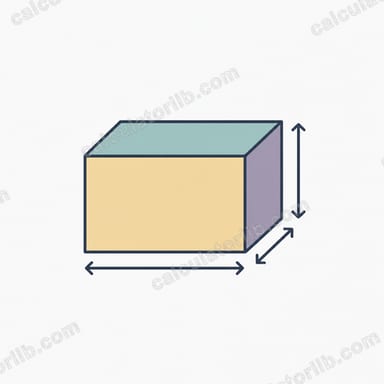
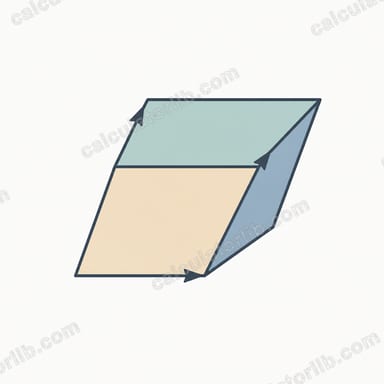
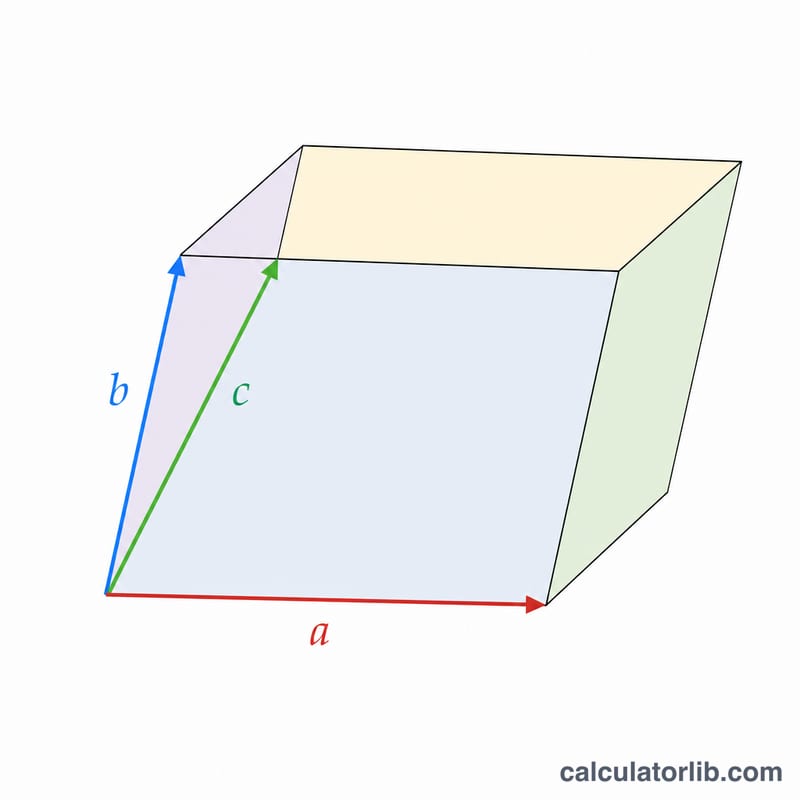
A parallelepiped is a three-dimensional figure formed by six parallelogram faces. It can be fully described by three edge vectors a, b, and c that emanate from a single corner. A cube and a rectangular box (cuboid) are special cases of a parallelepiped where the edges are mutually perpendicular.
How to use this calculator
Enter the x, y, and z components of each of the three edge vectors. The calculator computes the cross product of b and c, then takes the dot product with a, and finally returns the absolute value. The result is the volume in cubic units.
The formula explained
The volume is given by the magnitude of the scalar triple product: \(V = |\mathbf{a} \cdot (\mathbf{b} \times \mathbf{c})|\). The cross product \(\mathbf{b} \times \mathbf{c}\) produces a vector perpendicular to the base parallelogram whose magnitude equals that base's area. Dotting with a projects it onto the height direction, so the product equals base area times height — exactly the volume. The absolute value ensures the answer is positive regardless of vector orientation. Equivalently, the triple product is the determinant of the 3×3 matrix whose rows are the three vectors.
$$V = \left| \, \text{a}_x(\text{b}_y\,\text{c}_z - \text{b}_z\,\text{c}_y) - \text{a}_y(\text{b}_x\,\text{c}_z - \text{b}_z\,\text{c}_x) + \text{a}_z(\text{b}_x\,\text{c}_y - \text{b}_y\,\text{c}_x) \, \right|$$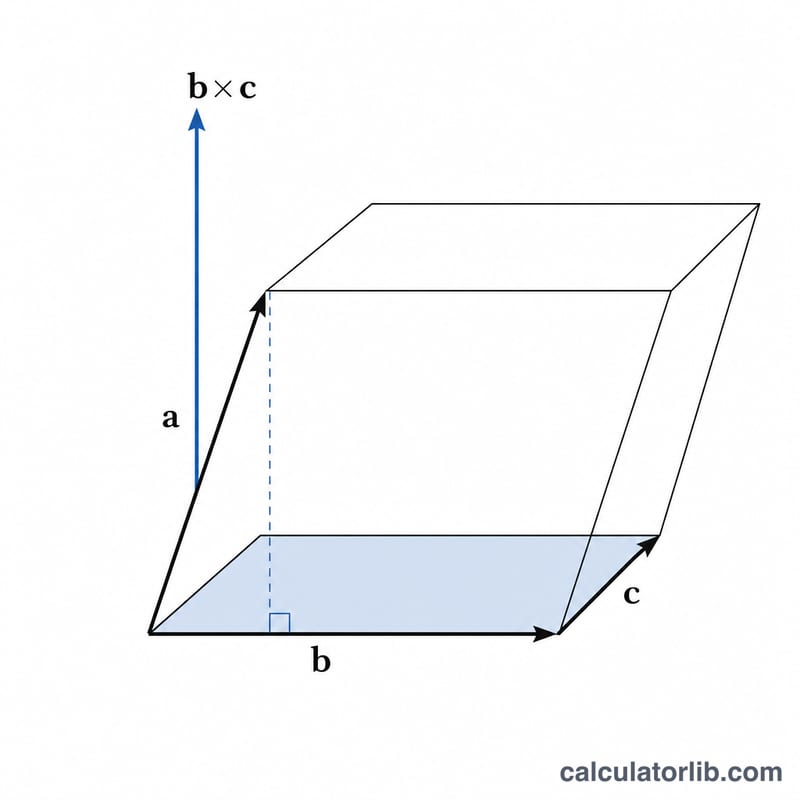
Worked example
Take \(\mathbf{a} = (2, 0, 0)\), \(\mathbf{b} = (0, 3, 0)\), \(\mathbf{c} = (0, 0, 4)\). First, $$\mathbf{b} \times \mathbf{c} = (3\cdot4 - 0\cdot0,\ 0\cdot0 - 0\cdot4,\ 0\cdot0 - 3\cdot0) = (12, 0, 0).$$ Then $$\mathbf{a} \cdot (12, 0, 0) = 2\cdot12 = 24.$$ The volume is \(|24| = 24\) cubic units — which matches the box \(2 \times 3 \times 4 = 24\).
FAQ
What if the volume is zero? A zero volume means the three vectors are coplanar (linearly dependent), so they cannot enclose a solid.
Does vector order matter? Reordering vectors can flip the sign of the triple product, but because we take the absolute value the volume is unchanged.
Can I use it for a cube? Yes — enter perpendicular edge vectors of equal length, e.g. \((s,0,0)\), \((0,s,0)\), \((0,0,s)\) gives \(s^3\).